 +7 775 858 9294
 WhatsApp
Can a Driver’s License Be Restricted for Child Support Debt in Kazakhstan?
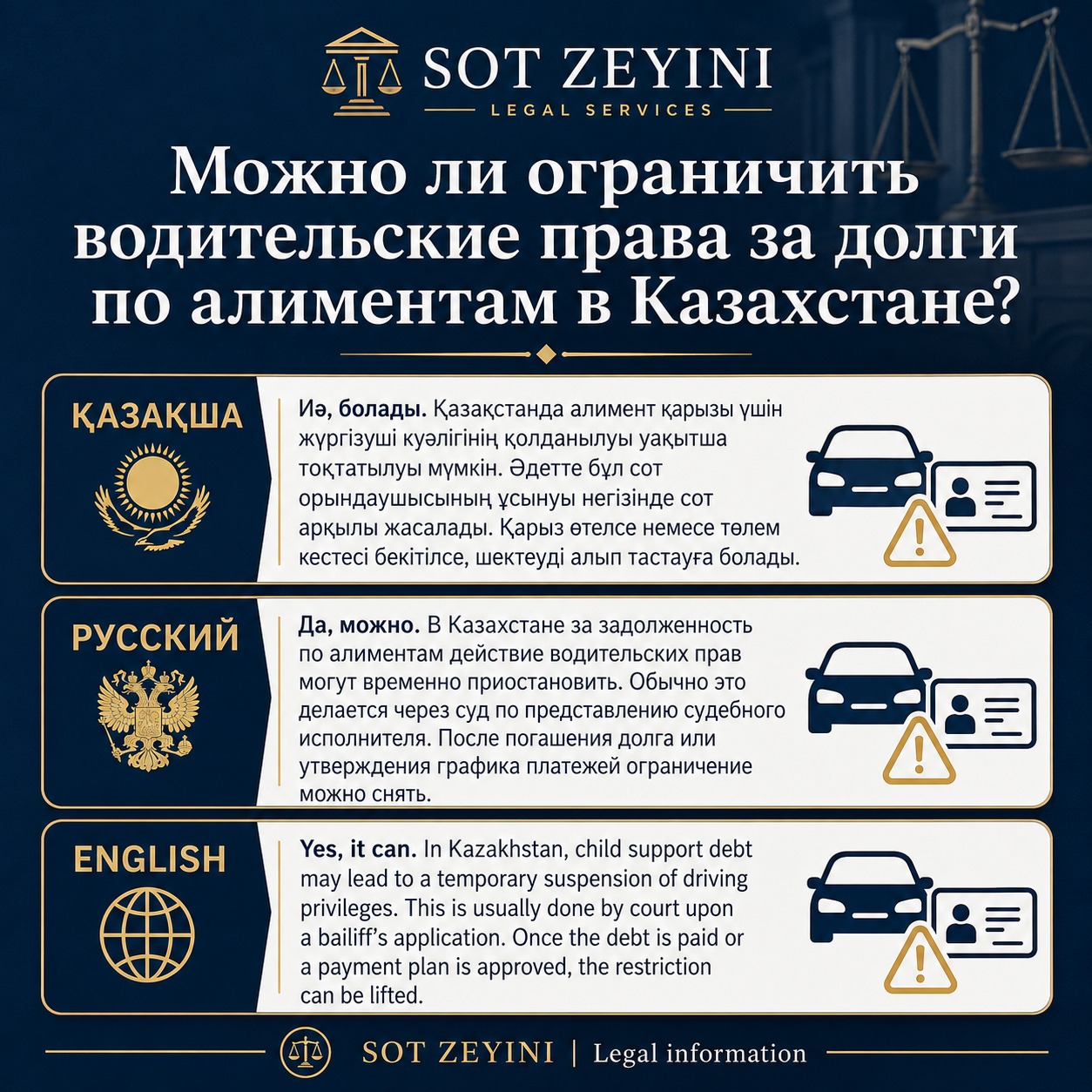
Can a driver’s license be restricted for child support debt in Kazakhstan? Yes. If a person has child support debt, the issue of temporarily suspending the right to drive may be raised. However, this measure is not automatic. Usually, the enforcement officer submits a request to the court, and the court makes the final decision.
It is important to understand that this is not a permanent revocation of a driver’s license. It is a temporary restriction of a special right until the debt is paid or the grounds for restriction are eliminated.
What does driver’s license restriction mean?
Driver’s license restriction means that the debtor is temporarily prohibited from driving a vehicle. The license is not permanently cancelled, but the right to drive may be suspended.
This measure is used to encourage the debtor to comply with the child support obligation and repay the debt.
Who can restrict the right to drive?
A private enforcement officer cannot simply take away the debtor’s driver’s license. The enforcement officer may submit a request to the court to temporarily suspend the debtor’s special right to drive.
The court makes the final decision. If the court grants the request, the debtor may be temporarily restricted from driving.
When can a driver’s license be restricted?
This measure may be applied if:
- the debtor has child support debt;
- the debtor has not paid for a long time;
- the debtor does not take steps to repay the debt;
- enforcement measures are already being taken;
- the debtor hides income or property;
- the debtor ignores the enforcement officer’s requirements;
- the debtor has a valid driver’s license;
- the restriction may help enforce the court act.
This is one of the enforcement measures used when a debtor avoids paying child support.
Is the restriction automatic?
No. Child support debt does not automatically result in driver’s license restriction.
First, enforcement proceedings are opened. The enforcement officer calculates the debt, notifies the debtor, checks income, bank accounts and property, and takes enforcement measures. If the debtor still does not pay, the officer may apply to the court for temporary suspension of the right to drive.
What is the difference between car seizure and driver’s license restriction?
Car seizure and driver’s license restriction are different measures.
Car seizure concerns property. If a car is seized, the debtor may be restricted from selling, transferring or registering the vehicle.
Driver’s license restriction concerns a special right. In this case, the debtor is temporarily prohibited from driving a vehicle.
So, one measure affects the vehicle as property, while the other affects the person’s right to drive.
Can the debtor drive after the restriction?
If the court temporarily suspends the right to drive, the debtor should not drive until the restriction is removed.
Continuing to drive despite the restriction may lead to additional legal consequences. Therefore, the debtor should resolve the issue through the enforcement officer and the court rather than ignore it.
What if the car is needed for work?
If driving is the debtor’s main source of income, this may be an important circumstance for the court.
For example, the debtor may work as:
- a driver;
- taxi driver;
- courier;
- truck driver;
- delivery worker;
- employee whose work requires daily driving.
In this case, the debtor should provide evidence such as an employment contract, income documents, employer confirmation or other proof. However, the fact that driving is needed for work does not automatically prevent the restriction. The court will assess all circumstances, including the child’s interests and the debtor’s behavior.
Can the receiving parent request this measure?
Yes. The receiving parent may submit a written application to the enforcement officer asking them to consider applying to court for temporary suspension of the debtor’s right to drive.
The application may include:
- the amount of debt;
- the period of non-payment;
- information that the debtor drives a vehicle;
- evidence of evasion;
- a request to submit the matter to court;
- a request for additional enforcement measures.
A written application is better than an oral request because it remains in the enforcement file.
Can the enforcement officer take the license without court?
No. A private enforcement officer cannot independently deprive the debtor of the right to drive. The officer can only initiate the process through court.
If the court grants the request, the restriction is applied officially.
How can the restriction be removed?
To remove the restriction, the debtor usually needs to eliminate the grounds for it. Most often, this means:
- paying the child support debt in full;
- providing proof of payment;
- submitting a written application to the enforcement officer;
- requesting removal of the restriction;
- applying to court if necessary.
If the debt is paid but the restriction is not removed, the debtor should submit a written application to the enforcement officer. If there is no response, a complaint may be filed.
What if the restriction was applied unlawfully?
If the debtor believes the restriction was applied unlawfully, they may appeal the enforcement officer’s actions or the court act in the established procedure.
Possible grounds for appeal may include:
- the debtor was not properly notified;
- the debt was calculated incorrectly;
- payments were not counted;
- driving is the main source of income;
- important circumstances were not checked;
- the restriction is disproportionate.
However, an appeal does not cancel the duty to pay child support. The debt issue should be addressed at the same time.
What other measures can be applied for child support debt?
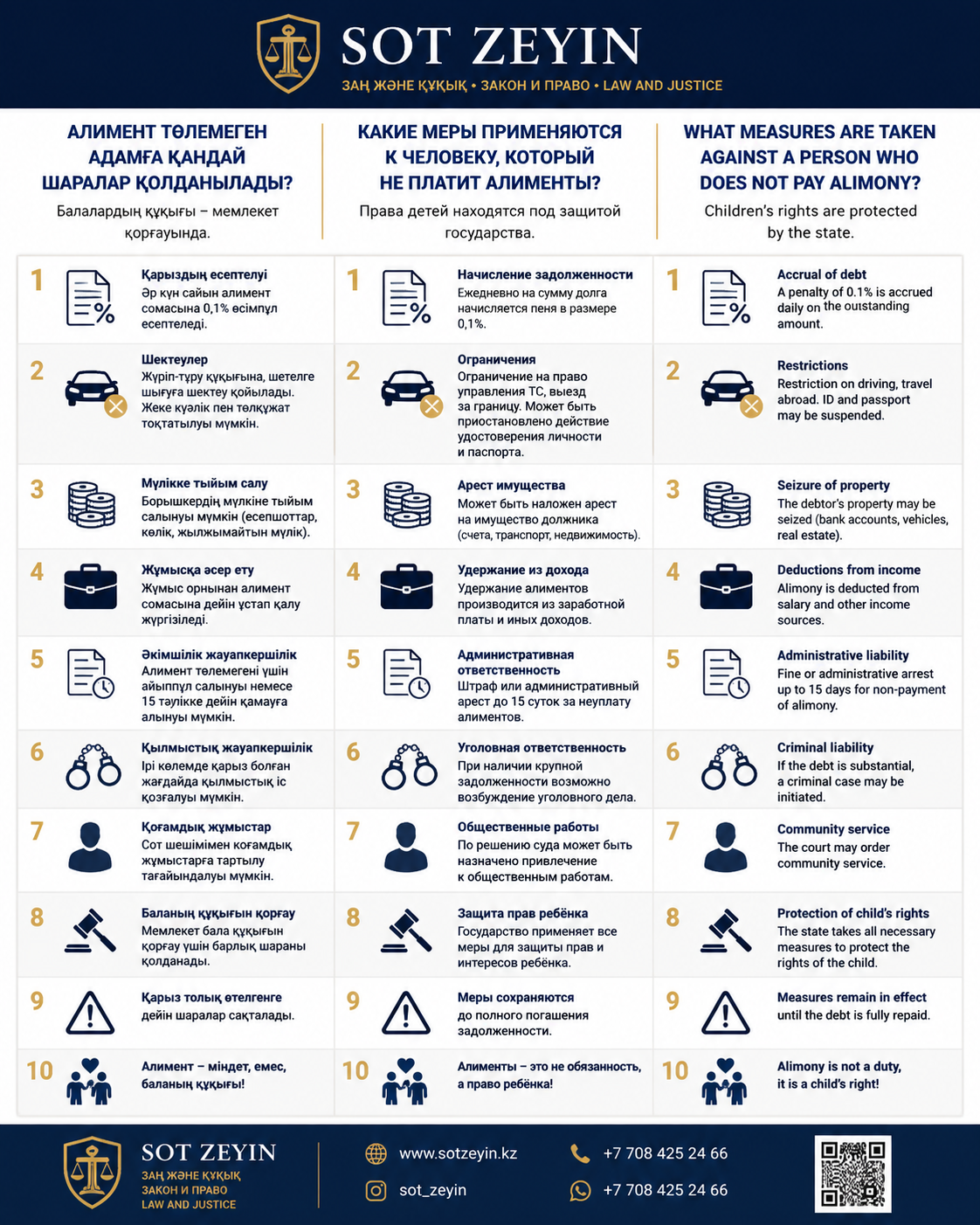
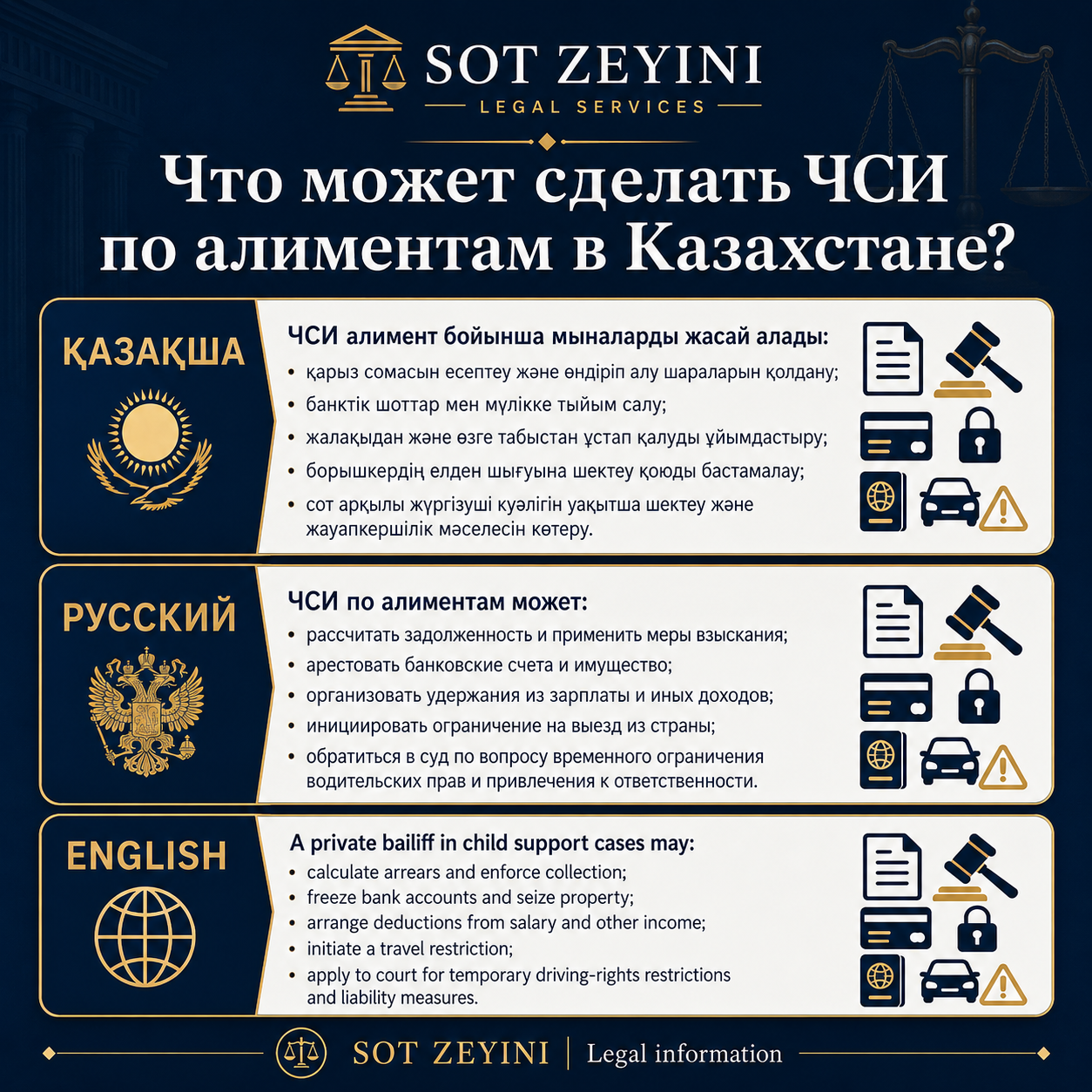
Driver’s license restriction is not the only measure. The enforcement officer may also:
- calculate the debt;
- freeze bank accounts;
- send an order to the employer;
- withhold child support from salary;
- seize a vehicle;
- seize real estate;
- restrict travel from Kazakhstan;
- include the debtor in the debtor register;
- raise the issue of administrative liability;
- in cases of willful evasion, send materials for criminal liability.
If the debtor does not pay, several measures may be applied at the same time.
What should the receiving parent do?
If child support is not being paid, the receiving parent should act step by step:
- contact the enforcement officer;
- request debt calculation;
- request checking of bank accounts, property and income;
- request freezing of accounts and seizure of property;
- request travel restriction if there are grounds;
- request consideration of driver’s license restriction;
- file a complaint if the enforcement officer is inactive.
All applications should be submitted in writing.
Conclusion
A driver’s license can be restricted for child support debt in Kazakhstan, but only in the procedure established by law. The enforcement officer may apply to the court, and the court makes the decision.
This measure is used to ensure that the debtor fulfills the obligation to support the child. If the debt is paid or the grounds for restriction disappear, the debtor may request removal of the restriction.
FAQ: Driver’s License Restriction for Child Support Debt
Can a driver’s license be restricted for child support debt?
Yes. If there is child support debt, the enforcement officer may apply to court for temporary suspension of the right to drive.
Can the enforcement officer take the license without court?
No. The enforcement officer cannot independently take away the license. The decision is made by the court.
Is it a permanent revocation?
No. It is a temporary restriction. After the debt is paid or the grounds disappear, removal of the restriction may be requested.
What if the car is needed for work?
The court may consider this. The debtor should provide documents proving that driving is the main source of income.
What is the difference between car seizure and license restriction?
Car seizure affects the vehicle as property. License restriction affects the person’s right to drive.
Can the receiving parent request this measure?
Yes. The receiving parent may submit a written application to the enforcement officer asking them to apply to court.
How can the restriction be removed?
Usually, the debtor must pay the debt, provide proof of payment and request removal of the restriction.
What if the debt is paid but the restriction remains?
A written application should be submitted to the enforcement officer. If there is no response, a complaint may be filed.
Can the restriction be appealed?
Yes. The enforcement officer’s actions or the court act may be appealed according to legal procedure.
What other measures can apply for child support debt?
Bank accounts may be frozen, salary may be withheld, property may be seized, travel may be restricted, and administrative or criminal liability may be considered.