 +7 775 858 9294
 WhatsApp
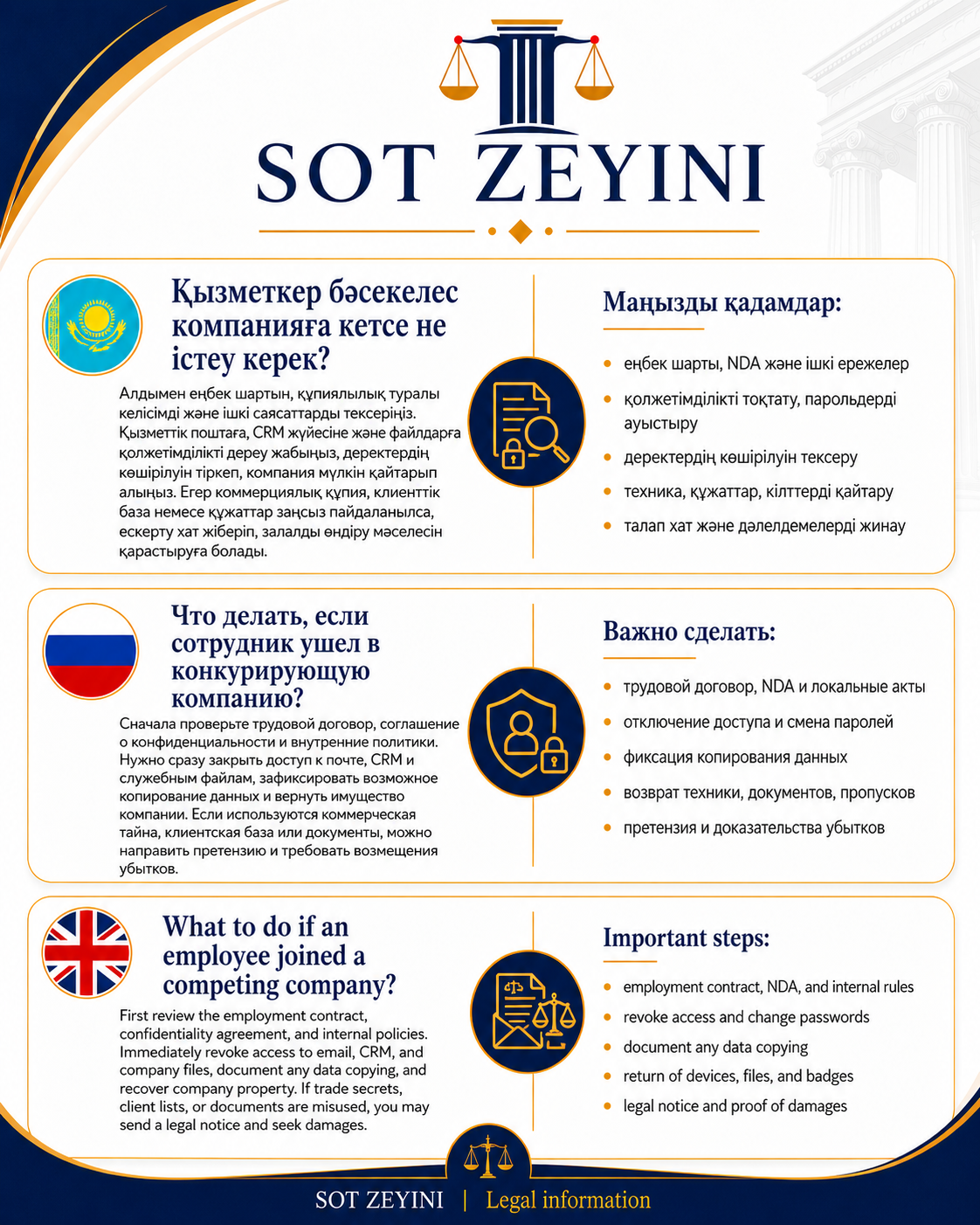
What Can a Company Do If an Employee Joins a Competitor?
Is it illegal for an employee to join a competitor?
An employee’s decision to join a competing company is not automatically illegal. A person generally has the right to choose their place of work, profession, and field of activity. Therefore, an employer cannot simply prohibit a former employee from working for a competitor without proper legal grounds.
The real issue is not where the employee goes, but what they take with them. If the employee takes the client database, trade secrets, internal documents, pricing information, CRM data, logins, passwords, or business processes, the employer may have legal grounds to act.
In simple terms, joining a competitor may be lawful. Joining a competitor with the former employer’s client database is a very different situation.
When can the employer take action?
The employer may take action if the employee:
- copied the client database;
- exported data from the CRM;
- sent company documents to a personal email;
- transferred commercial offers to a competitor;
- used internal sales scripts;
- disclosed prices, discounts, or contract terms;
- took logins and passwords;
- failed to return corporate documents;
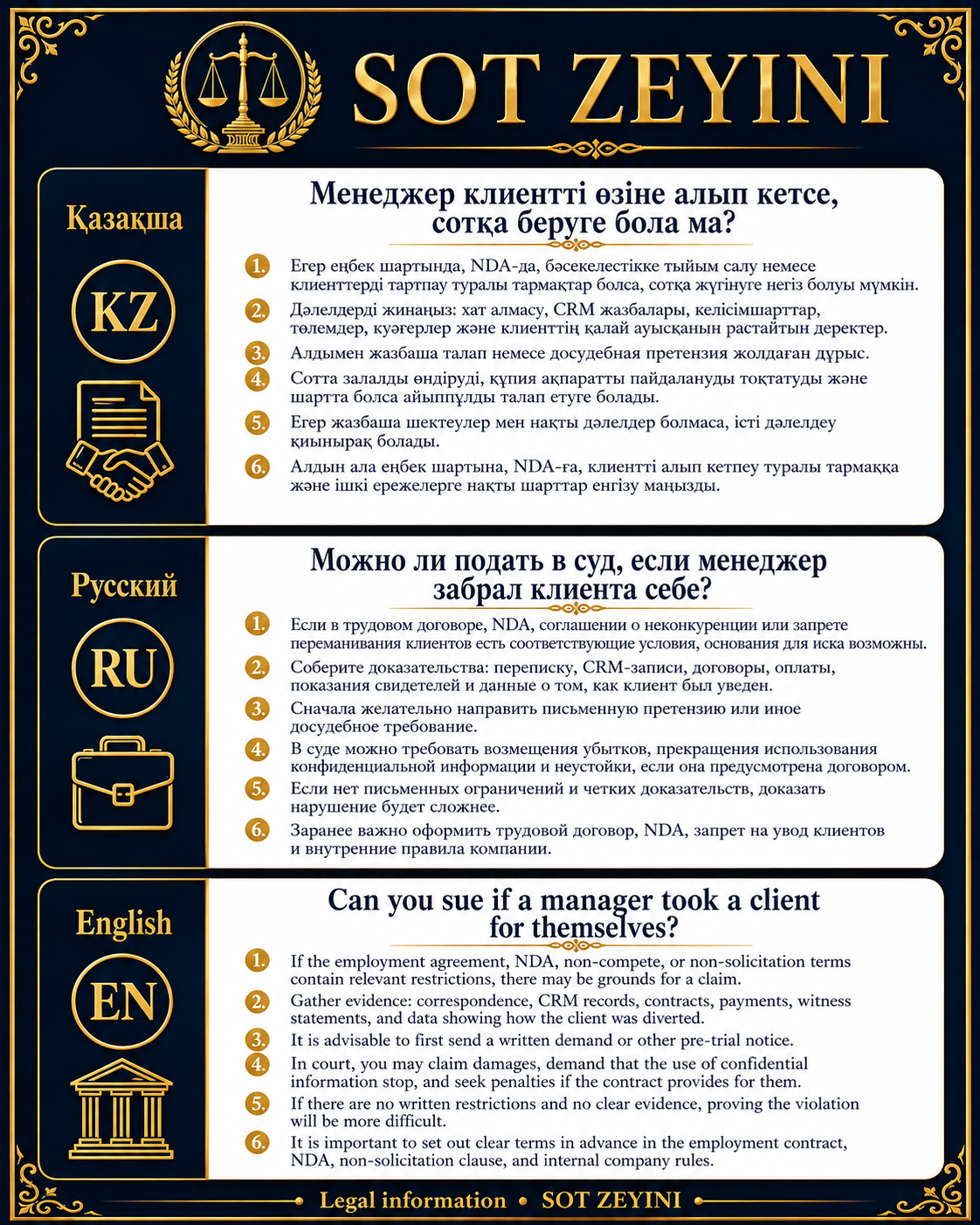
- started poaching clients;
- encouraged other employees to leave;
- breached an NDA or confidentiality agreement;
- caused losses to the company.
If there are no such facts, the mere fact that the employee joined a competitor may not be enough for a legal claim.
Can an employer prohibit an employee from working for a competitor?
Some companies include non-compete clauses in employment contracts or NDAs. However, such clauses may be legally sensitive because they can restrict a person’s freedom to work.
A safer approach is to protect specific business interests rather than trying to prohibit employment altogether.
The company can protect:
- trade secrets;
- client database;
- internal documents;
- CRM data;
- logins and passwords;
- pricing policy;
- confidential business processes;
- clients from unlawful poaching, if such restriction is properly agreed.
In other words, it is stronger to say “do not use our confidential information” than to say “you cannot work anywhere near our industry.”
What should the employer do first?
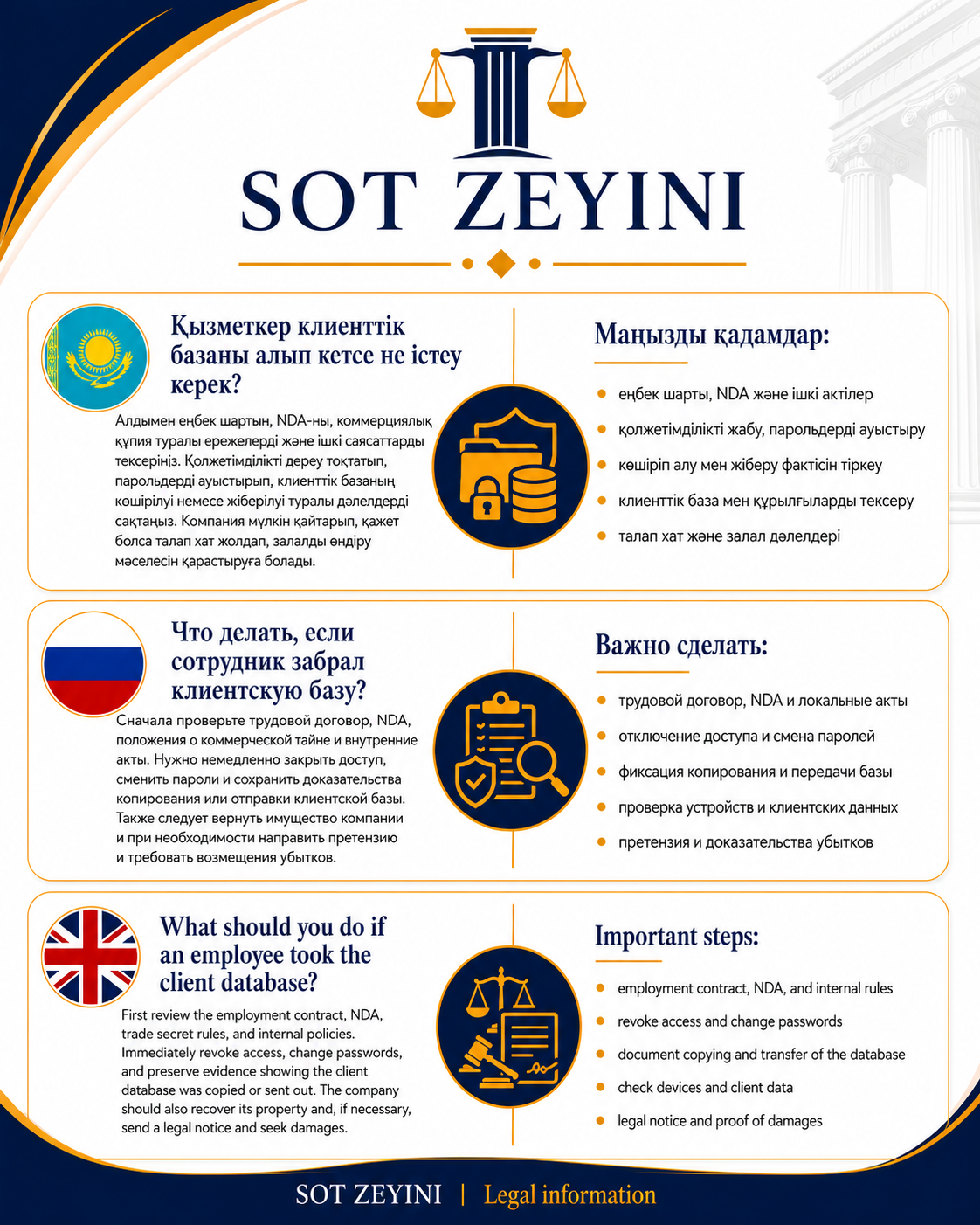
If an employer learns that an employee has joined a competitor, the company should act quickly and carefully.
Initial steps:
- Block access to CRM, email, WhatsApp Business, Google Drive, website, and social media accounts.
- Change passwords.
- Check the client database export history.
- Save logs of the employee’s actions.
- Check whether files were sent to personal email.
- Prepare an internal incident report.
- Request a written explanation from the employee.
- Record client complaints or contacts if poaching has started.
- Save correspondence and screenshots.
- Prepare a written demand or court claim.
The key is evidence. Without evidence, the dispute may become an emotional accusation rather than a legal case.
What claims can be made against the employee?
Depending on the situation, the employer may bring several claims.
1. Return of the client database
If the employee took client lists, CRM exports, Excel files, contacts, or correspondence, the employer may demand their return.
2. Stop using confidential information
The employer may demand that the former employee stop using trade secrets, client data, internal documents, and other company materials.
3. Delete unlawfully copied data
If the data is stored on the employee’s personal phone, email, flash drive, cloud storage, or messenger, the employer may demand deletion.
4. Return documents and access credentials
The employee should return documents, devices, corporate accounts, logins, passwords, CRM access, social media access, and advertising account access.
5. Stop poaching clients
If a non-solicitation obligation was agreed, the employer may demand that the former employee stop contacting and poaching company clients.
6. Compensation for damages
If the company lost clients, revenue, or a contract because of the employee’s actions, the employer may claim damages.
7. Contractual penalty
If an NDA, employment contract, or confidentiality agreement provides for a penalty, the employer may claim it.
8. Court claim
Through court, the employer may seek an injunction on the use of information, return of documents, damages, and penalties.
9. Police report
If there are signs of unlawful acquisition, use, or transfer of trade secrets, the employer may consider filing a police report.
What evidence is needed?
The employer should collect:
- employment contract;
- NDA;
- confidentiality agreement;
- trade secret policy;
- employee acknowledgment forms;
- job description;
- CRM logs;
- file export history;
- email, WhatsApp, or Telegram correspondence;
- screenshots of messages to clients;
- client complaints;
- evidence of clients moving to the competitor;
- internal investigation report;
- employee explanation;
- calculation of damages.
The evidence should prove not merely that the employee joined a competitor, but that they violated obligations: copied, transferred, used, poached, or caused damage.
What if the former employee poaches clients?
If the former employee starts calling or messaging company clients on behalf of the new company, the employer should record:
- message text;
- date and time of calls;
- screenshots of correspondence;
- client statements;
- commercial offers from the competitor;
- link between the former employee and the client;
- proof that the client or contract was lost.
After collecting evidence, the employer may send a written demand to the former employee and, if necessary, to the competing company.
Can a demand be sent to the competing company?
Yes, if there is evidence that the competing company received and uses unlawfully transferred information. The employer may demand that the competitor:
- stop using the client database;
- delete unlawfully obtained data;
- stop using trade secrets;
- stop contacting clients based on the unlawfully obtained database;
- compensate damages if they were caused.
Such a demand should be carefully drafted and based on evidence. Without evidence, the company may face reputational or counterclaim risks.
What should be included in the demand letter?
The demand letter should state:
- the employee’s former position;
- what information the employee had access to;
- what documents were signed;
- what actions were taken;
- what evidence the company has;
- what the company demands;
- the deadline for voluntary compliance;
- warning about court or authorities if the demand is ignored.
The letter should be professional and fact-based.
How can a company protect itself in advance?
To reduce the risk of employees leaving for competitors with sensitive data, the company should:
- sign NDAs;
- include confidentiality clauses in employment contracts;
- adopt a trade secret policy;
- restrict access to the client database;
- use a CRM system;
- prohibit full database exports;
- keep user action logs;
- use individual logins;
- block access immediately upon termination;
- sign a return act for documents and access credentials;
- define liability for disclosure.
If the protection system is built in advance, the employer can act much faster and more confidently.
What can be claimed in court?
Through court, the employer may request:
- prohibition on using trade secrets;
- return of the client database;
- deletion of unlawfully copied data;
- compensation for damages;
- contractual penalty;
- return of documents and access credentials;
- recognition of unlawful actions;
- reimbursement of court expenses.
If damages are claimed, the employer should prepare a clear calculation and supporting documents.
Conclusion
An employee has the right to join a competing company. However, the employee does not have the right to take the former employer’s client database, trade secrets, internal documents, logins, passwords, or business processes and use them against the former employer.
The employer should quickly block access, preserve evidence, request an explanation, send a written demand, and, if necessary, go to court or file a police report.
The main rule is simple: protect the company’s assets, not the employee’s career path.
FAQ
Can an employer prohibit an employee from working for a competitor?
A complete prohibition may be difficult because of freedom of labor. However, the employer can prohibit the use of trade secrets, client databases, and confidential documents.
What should be done if an employee joins a competitor with the client database?
The employer should block access, preserve logs, prepare an internal report, send a demand, request deletion of the database, and consider court or police action.
Can damages be recovered?
Yes, if the company proves the violation, the amount of damage, and the connection between the former employee’s actions and the loss.
Does an NDA continue after termination?
Yes, if the NDA or contract states that confidentiality obligations continue after termination.
Can an employee be punished only for joining a competitor?
Usually no. Additional violations are needed, such as disclosure of trade secrets, copying the database, poaching clients, or causing damage.
What if the former employee poaches clients?
The employer should collect evidence, send a demand, request that the actions stop, and consider filing a court claim.
How can a business protect itself in advance?
Use NDAs, trade secret policies, CRM controls, access restrictions, export limits, and return acts when employees leave.