 +7 775 858 9294
 WhatsApp
Can a mediation agreement be concluded during divorce?
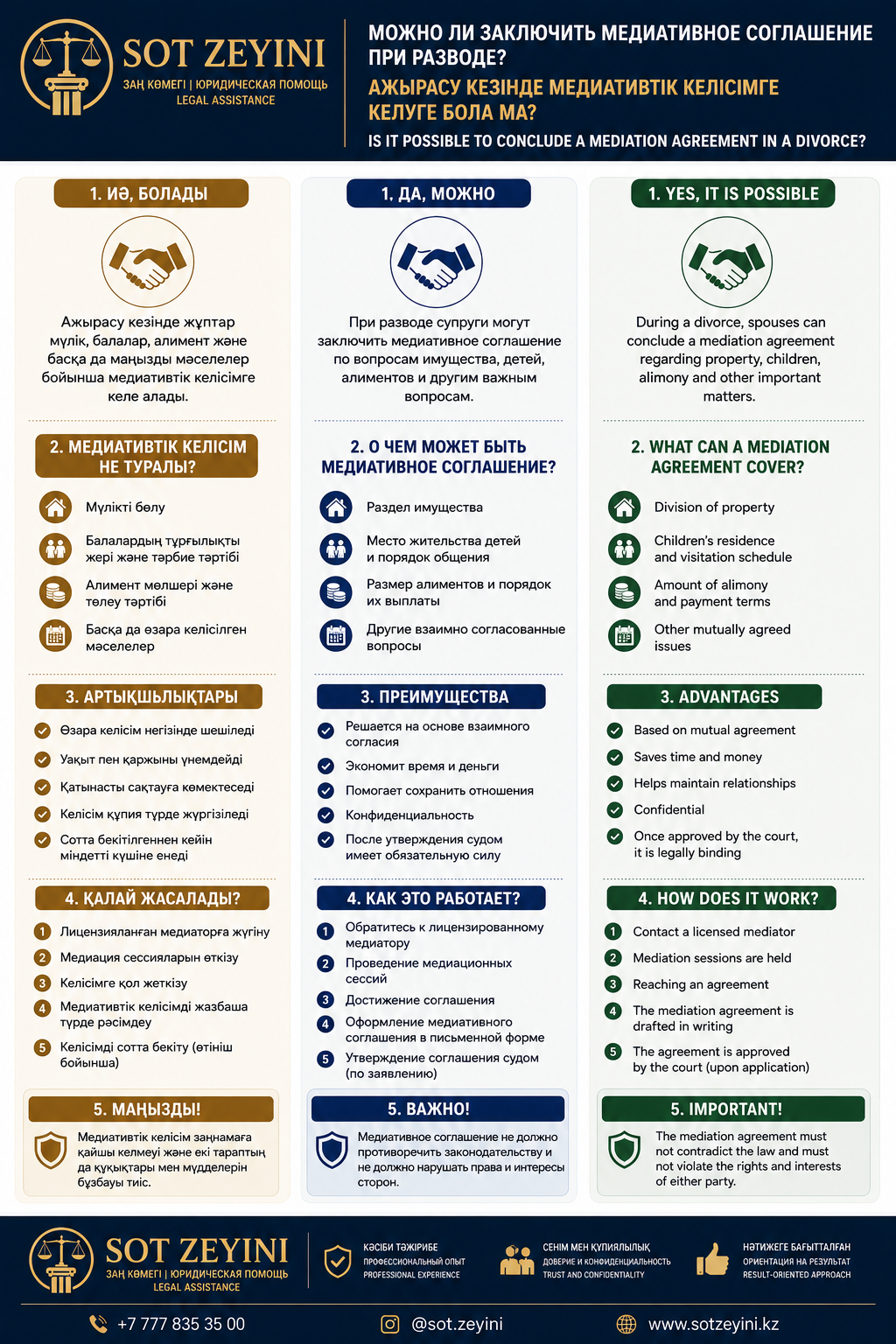
Yes, spouses can conclude a mediation agreement during divorce. This is a lawful and practical way to resolve disputes between husband and wife peacefully, without lengthy court conflicts.
Mediation is especially useful when spouses have children, property, child support issues, loans, or other disagreements that need to be settled in writing. Instead of arguing in court for months, the parties can negotiate and record their agreed terms in a formal document.
However, it is important to understand that if the law requires the marriage to be dissolved through court, the mediation agreement itself does not always replace the court decision on divorce. But it can simplify the process and help the court consider the case faster.
What is a mediation agreement?
A mediation agreement is a written document concluded between the parties as a result of the mediation procedure. It sets out the issues on which the spouses have reached an agreement and explains how these agreements will be fulfilled.
Mediation is conducted with the participation of a mediator. A mediator is a neutral person who helps the parties find a compromise. The mediator does not make a decision instead of the court and does not force the parties to agree. Their role is to help spouses reach an agreement without unnecessary conflict.
In simple terms, a mediator is not a judge or a “family prosecutor.” A mediator helps the parties leave the conflict without turning every WhatsApp message into a final boss battle.
What issues can be resolved through a mediation agreement?
During divorce, a mediation agreement may regulate the following issues:
- consent of the parties to divorce;
- place of residence of minor children;
- communication procedure between the child and the other parent;
- visitation schedule;
- participation of parents in the child’s upbringing;
- child support and maintenance of children;
- additional expenses for the child;
- division of jointly acquired property;
- use of housing;
- distribution of loans and obligations;
- transfer of a car, real estate, or other property;
- absence of mutual claims;
- procedure for fulfilling the agreements.
The more specific the terms are, the lower the risk of new disputes after divorce.
Can child-related issues be settled through mediation?
Yes, parents can resolve child-related issues through a mediation agreement. For example, the agreement may determine:
- who the child will live with;
- when and how the other parent will see the child;
- whether the child may stay overnight with the other parent;
- who will pay for clubs, kindergarten, school, and medical treatment;
- how parents will make decisions about the child’s education and health;
- how communication will take place during holidays and vacations.
The main requirement is that the agreement must not violate the rights and interests of the child. If the terms harm the child or deprive the child of proper support, the court may refuse to approve such an agreement.
Can child support be resolved through mediation?
Yes, child support issues can also be regulated through a mediation agreement. The agreement may specify:
- amount of child support;
- monthly payment date;
- payment method;
- bank details;
- additional expenses for the child;
- procedure for confirming payments;
- liability for late payment.
However, the agreement must not contain terms that worsen the child’s situation. For example, a complete waiver of child support may be problematic if it violates the interests of a minor child.
It is better to specify clear and enforceable terms: amount, deadline, payment method, and confirmation procedure.
Can property be divided through a mediation agreement?
Yes, spouses may divide property through a mediation agreement. This is especially useful if the spouses have:
- an apartment;
- a house;
- a land plot;
- a car;
- a business;
- a share in a company;
- money in bank accounts;
- loans;
- a mortgage;
- household appliances and furniture.
The agreement may state which property remains with which spouse, who pays compensation, who continues paying the loan, and within what period the parties must complete the paperwork.
If the issue concerns real estate, a vehicle, or a share in a company, the mediation agreement alone may not be enough. Notarial certification, registration of ownership rights, or signing additional documents may be required.
When can a mediation agreement be concluded?
A mediation agreement may be concluded at different stages.
Before court
Spouses may go through mediation before filing a claim in court and agree on children, child support, and property issues in advance. This can simplify the divorce process and reduce conflict.
During court proceedings
If the divorce case is already being considered by the court, the parties may state that they wish to resolve the dispute through mediation. After signing the agreement, it may be submitted to the court for approval.
After a court decision
In some cases, the parties may reach an agreement even after a court act has been issued, for example, regarding the procedure for fulfilling obligations or transferring property.
Does the court approve a mediation agreement?
If the case is already in court, the mediation agreement may be submitted to the court for approval. The court checks whether the agreement complies with the law and whether it violates the rights of other persons.
The court pays special attention to the rights of children. If the agreement concerns the child’s place of residence, child support, or communication with a parent, its terms must be in the child’s best interests.
If the court approves the mediation agreement, it issues a relevant ruling. Proceedings may be terminated in the part of the dispute that has been settled.
When can the court refuse to approve a mediation agreement?
The court may refuse to approve a mediation agreement if it:
- contradicts the law;
- violates the rights of the child;
- violates the rights of one of the spouses;
- violates the rights of third parties;
- contains unclear terms;
- contains obligations that cannot be fulfilled;
- was signed under pressure;
- effectively deprives the child of support;
- conceals an illegal transaction.
That is why a mediation agreement should be prepared carefully. A beautiful text is good, but an enforceable text is legal luxury.
What is the difference between a mediation agreement and a settlement agreement?
A settlement agreement is usually concluded within court proceedings and approved by the court.
A mediation agreement is concluded as a result of mediation with the participation of a mediator. It may be concluded both before court and during court proceedings.
Both options help resolve a dispute peacefully. However, mediation is more focused on negotiation, balance, and preserving normal communication between the parties.
This is especially important during divorce. Former spouses may stop being husband and wife, but if they have children, they remain parents.
What should be included in a mediation agreement during divorce?
A mediation agreement should preferably include:
- details of the spouses;
- details of the children;
- information about the marriage;
- terms related to divorce;
- children’s place of residence;
- communication procedure with children;
- child support;
- additional expenses for children;
- terms of property division;
- procedure for transferring property and documents;
- deadlines for fulfilling obligations;
- liability for breach of the agreement;
- procedure for resolving future disputes;
- absence of mutual claims;
- signatures of the parties and the mediator.
The main rule is: fewer general phrases, more specific terms. Not “the father sees the child when possible,” but “every Saturday from 10:00 a.m. to 6:00 p.m.”
Does a mediation agreement need to be notarized?
It depends on the content of the agreement.
If the agreement is submitted within a divorce case, the court may approve it by its ruling.
However, if the agreement concerns child support, real estate, a car, a business share, or monetary compensation, notarization or additional registration of rights may be required.
Before signing, it is better to have the document checked by a lawyer. Otherwise, the agreement may remain just a nice piece of paper without real results.
What happens if one party does not comply with the agreement?
If the mediation agreement is approved by the court, its terms become binding on the parties. If one party fails to comply, the issue of enforcement may be raised in the procedure established by law.
If the agreement was concluded before court and was not approved by the court, the method of protecting rights depends on the content and form of the agreement. In some cases, it may be necessary to apply to court to protect the violated right.
Therefore, it is important not only to reach an agreement, but also to formalize it correctly.
Advantages of a mediation agreement during divorce
A mediation agreement has several advantages:
- reduces conflict between spouses;
- saves time;
- reduces court expenses;
- helps preserve normal communication for the sake of children;
- allows flexible terms;
- protects the child’s interests;
- helps avoid lengthy court proceedings;
- gives the parties more control over the outcome.
The court resolves disputes according to the law, while mediation allows the parties to find a solution that fits their real-life situation.
Risks of a mediation agreement
Despite its advantages, there are also risks:
- one party may sign the agreement under pressure;
- the terms may be too general;
- the agreement may violate the rights of the child;
- property may be described inaccurately;
- the enforcement procedure may be unclear;
- the agreement may be difficult to enforce;
- the court may refuse to approve it.
Therefore, a mediation agreement during divorce is best prepared with legal assistance.
When is mediation especially useful?
Mediation is suitable when:
- spouses want to divorce peacefully;
- there are children and normal communication must be preserved;
- a visitation schedule needs to be agreed;
- child support issues must be resolved;
- there is property, but the parties are ready to compromise;
- the parties do not want lengthy court proceedings;
- confidentiality is important;
- spouses want to avoid mutual accusations.
However, if there is violence, threats, pressure, concealment of property, or serious violation of the child’s rights, mediation may not be the best option. In such cases, stronger legal protection may be required.
Is a lawyer needed for a mediation agreement?
Yes, it is advisable to seek legal assistance before signing the agreement. A mediator helps the parties reach an agreement, while a lawyer checks the legal consequences.
A lawyer can help:
- properly formulate the terms;
- protect the client’s interests;
- check the child’s rights;
- clearly describe the enforcement procedure;
- include liability for breach;
- anticipate future disputes;
- prepare documents for court;
- avoid terms that the court may refuse to approve.
A mediator helps find a compromise, and a lawyer makes sure that the compromise does not later turn into a new court dispute.
Legal assistance with a mediation agreement
The lawyers of SOT ZEYINI can help prepare a mediation agreement during divorce and protect your interests.
We can help if you need to:
- conclude an agreement regarding children;
- determine the child’s place of residence;
- establish a communication schedule with the child;
- agree on child support;
- divide property;
- settle loans and mortgage issues;
- submit the agreement to court;
- check the agreement before signing.
Need help with a mediation agreement during divorce? Message us on WhatsApp — a lawyer will explain what terms should be included and how to formalize the agreement so that it actually works.
Frequently Asked Questions
Can a mediation agreement be concluded before court?
Yes, spouses may conclude a mediation agreement before applying to court. This may simplify the divorce process and reduce conflict.
Can a mediation agreement be concluded during court proceedings?
Yes. If the case is already being considered by the court, the parties may go through mediation and submit the agreement to the court for approval.
Can child support be resolved through mediation?
Yes. However, the terms must not violate the child’s interests. It is better to specify the exact amount, payment deadlines, and payment procedure.
Can mediation determine who the child will live with?
Yes, parents may agree on the child’s place of residence. However, the agreement must be in the child’s best interests.
Can an apartment be divided through a mediation agreement?
Yes. However, when real estate is involved, ownership rights must be formalized correctly. Notarization and registration may be required.
Is the court required to approve a mediation agreement?
No. The court reviews the agreement. If it contradicts the law or violates the rights of a child, spouse, or third parties, the court may refuse to approve it.