 +7 775 858 9294
 WhatsApp
What happens if one of the spouses is against divorce?
One of the most frequently asked divorce questions is: "Can my spouse not get divorced if he is against divorce?"
The short answer is no, in most cases one person's resistance can't keep a marriage going forever. If one of the spouses wants to dissolve the marriage, and the other objects or does not give consent, the issue is resolved in court.
In Kazakhstan, the procedure for divorce is regulated by the Code "On Marriage (Marriage) and Family." If the parties cannot agree among themselves, the court may consider the issue of divorce, with whom the children will remain, the procedure for distributing alimony, property and visits with the child.
If the spouse is against, is it possible to divorce?
Yes, perhaps. If one spouse does not consent to the dissolution of the marriage, the other spouse can apply to the court with a statement of claim.
In this case, the court may:
finds out why spouses want to divorce;
considers preserving the family;
if necessary, gives time for reconciliation;
considers disputes on children, alimony, property;
in the absence of reconciliation, decides on the dissolution of the marriage.
That is, the expression of one of the parties "I will not part" can complicate or extend the process, but in most cases it cannot completely stop the divorce.
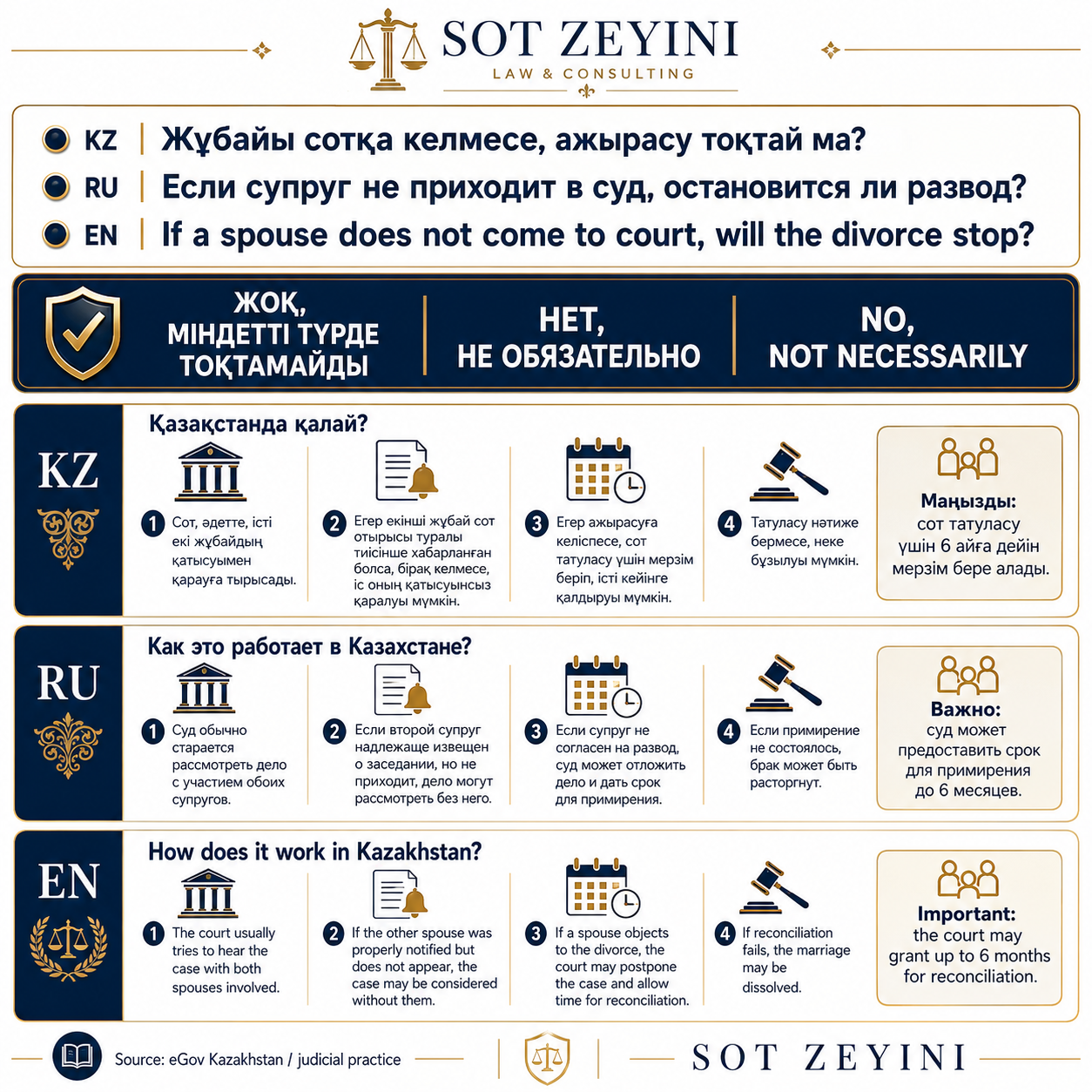
Can the court give time for reconciliation?
Yes. If one of the spouses is against the divorce, the court can postpone the case and give the spouses a time limit for reconciliation. According to the official interpretation, such a period can be up to 6 months. If the parties do not reconcile during this time, the court may decide to terminate the marriage.
It is important here: the term of reconciliation is not automatically awarded in each case. The court assesses the real situation, the positions of the parties, the presence of children and the possibility of preserving the family.
What happens if the spouse does not appear in court?
Some people think: "If I don't go to court, there will be no divorces." This is a myth. Failure to appear in court can delay the process, but does not dismiss the cases.
If the defendant has repeatedly failed to appear at the hearing, but is duly notified, the court may consider the case in his absence. Therefore, escape from the court is not a strategy, but simply a waste of time. Legally speaking, "just ghost mode" does not help.
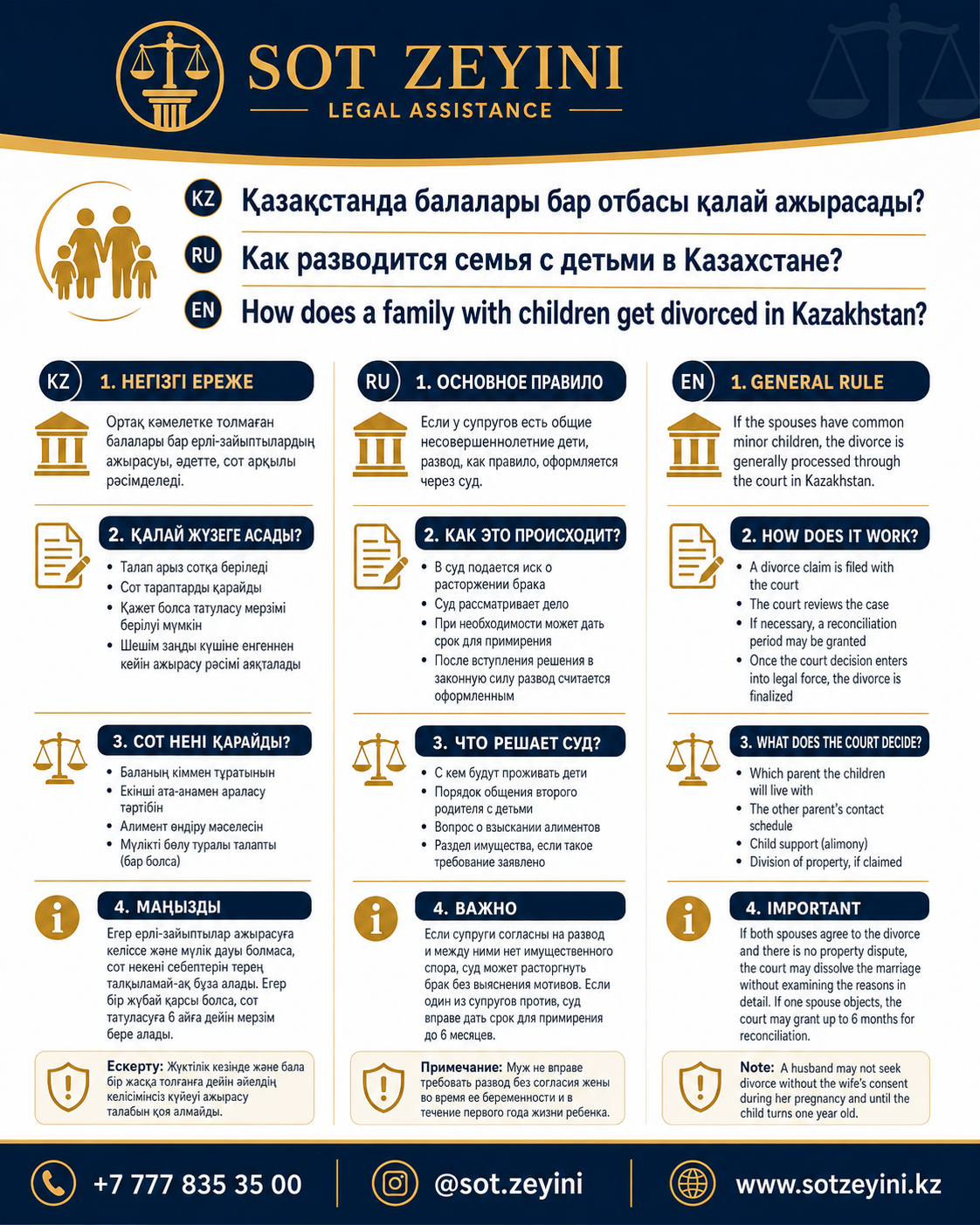
How does divorce work if there are children?
If the spouses have common minor children, the marriage is usually dissolved by the court. The court primarily takes into account the interests of children.
The court may decide the following issues:
which parent the child lives with;
who pays child support and in what amount;
what will be the procedure for meeting the second parent with the child;
procedure for participation in the upbringing of a child;
if necessary, the issue of division of property.
In accordance with article 22 of the Code, the court, upon divorce, can determine the place of residence of the children, the procedure for distributing alimony, common property and the treatment of the parents with the child.
Are there conditions under which you cannot divorce?
Yes, there are special restrictions in the law. In Kazakhstan, divorce during a woman's pregnancy and before the child reaches the age of 1 year is impossible without the consent of the spouse. This restriction is aimed at protecting the rights of the family and the child.
But each case is considered separately. Therefore, in this case it is advisable to get specific legal advice.
And if there is a dispute over property or alimony?
Divorce isn't just about ending a marriage. In most cases, additional disputes are attached to it:
division of common property;
recovery of alimony;
establishing the child's place of residence;
establishing a procedure for meeting a child;
credit and loan issues;
recovery of legal costs.
If the parties agree, these issues can be settled by agreement. If you do not agree, the court decides.
Which court to go to?
As a rule, a statement of claim is filed at the place of residence of the defendant. And if there are common minor children, such cases can be considered in a specialized interdistrict juvenile court. In the explanation of the Supreme Court, it is indicated that such cases are considered at the place of residence of the defendant, and in some cases can be transferred to the place of residence of the plaintiff.
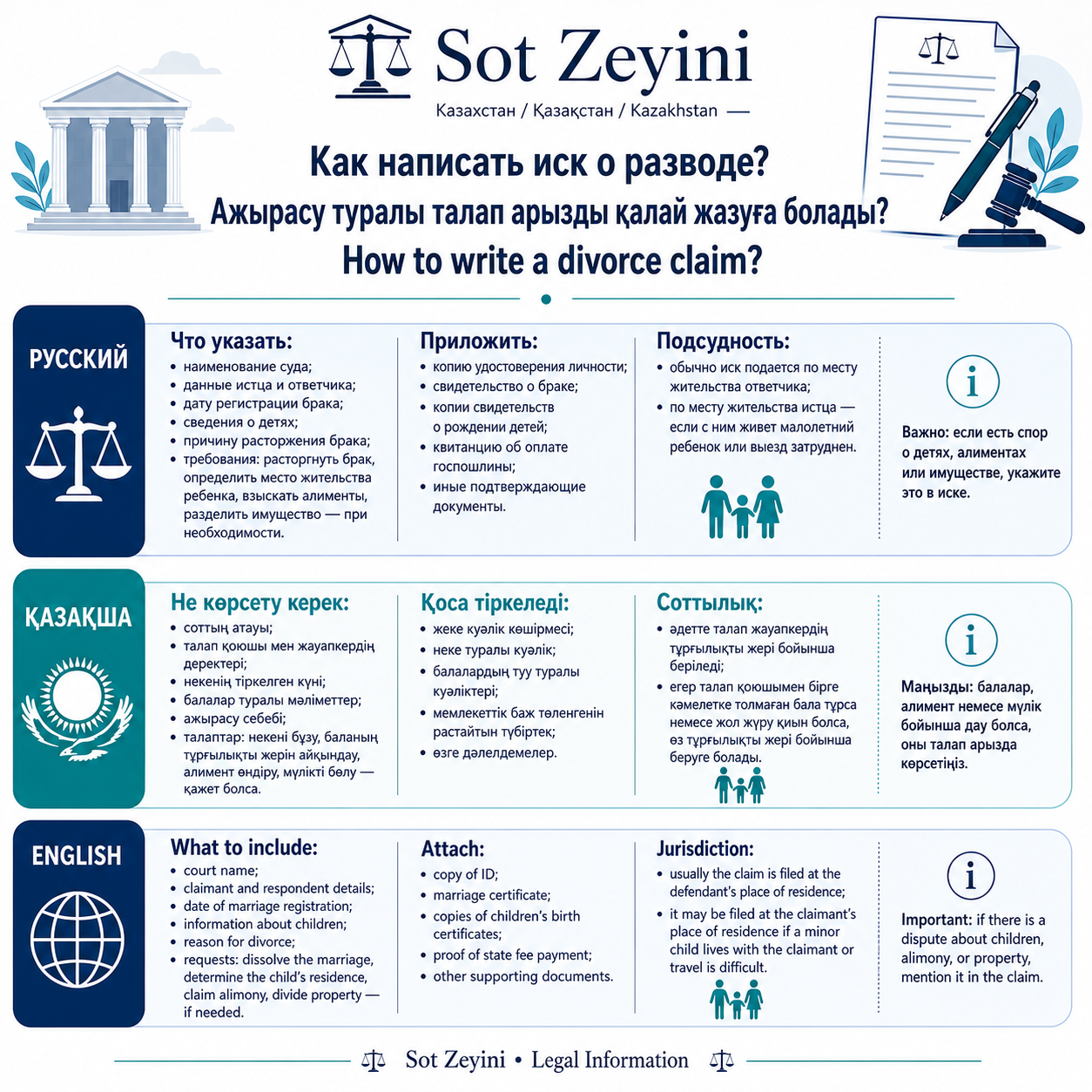
What documents are needed for a judicial divorce?
The following documents are generally required:
Declaration of divorce;
Certificate of marriage or record of the act;
Birth certificates of children;
Copy of identity card;
Receipt of payment of state duty;
If there is a question about alimony, property, child - evidence related to it;
Information confirming the address of the defendant.
Documents may change depending on the situation. For example, when dividing property - you may need real estate, transport, bank accounts, credit, valuation documents.
How long does the divorce last if the spouse is against?
If there is little dispute, the process can go relatively quickly. But if the spouse is against, if the court gives time for reconciliation, if there is a dispute over the child or property, the case may drag on for several months.
Main factors:
the defendant's appearance or failure to appear in court;
the presence of a dispute over children;
availability of the property division requirement;
the issue of alimony;
the possibility of consent of the parties;
legal burden.
Why do you need the help of a lawyer?
If the spouse is against divorce, it is very important to correctly prepare a statement of claim
What happens if one of the spouses is against divorce?
One of the most frequently asked divorce questions is: "Can my spouse not get divorced if he is against divorce?"
The short answer is no, in most cases one person's resistance can't keep a marriage going forever. If one of the spouses wants to dissolve the marriage, and the other objects or does not give consent, the issue is resolved in court.
In Kazakhstan, the procedure for divorce is regulated by the Code "On Marriage (Marriage) and Family." If the parties cannot agree among themselves, the court may consider the issue of divorce, with whom the children will remain, the procedure for distributing alimony, property and visits with the child.
If the spouse is against, is it possible to divorce?
Yes, perhaps. If one spouse does not consent to the dissolution of the marriage, the other spouse can apply to the court with a statement of claim.
In this case, the court may:
finds out why spouses want to divorce;
considers preserving the family;
if necessary, gives time for reconciliation;
considers disputes on children, alimony, property;
in the absence of reconciliation, decides on the dissolution of the marriage.
That is, the expression of one of the parties "I will not part" can complicate or extend the process, but in most cases it cannot completely stop the divorce.
Can the court give time for reconciliation?
Yes. If one of the spouses is against the divorce, the court can postpone the case and give the spouses a time limit for reconciliation. According to the official interpretation, such a period can be up to 6 months. If the parties do not reconcile during this time, the court may decide to terminate the marriage.
It is important here: the term of reconciliation is not automatically awarded in each case. The court assesses the real situation, the positions of the parties, the presence of children and the possibility of preserving the family.
What happens if the spouse does not appear in court?
Some people think: "If I don't go to court, there will be no divorces." This is a myth. Failure to appear in court can delay the process, but does not dismiss the cases.
If the defendant has repeatedly failed to appear at the hearing, but is duly notified, the court may consider the case in his absence. Therefore, escape from the court is not a strategy, but simply a waste of time. Legally speaking, "just ghost mode" does not help.
How does divorce work if there are children?
If the spouses have common minor children, the marriage is usually dissolved by the court. The court primarily takes into account the interests of children.
The court may decide the following issues:
which parent the child lives with;
who pays child support and in what amount;
what will be the procedure for meeting the second parent with the child;
procedure for participation in the upbringing of a child;
if necessary, the issue of division of property.
In accordance with article 22 of the Code, the court, upon divorce, can determine the place of residence of the children, the procedure for distributing alimony, common property and the treatment of the parents with the child.
Are there conditions under which you cannot divorce?
Yes, there are special restrictions in the law. In Kazakhstan, divorce during a woman's pregnancy and before the child reaches the age of 1 year is impossible without the consent of the spouse. This restriction is aimed at protecting the rights of the family and the child.
But each case is considered separately. Therefore, in this case it is advisable to get specific legal advice.
And if there is a dispute over property or alimony?
Divorce isn't just about ending a marriage. In most cases, additional disputes are attached to it:
division of common property;
recovery of alimony;
establishing the child's place of residence;
establishing a procedure for meeting a child;
credit and loan issues;
recovery of legal costs.
If the parties agree, these issues can be settled by agreement. If you do not agree, the court decides.
Which court to go to?
As a rule, a statement of claim is filed at the place of residence of the defendant. And if there are common minor children, such cases can be considered in a specialized interdistrict juvenile court. In the explanation of the Supreme Court, it is indicated that such cases are considered at the place of residence of the defendant, and in some cases can be transferred to the place of residence of the plaintiff.
What documents are needed for a judicial divorce?
The following documents are generally required:
Declaration of divorce;
Certificate of marriage or record of the act;
Birth certificates of children;
Copy of identity card;
Receipt of payment of state duty;
If there is a question about alimony, property, child - evidence related to it;
Information confirming the address of the defendant.
Documents may change depending on the situation. For example, when dividing property - you may need real estate, transport, bank accounts, credit, valuation documents.
How long does the divorce last if the spouse is against?
If there is little dispute, the process can go relatively quickly. But if the spouse is against, if the court gives time for reconciliation, if there is a dispute over the child or property, the case may drag on for several months.
Main factors:
the defendant's appearance or failure to appear in court;
the presence of a dispute over children;
availability of the property division requirement;
the issue of alimony;
the possibility of consent of the parties;
legal burden.
Why do you need the help of a lawyer?
If the spouse is against divorce, it is very important to correctly prepare a statement of claim
What happens if one of the spouses is against divorce?
One of the most frequently asked divorce questions is: "Can my spouse not get divorced if he is against divorce?"
The short answer is no, in most cases one person's resistance can't keep a marriage going forever. If one of the spouses wants to dissolve the marriage, and the other objects or does not give consent, the issue is resolved in court.
In Kazakhstan, the procedure for divorce is regulated by the Code "On Marriage (Marriage) and Family." If the parties cannot agree among themselves, the court may consider the issue of divorce, with whom the children will remain, the procedure for distributing alimony, property and visits with the child.
If the spouse is against, is it possible to divorce?
Yes, perhaps. If one spouse does not consent to the dissolution of the marriage, the other spouse can apply to the court with a statement of claim.
In this case, the court may:
finds out why spouses want to divorce;
considers preserving the family;
if necessary, gives time for reconciliation;
considers disputes on children, alimony, property;
in the absence of reconciliation, decides on the dissolution of the marriage.
That is, the expression of one of the parties "I will not part" can complicate or extend the process, but in most cases it cannot completely stop the divorce.
Can the court give time for reconciliation?
Yes. If one of the spouses is against the divorce, the court can postpone the case and give the spouses a time limit for reconciliation. According to the official interpretation, such a period can be up to 6 months. If the parties do not reconcile during this time, the court may decide to terminate the marriage.
It is important here: the term of reconciliation is not automatically awarded in each case. The court assesses the real situation, the positions of the parties, the presence of children and the possibility of preserving the family.
What happens if the spouse does not appear in court?
Some people think: "If I don't go to court, there will be no divorces." This is a myth. Failure to appear in court can delay the process, but does not dismiss the cases.
If the defendant has repeatedly failed to appear at the hearing, but is duly notified, the court may consider the case in his absence. Therefore, escape from the court is not a strategy, but simply a waste of time. Legally speaking, "just ghost mode" does not help.
How does divorce work if there are children?
If the spouses have common minor children, the marriage is usually dissolved by the court. The court primarily takes into account the interests of children.
The court may decide the following issues:
which parent the child lives with;
who pays child support and in what amount;
what will be the procedure for meeting the second parent with the child;
procedure for participation in the upbringing of a child;
if necessary, the issue of division of property.
In accordance with article 22 of the Code, the court, upon divorce, can determine the place of residence of the children, the procedure for distributing alimony, common property and the treatment of the parents with the child.
Are there conditions under which you cannot divorce?
Yes, there are special restrictions in the law. In Kazakhstan, divorce during a woman's pregnancy and before the child reaches the age of 1 year is impossible without the consent of the spouse. This restriction is aimed at protecting the rights of the family and the child.
But each case is considered separately. Therefore, in this case it is advisable to get specific legal advice.
And if there is a dispute over property or alimony?
Divorce isn't just about ending a marriage. In most cases, additional disputes are attached to it:
division of common property;
recovery of alimony;
establishing the child's place of residence;
establishing a procedure for meeting a child;
credit and loan issues;
recovery of legal costs.
If the parties agree, these issues can be settled by agreement. If you do not agree, the court decides.
Which court to go to?
As a rule, a statement of claim is filed at the place of residence of the defendant. And if there are common minor children, such cases can be considered in a specialized interdistrict juvenile court. In the explanation of the Supreme Court, it is indicated that such cases are considered at the place of residence of the defendant, and in some cases can be transferred to the place of residence of the plaintiff.
What documents are needed for a judicial divorce?
The following documents are generally required:
Declaration of divorce;
Certificate of marriage or record of the act;
Birth certificates of children;
Copy of identity card;
Receipt of payment of state duty;
If there is a question about alimony, property, child - evidence related to it;
Information confirming the address of the defendant.
Documents may change depending on the situation. For example, when dividing property - you may need real estate, transport, bank accounts, credit, valuation documents.
How long does the divorce last if the spouse is against?
If there is little dispute, the process can go relatively quickly. But if the spouse is against, if the court gives time for reconciliation, if there is a dispute over the child or property, the case may drag on for several months.
Main factors:
the defendant's appearance or failure to appear in court;
the presence of a dispute over children;
availability of the property division requirement;
the issue of alimony;
the possibility of consent of the parties;
legal burden.
Why do you need the help of a lawyer?
If the spouse is against divorce, it is very important to correctly prepare a statement of claim
What happens if one of the spouses is against divorce?
One of the most frequently asked divorce questions is: "Can my spouse not get divorced if he is against divorce?"
The short answer is no, in most cases one person's resistance can't keep a marriage going forever. If one of the spouses wants to dissolve the marriage, and the other objects or does not give consent, the issue is resolved in court.
In Kazakhstan, the procedure for divorce is regulated by the Code "On Marriage (Marriage) and Family." If the parties cannot agree among themselves, the court may consider the issue of divorce, with whom the children will remain, the procedure for distributing alimony, property and visits with the child.
If the spouse is against, is it possible to divorce?
Yes, perhaps. If one spouse does not consent to the dissolution of the marriage, the other spouse can apply to the court with a statement of claim.
In this case, the court may:
finds out why spouses want to divorce;
considers preserving the family;
if necessary, gives time for reconciliation;
considers disputes on children, alimony, property;
in the absence of reconciliation, decides on the dissolution of the marriage.
That is, the expression of one of the parties "I will not part" can complicate or extend the process, but in most cases it cannot completely stop the divorce.
Can the court give time for reconciliation?
Yes. If one of the spouses is against the divorce, the court can postpone the case and give the spouses a time limit for reconciliation. According to the official interpretation, such a period can be up to 6 months. If the parties do not reconcile during this time, the court may decide to terminate the marriage.
It is important here: the term of reconciliation is not automatically awarded in each case. The court assesses the real situation, the positions of the parties, the presence of children and the possibility of preserving the family.
What happens if the spouse does not appear in court?
Some people think: "If I don't go to court, there will be no divorces." This is a myth. Failure to appear in court can delay the process, but does not dismiss the cases.
If the defendant has repeatedly failed to appear at the hearing, but is duly notified, the court may consider the case in his absence. Therefore, escape from the court is not a strategy, but simply a waste of time. Legally speaking, "just ghost mode" does not help.
How does divorce work if there are children?
If the spouses have common minor children, the marriage is usually dissolved by the court. The court primarily takes into account the interests of children.
The court may decide the following issues:
which parent the child lives with;
who pays child support and in what amount;
what will be the procedure for meeting the second parent with the child;
procedure for participation in the upbringing of a child;
if necessary, the issue of division of property.
In accordance with article 22 of the Code, the court, upon divorce, can determine the place of residence of the children, the procedure for distributing alimony, common property and the treatment of the parents with the child.
Are there conditions under which you cannot divorce?
Yes, there are special restrictions in the law. In Kazakhstan, divorce during a woman's pregnancy and before the child reaches the age of 1 year is impossible without the consent of the spouse. This restriction is aimed at protecting the rights of the family and the child.
But each case is considered separately. Therefore, in this case it is advisable to get specific legal advice.
And if there is a dispute over property or alimony?
Divorce isn't just about ending a marriage. In most cases, additional disputes are attached to it:
division of common property;
recovery of alimony;
establishing the child's place of residence;
establishing a procedure for meeting a child;
credit and loan issues;
recovery of legal costs.
If the parties agree, these issues can be settled by agreement. If you do not agree, the court decides.
Which court to go to?
As a rule, a statement of claim is filed at the place of residence of the defendant. And if there are common minor children, such cases can be considered in a specialized interdistrict juvenile court. In the explanation of the Supreme Court, it is indicated that such cases are considered at the place of residence of the defendant, and in some cases can be transferred to the place of residence of the plaintiff.
What documents are needed for a judicial divorce?
The following documents are generally required:
Declaration of divorce;
Certificate of marriage or record of the act;
Birth certificates of children;
Copy of identity card;
Receipt of payment of state duty;
If there is a question about alimony, property, child - evidence related to it;
Information confirming the address of the defendant.
Documents may change depending on the situation. For example, when dividing property - you may need real estate, transport, bank accounts, credit, valuation documents.
How long does the divorce last if the spouse is against?
If there is little dispute, the process can go relatively quickly. But if the spouse is against, if the court gives time for reconciliation, if there is a dispute over the child or property, the case may drag on for several months.
Main factors:
the defendant's appearance or failure to appear in court;
the presence of a dispute over children;
availability of the property division requirement;
the issue of alimony;
the possibility of consent of the parties;
legal burden.
Why do you need the help of a lawyer?
If the spouse is against divorce, it is very important to correctly prepare a statement of claim
What happens if one of the spouses is against divorce?
One of the most frequently asked divorce questions is: "Can my spouse not get divorced if he is against divorce?"
The short answer is no, in most cases one person's resistance can't keep a marriage going forever. If one of the spouses wants to dissolve the marriage, and the other objects or does not give consent, the issue is resolved in court.
In Kazakhstan, the procedure for divorce is regulated by the Code "On Marriage (Marriage) and Family." If the parties cannot agree among themselves, the court may consider the issue of divorce, with whom the children will remain, the procedure for distributing alimony, property and visits with the child.
If the spouse is against, is it possible to divorce?
Yes, perhaps. If one spouse does not consent to the dissolution of the marriage, the other spouse can apply to the court with a statement of claim.
In this case, the court may:
finds out why spouses want to divorce;
considers preserving the family;
if necessary, gives time for reconciliation;
considers disputes on children, alimony, property;
in the absence of reconciliation, decides on the dissolution of the marriage.
That is, the expression of one of the parties "I will not part" can complicate or extend the process, but in most cases it cannot completely stop the divorce.
Can the court give time for reconciliation?
Yes. If one of the spouses is against the divorce, the court can postpone the case and give the spouses a time limit for reconciliation. According to the official interpretation, such a period can be up to 6 months. If the parties do not reconcile during this time, the court may decide to terminate the marriage.
It is important here: the term of reconciliation is not automatically awarded in each case. The court assesses the real situation, the positions of the parties, the presence of children and the possibility of preserving the family.
What happens if the spouse does not appear in court?
Some people think: "If I don't go to court, there will be no divorces." This is a myth. Failure to appear in court can delay the process, but does not dismiss the cases.
If the defendant has repeatedly failed to appear at the hearing, but is duly notified, the court may consider the case in his absence. Therefore, escape from the court is not a strategy, but simply a waste of time. Legally speaking, "just ghost mode" does not help.
How does divorce work if there are children?
If the spouses have common minor children, the marriage is usually dissolved by the court. The court primarily takes into account the interests of children.
The court may decide the following issues:
which parent the child lives with;
who pays child support and in what amount;
what will be the procedure for meeting the second parent with the child;
procedure for participation in the upbringing of a child;
if necessary, the issue of division of property.
In accordance with article 22 of the Code, the court, upon divorce, can determine the place of residence of the children, the procedure for distributing alimony, common property and the treatment of the parents with the child.
Are there conditions under which you cannot divorce?
Yes, there are special restrictions in the law. In Kazakhstan, divorce during a woman's pregnancy and before the child reaches the age of 1 year is impossible without the consent of the spouse. This restriction is aimed at protecting the rights of the family and the child.
But each case is considered separately. Therefore, in this case it is advisable to get specific legal advice.
And if there is a dispute over property or alimony?
Divorce isn't just about ending a marriage. In most cases, additional disputes are attached to it:
division of common property;
recovery of alimony;
establishing the child's place of residence;
establishing a procedure for meeting a child;
credit and loan issues;
recovery of legal costs.
If the parties agree, these issues can be settled by agreement. If you do not agree, the court decides.
Which court to go to?
As a rule, a statement of claim is filed at the place of residence of the defendant. And if there are common minor children, such cases can be considered in a specialized interdistrict juvenile court. In the explanation of the Supreme Court, it is indicated that such cases are considered at the place of residence of the defendant, and in some cases can be transferred to the place of residence of the plaintiff.
What documents are needed for a judicial divorce?
The following documents are generally required:
Declaration of divorce;
Certificate of marriage or record of the act;
Birth certificates of children;
Copy of identity card;
Receipt of payment of state duty;
If there is a question about alimony, property, child - evidence related to it;
Information confirming the address of the defendant.
Documents may change depending on the situation. For example, when dividing property - you may need real estate, transport, bank accounts, credit, valuation documents.
How long does the divorce last if the spouse is against?
If there is little dispute, the process can go relatively quickly. But if the spouse is against, if the court gives time for reconciliation, if there is a dispute over the child or property, the case may drag on for several months.
Main factors:
the defendant's appearance or failure to appear in court;
the presence of a dispute over children;
availability of the property division requirement;
the issue of alimony;
the possibility of consent of the parties;
legal burden.
Why do you need the help of a lawyer?
If the spouse is against divorce, it is very important to correctly prepare a statement of claim
Why do you need the help of a lawyer?
If the spouse is against divorce, it is very important to correctly prepare a statement of claim. An erroneously drafted application may be returned or the process delayed.
Lawyer:
prepares the statement of claim correctly;
determines which court to apply to;
correctly combines issues of alimony, child, property;
assists in evidence gathering;
defends your position in court;
if necessary, prepares a settlement agreement.
Conclusion
If one of the spouses is against divorce, this is not an obstacle to the dissolution of the marriage. In this case, the issue is resolved in court. The court can give the parties time to reconcile, but if the family is not preserved, the marriage is dissolved.
The most important thing is to correctly prepare a statement of claim, to think over the issues of children, alimony and property in advance.
If you have questions about divorce, child support, child release or property, contact the SOT ZEYINI legal platform. We will analyze your situation and help the court prepare the necessary documents.
FAQ
If my husband is against it, can I get a divorce?
Yes. If the spouse does not give consent, you can go to court with a statement of claim.
How much time does the court give for reconciliation?
The court can give up to 6 months for reconciliation, but this is decided separately for each case.
Will the divorce end if the spouse does not appear in court?
No. A case may be heard by a court in its absence if properly notified.
How does divorce work if there are children?
The court can determine with whom the child lives, alimony and the procedure for meeting with the second parent.
Is it possible to divide property along with divorce?
Yes, a property sharing claim can be made at the same time as a divorce or as a separate claim.