 +7 775 858 9294
 WhatsApp
What Is the Difference Between an Employment Contract and a Civil Law Contract?
What are an employment contract and a civil law contract?
In Kazakhstan, a company may work with an individual under an employment contract or under a civil law contract. A civil law contract is often referred to as a GPH contract in practice.
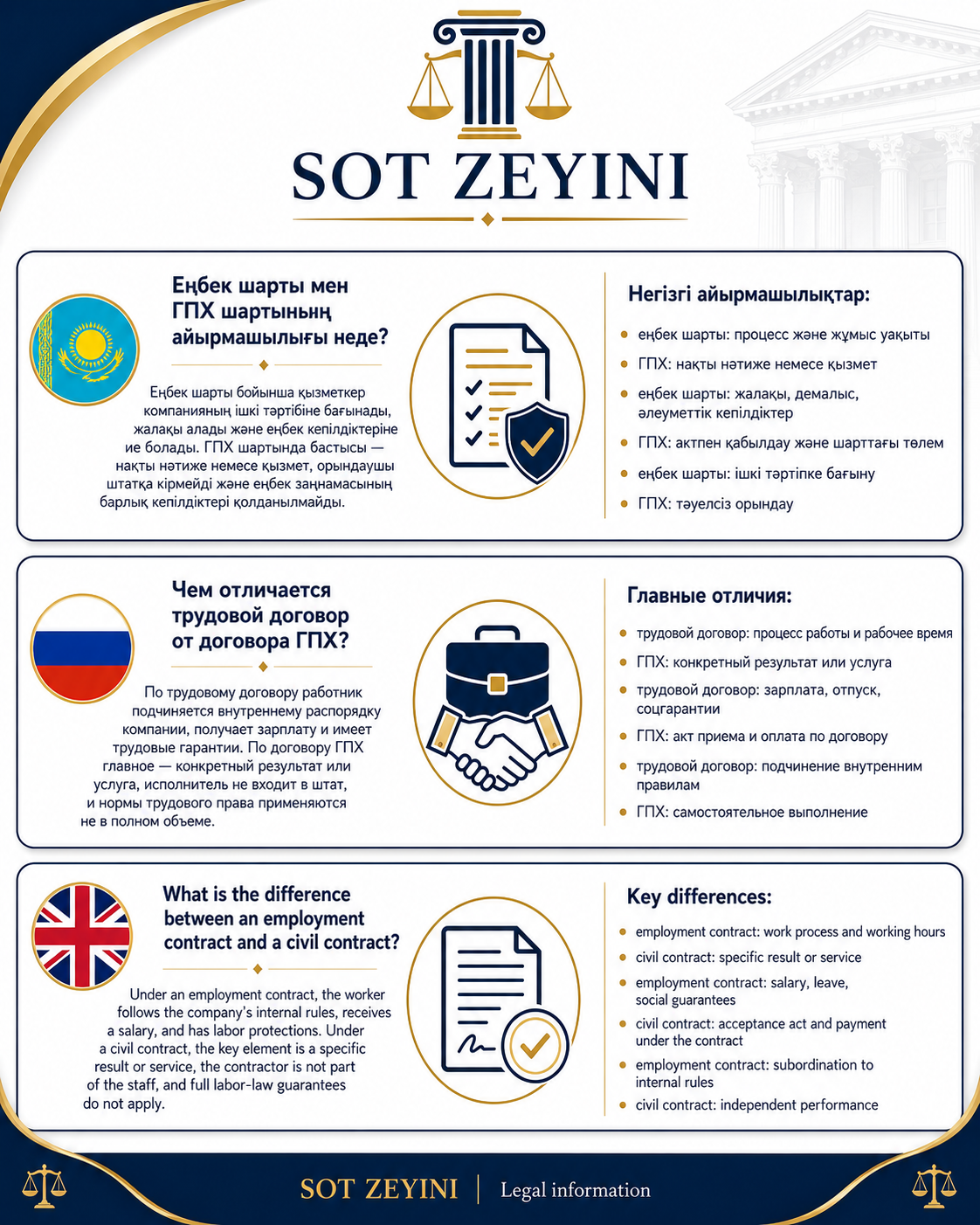
An employment contract is an agreement between an employer and an employee. Under this contract, the person holds a specific position, performs a labor function, follows internal workplace rules, and receives a salary.
A civil law contract is an agreement under which a contractor performs a specific task or provides a specific service. The parties are not called “employer” and “employee,” but “customer” and “contractor” or “client” and “service provider.”
In simple terms, an employment contract means the person becomes part of the company’s team. A civil law contract means the person performs a specific task and delivers a result.
Main signs of an employment contract
An employment contract usually has the following features:
- the person holds a specific position;
- the person performs a labor function;
- the employee follows internal workplace rules;
- working hours are established;
- the employee receives a salary;
- the work is performed personally;
- the employee has the right to paid annual leave;
- the employer makes mandatory payments and contributions;
- labor law guarantees apply to the employee.
For example, a manager, lawyer, accountant, operator, administrator, or salesperson who works daily according to a schedule and reports to a supervisor is usually an employee, not an independent contractor.
Main signs of a civil law contract
The main feature of a civil law contract is that the result matters more than the work process.
A civil law contract usually has the following features:
- the contractor performs a specific task;
- the parties are a customer and a contractor;
- the contractor does not follow internal workplace rules;
- fixed working hours are usually not established;
- there is no official job position;
- payment is made for the result or service;
- work is accepted through an acceptance act;
- the contractor may use their own tools and organize work independently;
- the relationship is governed by civil law.
For example, a designer creates a logo, a developer builds a website module, a photographer covers one event, or a lawyer prepares one document. These may be civil law contract situations.
The key difference between employment and civil law contracts
The main difference is the nature of the relationship.
Under an employment contract, the employer organizes the work process: schedule, workplace, internal rules, job duties, and subordination. The employee becomes part of the company’s structure.
Under a civil law contract, the customer expects a specific result. The contractor usually decides how to organize the work. The key point is that the service or work must be completed.
Comparison table
| Feature | Employment contract | Civil law contract |
|---|---|---|
| Parties | Employer and employee | Customer and contractor |
| Purpose | Performance of a labor function | Performance of a specific task or service |
| Working hours | Established | Usually not established |
| Internal rules | Employee follows them | Contractor does not follow them |
| Payment | Salary | Service or work fee |
| Paid leave | Provided | Not provided as labor leave |
| Position | Specified | Usually not specified |
| Main focus | Work process | Specific result |
| Legal regulation | Labor law | Civil law |
| Guarantees | Broader labor guarantees | Limited by contract and law |
When should an employment contract be used?
An employment contract should be used when the person actually works as a regular employee.
This may be the case if:
- the person works permanently;
- the person has a position;
- working hours are set;
- the person reports to a manager;
- payment is made monthly;
- the work is performed personally;
- the person works for the company on an ongoing basis;
- the person follows company rules.
For example, if a sales manager answers clients every day, works on a fixed schedule, receives fixed payment, and reports to management, this looks like an employment relationship. Using a civil law contract in such a case may be risky.
When is a civil law contract suitable?
A civil law contract is suitable for one-time, project-based, or clearly measurable tasks.
It may be used for:
- website development;
- document preparation;
- consulting;
- design work;
- repair services;
- translation;
- photo or video shooting;
- advertising setup;
- completion of a specific project;
- provision of a specific service.
For example, if a company orders one website, one contract draft, one advertising design, or one consultation from an external specialist, a civil law contract may be appropriate.
Can an employment contract be replaced by a civil law contract?
No, not if the actual relationship is employment. The title of the contract is not decisive. If a civil law contract contains signs of employment, the relationship may be recognized as employment.
There may be risk if the contract or actual practice includes:
- a job position;
- fixed working hours;
- subordination to a manager;
- ongoing duties;
- fixed monthly payment;
- obligation to follow internal company rules;
- daily reporting;
- work performed as a regular staff member.
Simply naming a document “civil law contract” is not enough. If the actual relationship is employment, a court or labor authority may assess it differently.
What risks does the employer have?
If an employer uses a civil law contract for someone who is actually an employee, several risks may arise:
- the contract may be recognized as an employment contract;
- the worker may complain to the labor authority;
- the worker may file a court claim;
- paid leave may be claimed;
- salary-related claims may arise;
- social and pension payment obligations may appear;
- administrative consequences may follow;
- the company may face reputational risks.
A civil law contract should not be used only to avoid paid leave, formal employment, or mandatory payments. That kind of “saving” can later become an expensive dispute.
What is the difference for the worker?
Under an employment contract, the employee has broader guarantees. These include salary, paid annual leave, limits on working hours, safe working conditions, social guarantees, and labor law protection.
Under a civil law contract, the contractor receives payment for a specific result or service. The contractor does not automatically receive all guarantees available to employees.
Therefore, if a person actually works like an employee but is formally engaged under a civil law contract, they may protect their rights through labor authorities or court.
What should be included in a civil law contract?
A civil law contract should describe the specific service or work, not a job position.
It may include:
- details of the parties;
- subject of the contract;
- specific result;
- deadlines;
- service fee;
- payment procedure;
- acceptance procedure;
- acceptance act;
- liability of the parties;
- confidentiality;
- rights to the work result;
- termination procedure.
For example, it is better to write “the contractor shall prepare a draft agreement” rather than “the contractor works as a lawyer.”
What is included in an employment contract?
An employment contract usually includes:
- details of the employer and employee;
- job position;
- labor function;
- workplace;
- start date;
- contract term;
- working time regime;
- salary amount;
- working conditions;
- rights and obligations of the parties;
- grounds for termination.
After signing an employment contract, the employer must formalize the employee according to the required procedure.
Which contract should be chosen?
The choice should be based on the actual relationship, not the contract title.
If the person works permanently, holds a position, follows company rules, and receives salary, an employment contract is required.
If the person performs a specific task or provides a one-time service and delivers a result, a civil law contract may be used.
The main rule is simple: employment relationships should not be disguised as civil law contracts.
Conclusion
An employment contract and a civil law contract serve different purposes. An employment contract formalizes regular employee work, while a civil law contract is used for a specific task or service.
If a person works like a staff employee, an employment contract should be used. If the person performs a separate task as an independent contractor, a civil law contract may be appropriate.
For businesses, choosing the correct format is important. A mistake may lead to labor disputes, additional payments, penalties, and court claims.
FAQ
What is the main difference between an employment contract and a civil law contract?
An employment contract regulates regular work performed by an employee. A civil law contract regulates a specific task or service.
Can a regular employee be hired under a civil law contract?
If the person actually works as an employee, using a civil law contract is risky. The relationship may be recognized as employment.
Is paid leave provided under a civil law contract?
No, paid annual labor leave is not provided under a civil law contract unless the contract specifically provides otherwise.
Who pays taxes and contributions under a civil law contract?
The procedure depends on the contractor’s status and the contract terms. If the contractor is an individual, the customer may have tax agent obligations.
Can a civil law contract be recognized as an employment contract?
Yes. If it contains signs of employment, such as a job position, schedule, subordination, regular work, and fixed payment, it may be recognized as employment.
When is a civil law contract appropriate?
It is appropriate for one-time services, project work, consulting, website development, design, translation, repair, or preparation of a specific document.
Which contract is safer for an employer?
If the person works like a staff employee, an employment contract is safer. If the employer needs a specific result from an external contractor, a civil law contract may be used.