 +7 775 858 9294
 WhatsApp
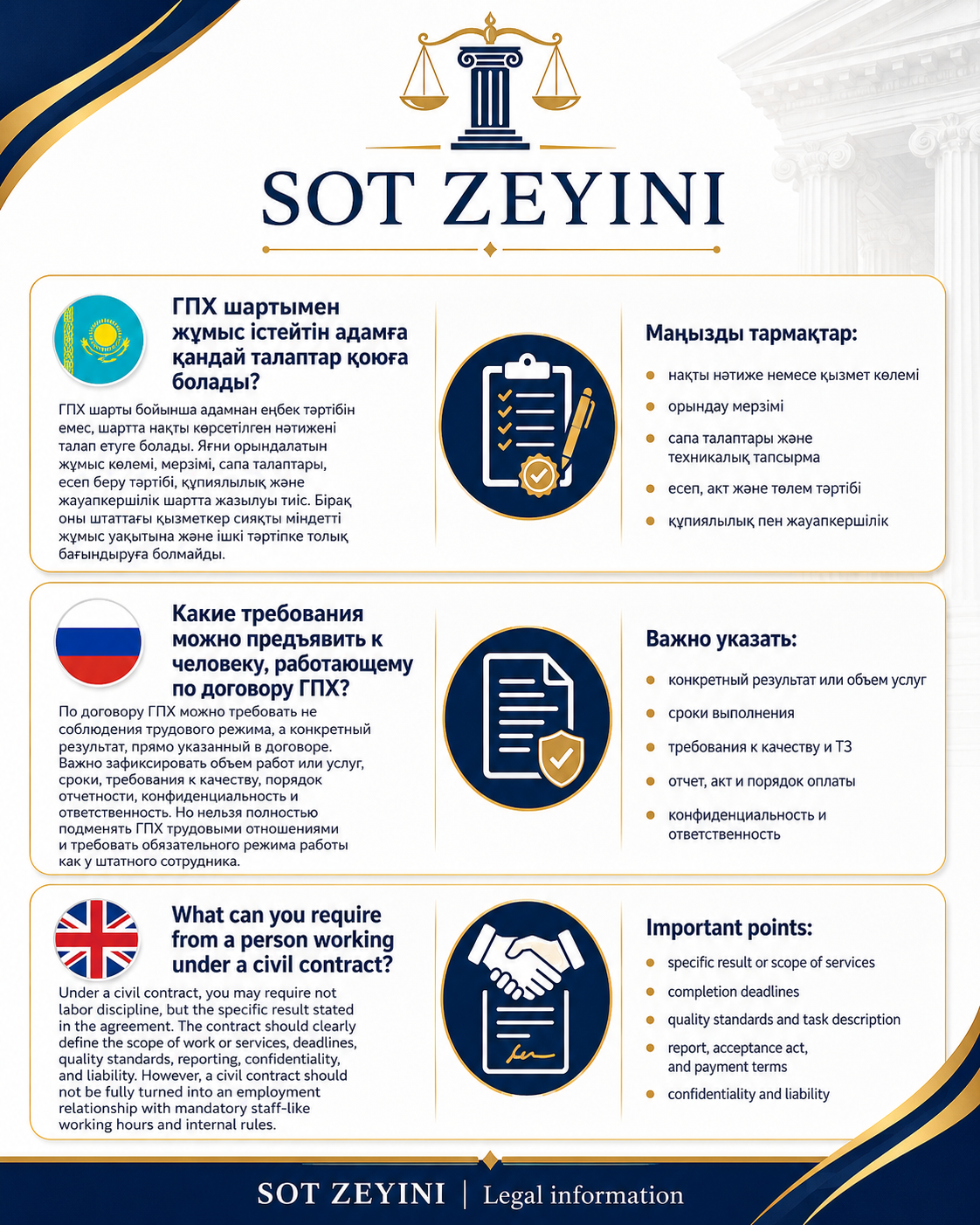
What Claims Can Be Made Against a Person Working Under a Civil Law Contract?
What is a civil law contract?
A civil law contract is an agreement under which a contractor performs specific work or provides a service, while the customer accepts the result and pays for it.
Unlike an employment contract, a person working under a civil law contract is usually not a staff employee. The contractor does not hold a company position, does not follow internal labor rules, and does not receive a salary as an employee. The key element of a civil law contract is a specific result.
In simple terms, the issue is not whether the person “came to work every day,” but whether they delivered the agreed result: a document, website, design, consultation, repair work, report, or another service.
What claims can be made against a contractor?
If the contractor violates the agreement, the customer may bring civil law claims. The exact claims depend on the contract terms, the work performed, the payment made, and the consequences of the violation.
1. Claim for performance of work or services
If the contractor fails to perform the work within the agreed period, the customer may demand performance of the obligation.
For example, the customer may demand that the contractor:
- complete website development;
- prepare a document;
- deliver design materials;
- finish repair work;
- provide a report;
- provide consulting services;
- transfer the agreed work result.
This claim is especially relevant when the contractor has received payment or an advance but has not delivered the result.
2. Claim to correct defects
If the work was completed but has defects, the customer may demand that the contractor correct them.
For example:
- the website does not function properly;
- the document contains serious errors;
- the design does not match the technical assignment;
- repair work was done poorly;
- the service was not provided in full;
- the result cannot be used for its intended purpose.
The written claim should clearly describe the defects and set a deadline for correction.
3. Claim for refund
If the contractor did not perform the work, refused to perform it, or delivered a result that cannot be used, the customer may demand a full or partial refund.
A refund may be claimed if:
- the work was not performed;
- the contractor took an advance and disappeared;
- the deadline was seriously violated;
- the result does not match the contract;
- the contractor refuses to correct defects;
- the service was not actually provided.
It is important to keep proof of payment, such as bank transfers, receipts, Kaspi checks, or written acknowledgments.
4. Claim for damages
If the customer suffered losses because of the contractor’s actions, damages may be claimed.
For example:
- the customer lost a client because of the delay;
- another specialist had to be hired to redo the work;
- an incorrect document led to a refusal by a court or authority;
- poor-quality work damaged property;
- the contractor disclosed confidential information;
- the customer incurred additional expenses to fix the result.
To recover damages, the customer must prove the amount of loss and the connection between the contractor’s breach and the damage suffered.
5. Claim for penalty or late payment interest
If the civil law contract provides for a penalty, fine, or late payment interest, the customer may demand payment.
For example, the contract may state that “for each day of delay, the contractor pays a penalty of 0.1% of the contract amount.”
If the contractor misses the deadline, the customer may calculate the penalty and include it in a written claim or court claim.
A penalty should be expressly stated in the contract. If there is no penalty clause, the customer may still claim damages, but claiming a contractual penalty will be more difficult.
6. Termination of the contract
If the contractor materially violates the contract, the customer may demand termination.
Together with termination, the customer may also claim:
- refund of the advance;
- refund for unperformed work;
- damages;
- penalty or interest;
- return of documents and materials;
- termination of access to databases and accounts.
Before termination, it is advisable to send a written notice or claim to the contractor.
7. Return of documents, materials, and access
If the customer provided documents, logins, passwords, client databases, equipment, or other materials to the contractor, the customer may demand their return after the contract ends.
This may include:
- company documents;
- website access;
- CRM access;
- client database;
- social media accounts;
- source design files;
- photo and video materials;
- equipment or other property.
To avoid disputes, the return procedure should be clearly stated in the contract.
8. Confidentiality obligations
If the contractor had access to trade secrets, client databases, internal documents, or the business model, the customer may require confidentiality.
The contract should state that the contractor may not:
- transfer client databases to third parties;
- use the customer’s data for personal purposes;
- disclose commercial information;
- copy internal materials;
- share logins and passwords;
- poach clients if such restriction is included in the contract.
If confidentiality is breached, the customer may claim damages and a contractual penalty if the contract provides for it.
9. Transfer of rights to the work result
If the contractor created a website, text, logo, design, software, video, photo, or another intellectual result, the contract should specify who owns the rights.
The customer may demand that the contractor:
- deliver the final result;
- provide source files;
- transfer usage rights;
- not sell the same result to others;
- not use the customer’s materials without consent;
- sign an acceptance certificate.
These provisions are especially important in contracts with designers, developers, marketers, copywriters, photographers, and videographers.
10. Filing a court claim
If the contractor ignores the claim, refuses to refund money, or does not correct the violation, the customer may file a court claim.
Through court, the customer may demand:
- refund of money;
- termination of the contract;
- compensation for damages;
- payment of a penalty;
- return of documents;
- forced performance of obligations;
- recognition that the work was defective.
Before filing a claim, the customer should collect all evidence of the breach.
What evidence is needed?
The following evidence may be useful:
- civil law contract;
- technical assignment;
- payment documents;
- bank transfers;
- Kaspi checks;
- WhatsApp, Telegram, or email correspondence;
- acceptance certificates;
- work result;
- photos or videos of defects;
- expert or specialist opinion;
- calculation of damages;
- written claim and response.
The stronger the evidence, the stronger the customer’s position.
What cannot be demanded from a civil law contractor?
A contractor under a civil law contract should not be treated like a regular employee unless the actual relationship is employment.
Usually, the customer should not require the contractor to:
- be present in the office every day;
- follow internal labor rules;
- work in a staff position;
- follow an employee-style schedule;
- receive “salary” instead of payment for results;
- perform ongoing labor functions;
- report like a staff employee.
If the customer actually requires employee-type behavior, the relationship may be recognized as employment. This creates legal risks for the company.
Conclusion
A person working under a civil law contract may be subject to claims based on the contract and civil law. The main claims include performance of work, correction of defects, refund, damages, penalty, return of documents, confidentiality, and transfer of the work result.
To protect itself, the customer should draft the contract properly: specify the result, deadlines, payment, acceptance procedure, liability, penalties, confidentiality, rights to the result, and return of materials.
A civil law contract is not just a “simple paper.” If it is poorly drafted, the customer may later have to prove everything through screenshots and chat messages.
FAQ
What should I do if the contractor does not perform the work?
Send a written claim first. If the contractor does not respond, you may claim a refund, damages, penalty, or file a court claim.
Can an advance payment be refunded?
Yes. If the work was not performed or the contractor breached the contract, the customer may claim full or partial refund of the advance.
Can a penalty be claimed from the contractor?
Yes, if the penalty, fine, or late payment interest is provided in the contract.
What if the work is poor quality?
The customer may demand correction of defects, price reduction, re-performance, refund, or damages.
Can the contractor be required to follow a work schedule?
Usually no. Under a civil law contract, the contractor is responsible for the result, not for following an employee-style schedule. A schedule, position, and subordination may indicate employment relations.
What documents are needed for court?
The contract, technical assignment, payment documents, correspondence, acceptance acts, evidence of defects, calculation of damages, and written claim may be needed.
Can the contractor be prohibited from using the client database?
Yes, but this restriction should be expressly included in the contract, along with liability for breach of confidentiality.