 +7 775 858 9294
 WhatsApp
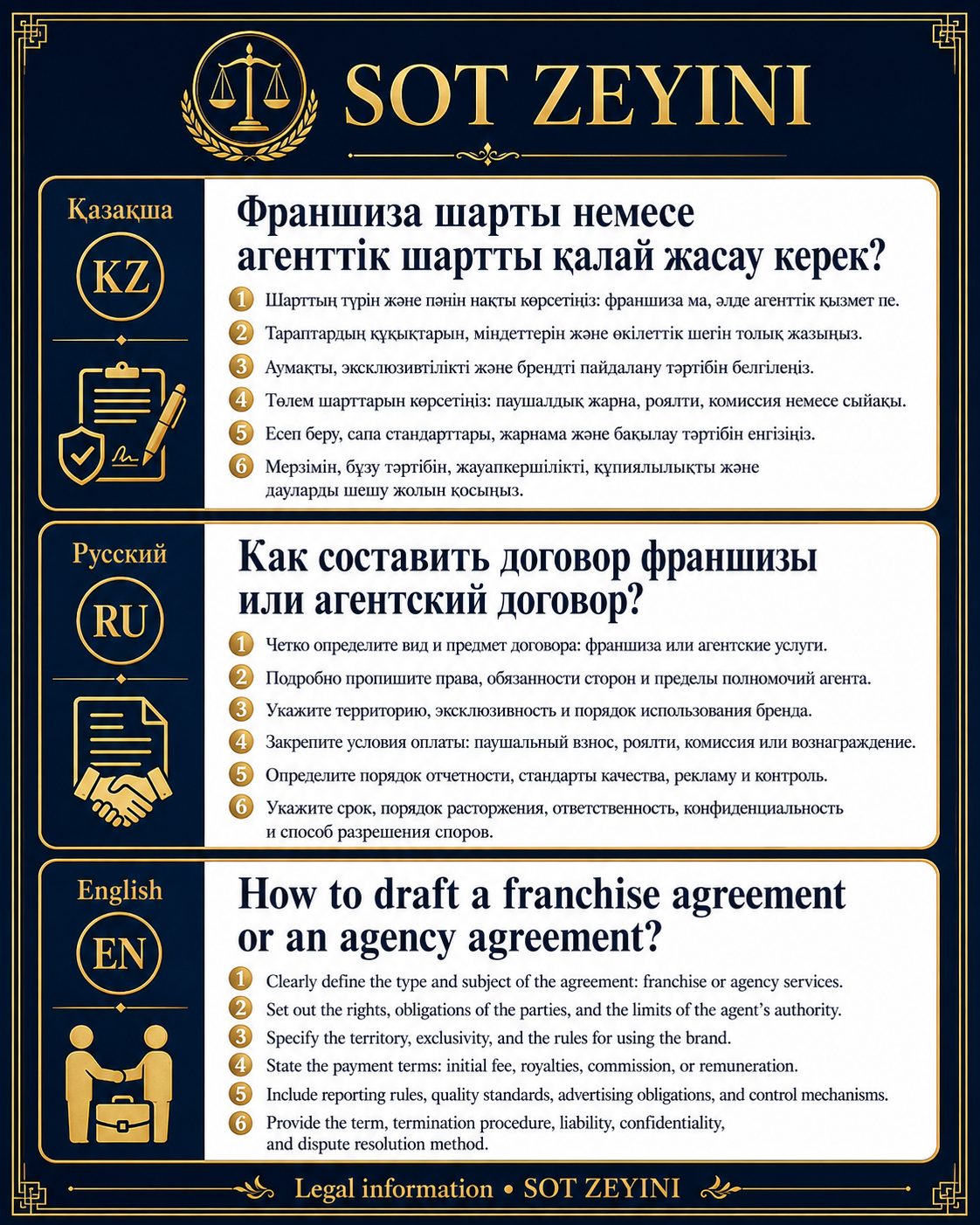
How to Draft a Franchise Agreement or Agency Agreement?
What Is a Franchise Agreement and an Agency Agreement?
A franchise agreement and an agency agreement are two different legal models for business cooperation. They may look similar in practice, but they have different purposes, risks, and legal consequences.
A franchise agreement allows one party to use another party’s brand, business model, standards, technology, know-how, and commercial system.
An agency agreement is usually used when one party finds clients, promotes goods or services, helps conclude deals, and receives commission for that work.
In simple terms, a franchise means using a ready-made business system. An agency agreement means attracting clients or sales for a commission.
What Is the Difference Between a Franchise and an Agency Agreement?
The key difference is the purpose of cooperation.
In a franchise model:
- the right to use the brand is granted;
- business standards must be followed;
- the franchisor controls quality;
- an initial fee may be paid;
- royalties may be charged;
- the franchisee works under the franchisor’s brand;
- training and support may be provided.
In an agency model:
- the agent finds clients;
- the agent earns commission;
- the agent may act on behalf of the company or in its interests;
- the full business model is not transferred;
- brand use may be limited;
- the agent does not own the business.
If a partner receives the brand, logo, standards, training, and business model, the relationship is closer to franchising. If the partner only brings clients or helps sell, it is closer to an agency agreement.
What Should Be Included in a Franchise Agreement?
A franchise agreement should clearly describe what rights are granted and how they may be used.
The agreement should include:
- details of the franchisor and franchisee;
- right to use the brand;
- trademark, logo, website, design;
- business standards;
- business model;
- territory;
- term of the agreement;
- initial franchise fee;
- royalties;
- training;
- support;
- quality control;
- advertising and marketing;
- client database;
- confidentiality;
- liability;
- termination procedure.
A franchise agreement should not simply say “you may use our name.” It should regulate the entire business cooperation system.
What Should Be Included in an Agency Agreement?
An agency agreement should clearly state what the agent must do.
For example, the agent may:
- find clients;
- receive applications;
- negotiate;
- sell goods;
- promote services;
- help conclude deals;
- collect orders;
- act on behalf of the company;
- act in their own name but in the company’s interests.
The agreement should specify:
- agent’s authority;
- territory;
- commission amount;
- when commission is paid;
- who owns the client;
- whether the agent may sign contracts;
- whether the agent may accept payments;
- reporting procedure;
- advertising rules;
- liability;
- termination procedure.
The main risk of an agency model is that the agent may find clients and then try to work with them directly. This is why the client database and non-solicitation clauses must be clearly drafted.
Should the Brand Be Registered Before Franchising?
Yes, this is highly recommended. The franchisor should protect the brand, logo, name, trademark, and other intellectual property before granting franchise rights.
If the brand is not protected, franchising becomes risky. A partner may start using the brand independently, register a similar name, or create a competing project.
Before launching a franchise, it is advisable to:
- check the trademark;
- register the brand;
- protect the logo;
- register the domain in the company’s name;
- control social media accounts;
- prepare a brand book;
- introduce trade secret protection.
How to Set Payment Terms
A franchise agreement may include several types of payments:
- initial franchise fee;
- monthly royalty;
- marketing fee;
- training fee;
- equipment fee;
- software fee;
- percentage of turnover or profit.
An agency agreement usually includes commission:
- percentage of the deal;
- fixed amount per client;
- percentage of actual payment;
- monthly agency fee;
- bonus for meeting targets.
Example:
“The agent’s commission is 10% of the amount actually paid by the client.”
It is safer to link commission to actual payment by the client, not merely to the transfer of a contact.
Territory and Exclusivity
The agreement should define the territory.
For example:
- Almaty;
- Astana;
- Shymkent;
- a specific district;
- the entire country;
- online sales;
- a specific sales channel.
If exclusivity is granted, the agreement should specify:
- the territory of exclusivity;
- the products or services covered;
- the period of exclusivity;
- whether exclusivity remains if sales targets are not met;
- whether the company may sell directly in that territory.
If exclusivity is unclear, disputes over “my city, my client, my territory” are very likely.
Who Owns the Client Database?
The client database is often one of the most valuable business assets. The agreement should clearly state who owns:
- leads;
- client contacts;
- CRM data;
- negotiation history;
- WhatsApp correspondence;
- repeat customer database;
- sales data;
- advertising leads.
Example:
“The client database, applications, negotiation history, CRM data, and client information are the company’s trade secret.”
Without this clause, the partner may leave with the clients.
Quality Standards
A franchise agreement must include quality standards. One bad franchisee can damage the reputation of the entire brand.
Standards may include:
- client service rules;
- communication scripts;
- premises requirements;
- employee appearance;
- pricing policy;
- document templates;
- advertising materials;
- complaint handling procedure;
- staff training.
Quality standards are also important in agency agreements. The agent may communicate with clients on behalf of the company, so they must not give false promises, distort terms, or damage the company’s reputation.
Confidentiality and Trade Secrets
The agreement should include a confidentiality section.
The following information should be protected:
- client database;
- prices;
- business model;
- marketing strategy;
- contracts;
- training materials;
- scripts;
- suppliers;
- financial indicators;
- CRM and WhatsApp data.
The agreement should prohibit copying, disclosure to third parties, and use of this information in a competing business.
Non-Competition and Non-Solicitation
The agreement may prohibit the partner from:
- opening a competing business during the agreement term;
- using the client database;
- soliciting clients;
- hiring away employees;
- copying the business model;
- using advertising materials after termination.
These restrictions should be specific and reasonable. Overly broad restrictions may be difficult to enforce, so they should be drafted carefully.
Advertising and Marketing
The agreement should define who is responsible for advertising.
It should specify:
- who pays for advertising;
- who approves advertising materials;
- whether the brand may be used in ads;
- what wording is prohibited;
- who manages social media;
- where leads go;
- how leads are distributed;
- who is responsible for reviews and reputation.
The agent or franchisee should not run misleading ads or promise something the company cannot deliver.
Reporting
The agreement should establish reporting rules.
Reports may include:
- number of clients;
- number of applications;
- concluded deals;
- payments received;
- refunds;
- complaints;
- advertising expenses;
- sales plan performance.
Reporting may be:
- daily;
- weekly;
- monthly;
- quarterly.
The format should also be specified: Excel, PDF, CRM report, accounting report, or another method.
Liability of the Parties
The agreement should include liability for violations.
For example:
- illegal use of the brand;
- copying the client database;
- non-payment of royalties;
- non-payment of commission;
- false information to clients;
- violation of quality standards;
- disclosure of trade secrets;
- opening a competing business;
- refusal to provide reports;
- signing contracts without authority.
Possible consequences include penalties, compensation of losses, termination of the agreement, termination of brand rights, and court action.
Termination of the Agreement
The agreement must include a termination procedure.
It should specify:
- grounds for termination;
- notice period;
- termination of brand use rights;
- return of materials;
- closure of CRM access;
- return of documents;
- termination of advertising;
- ownership of the client database;
- calculation of royalties or commission;
- confidentiality obligations after termination.
After the agreement ends, the partner should not continue using the brand, logo, website, advertising materials, or client database.
Common Mistakes in Franchise and Agency Agreements
The most common mistakes are:
- Confusing franchise and agency models
- Granting brand rights without registration
- Failing to protect the client database
- Not defining royalties or commission
- Not specifying territory
- Drafting exclusivity too vaguely
- Not approving quality standards
- Not including confidentiality
- Not prohibiting client solicitation
- Not describing termination rules
These mistakes may lead to loss of clients, brand value, money, and business control.
Conclusion
Before signing an agreement, it is important to choose the correct legal model. If the partner receives the brand, standards, and business model, it is closer to a franchise. If the partner only attracts clients or helps sell, it is closer to an agency agreement.
The agreement should clearly cover brand rights, territory, payment, commission, royalties, client database, quality standards, confidentiality, liability, and termination.
A well-drafted agreement protects the business. A poorly drafted one may allow the partner to take clients, copy the model, and use the brand against you.
FAQ
What is the difference between a franchise and an agency agreement?
A franchise grants the right to use a brand and business model. An agency agreement is used to attract clients or sales for commission.
Should a brand be registered before franchising?
Yes. It is advisable to register the trademark, logo, and protect the brand before granting franchise rights.
When should commission be paid to an agent?
It is safer to pay commission after the client actually makes payment, not simply after a contact is provided.
Can an agent be prohibited from taking clients?
Yes. The agreement should include ownership of the client database, confidentiality, and non-solicitation clauses.
Can a partner receive an exclusive territory?
Yes, but the territory, term, sales targets, and loss of exclusivity conditions should be clearly stated.
What happens after termination?
The partner should stop using the brand, return materials, close CRM access, and stop using the client database.
Is a lawyer needed for this type of agreement?
Yes. Franchise and agency agreements involve brand rights, clients, money, commission, and trade secrets.