 +7 775 858 9294
 WhatsApp
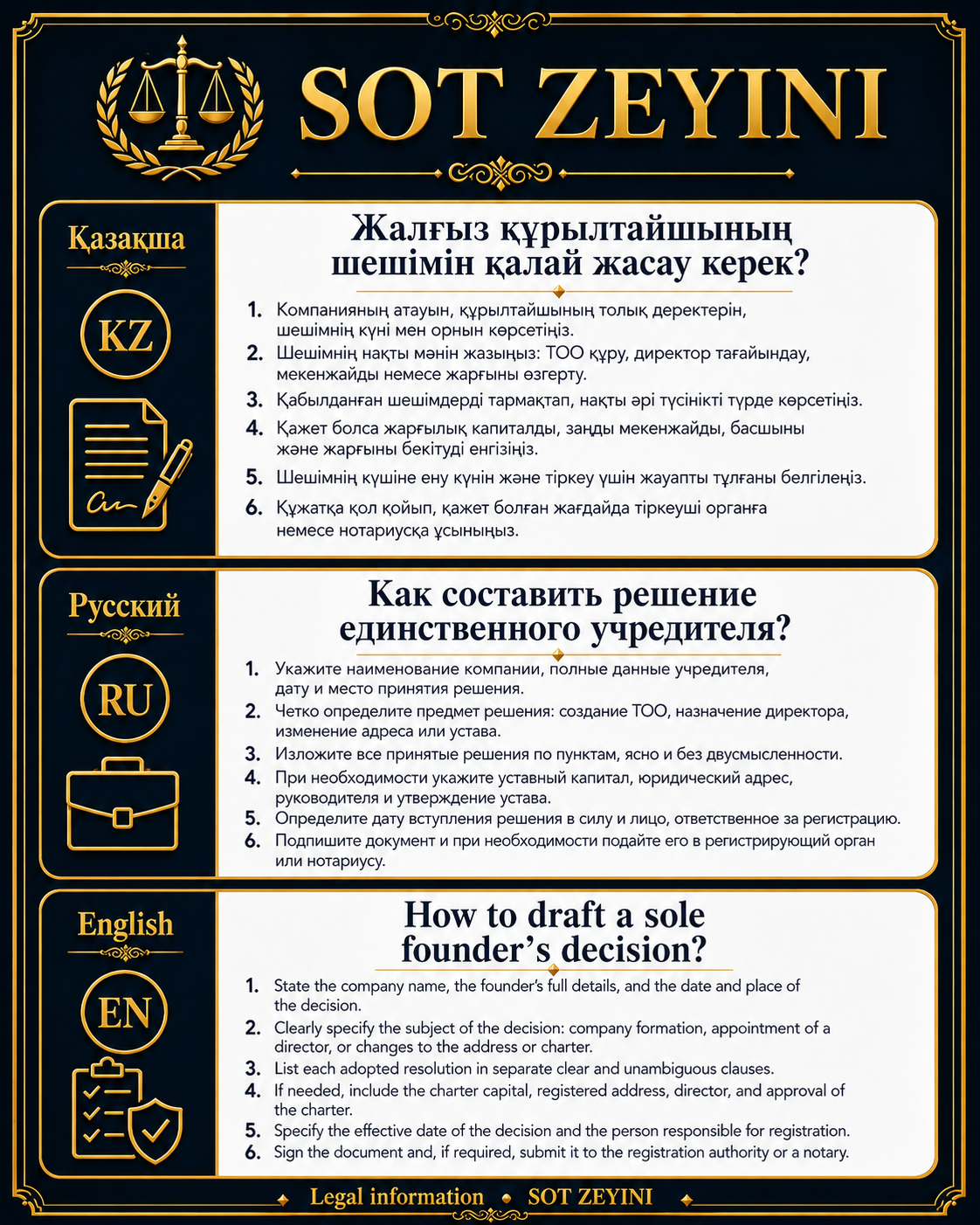
How to Draft a Founder’s Decision
What is a founder’s decision?
A founder’s decision is a document by which a sole founder decides to establish an LLP. If the LLP has only one participant, it is created based on that participant’s sole decision. In this case, a foundation agreement is not prepared.
In simple terms, the founder’s decision officially states: “I establish this LLP, approve its name, appoint the director, approve the charter, and define the main company details.”
This document may be needed for LLP registration, appointment of the director, approval of the charter, determination of the legal address, and setting of charter capital.
When is a founder’s decision needed?
A founder’s decision may be required:
- when establishing an LLP;
- when approving the company name;
- when appointing the director;
- when approving the charter;
- when determining the legal address;
- when setting charter capital;
- when changing the director;
- when changing the legal address;
- when amending the charter;
- when reorganizing or liquidating the LLP.
If the LLP has one participant, many corporate decisions are formalized through the decision of the sole participant.
Is minutes of meeting needed if there is one founder?
No. If the LLP is established by one person, there is no need for meeting minutes. Instead, the sole founder prepares a decision.
Minutes are used when there are two or more founders and a meeting takes place.
The rule is simple:
- one founder — decision;
- two or more founders — minutes of meeting.
What should be included in a founder’s decision?
A decision to establish an LLP usually includes:
- Title of the document.
- Number and date of the decision.
- Founder’s details.
- Decision to establish the LLP.
- Full name of the LLP.
- Short name, if needed.
- Legal address.
- Amount of charter capital.
- Sole participant’s share.
- Approval of the charter.
- Appointment of the director.
- Main business activity.
- Authorization to complete registration actions.
- Founder’s signature.
The document should be clear, concise, and formal.
What founder details should be included?
If the founder is an individual, the decision usually includes:
- full name;
- individual identification number;
- identity document number;
- issuing authority and date;
- registered address;
- contact details, if needed.
If the founder is a legal entity, the decision may include:
- full legal name;
- business identification number;
- legal address;
- registration details;
- representative’s details;
- document confirming the representative’s authority.
How should the LLP name be stated?
The full name of the LLP should be stated clearly. For example:
Limited Liability Partnership “ABC SERVICE”.
A short name may also be included:
LLP “ABC SERVICE”.
If the company will use names in Kazakh and Russian, both versions may be included. The name should not be misleading or identical to an already registered company.
How should the legal address be stated?
The decision should state the location of the LLP. For example:
Republic of Kazakhstan, Almaty city, Bostandyk district, Abay Avenue, building 10.
The legal address should be real and accessible. Official letters, tax notices, and other documents may be sent to this address.
How should charter capital be stated?
The decision should state the amount of charter capital and the sole participant’s share.
For example:
“To set the charter capital of the Partnership at 100,000 tenge. The sole participant’s share in the charter capital shall be 100%.”
Charter capital may be contributed in money or property. If there are several participants, their shares are distributed between them, but in that case meeting minutes are prepared instead of a sole founder’s decision.
How is the director appointed?
An LLP needs a director for registration and operation. The decision should state the director’s full name, identification number, and appointment date.
For example:
“To appoint Ivan Ivanov, IIN ____________, as Director of the Partnership.”
If the founder will also act as the director, this can be stated in the decision. The term of office may also be specified if needed.
How is the charter approved?
The decision should include a separate clause approving the charter.
For example:
“To approve the Charter of the Partnership.”
If the LLP operates under a model charter, this can also be stated. However, if the company has several participants, special management rules, or a specific business structure, an individual charter is usually preferable.
Should the business activity be included?
Yes, the decision may state the main business activity of the LLP. For example:
- legal services;
- trade;
- construction;
- education;
- consulting;
- IT services;
- manufacturing;
- marketing;
- real estate services.
If the activity is licensed, license requirements should be checked in advance.
Standard structure of a founder’s decision
A typical structure may be:
- “Decision of the sole founder”.
- Number, city, and date.
- Founder’s details.
- Wording: “I have decided”.
- Establish the LLP.
- Approve the name.
- Determine the legal address.
- Set charter capital.
- Approve the charter.
- Appoint the director.
- Authorize registration actions.
- Signature.
Short sample of a founder’s decision
DECISION OF THE SOLE FOUNDER No. 1
Almaty city
“___” __________ 2026
I, ____________________________, IIN ________________, identity document No. ______________, issued by ____________________, acting in accordance with the legislation of the Republic of Kazakhstan, have made the following decision:
- To establish Limited Liability Partnership “________________________”.
- To approve the full name: Limited Liability Partnership “________________________”.
- To approve the short name: LLP “________________________”.
- To determine the location of the Partnership: Republic of Kazakhstan, ____________________________.
- To set the charter capital of the Partnership at __________ tenge.
- To determine the sole participant’s share in the charter capital of the Partnership as 100%.
- To approve the Charter of the Partnership.
- To appoint ____________________________, IIN ________________, as Director of the Partnership.
- To authorize the Director to perform all necessary actions related to the state registration of the Partnership.
- This decision enters into force on the date of signing.
Sole founder: __________________ /signature/
This is a general sample and should be adapted to the specific situation.
Common mistakes in a founder’s decision
Common mistakes include:
- incorrect LLP name;
- missing legal address;
- missing charter capital;
- no clause approving the charter;
- no director appointment clause;
- incorrect founder details;
- no date;
- no signature;
- preparing a decision instead of meeting minutes when there are several founders;
- unclear director powers.
Such mistakes may create problems during registration, bank account opening, or later corporate changes.
Does the decision need notarization?
Not always. In many cases, the decision of the sole founder is signed by the founder. However, in some situations notarization or additional documents may be required.
For example:
- the founder acts through a representative;
- there is a foreign founder;
- the founder is a foreign legal entity;
- a bank or authority requests additional confirmation;
- transactions with participation shares are involved.
It is advisable to check requirements for the specific case before submitting documents.
Difference between a decision and minutes
A decision is used when there is one participant. Minutes are used when there are several participants.
In a decision, one person makes a corporate decision individually. In minutes, the discussion and voting of several participants are recorded.
If an LLP has two or more founders, a sole decision cannot replace meeting minutes.
Conclusion
A founder’s decision is one of the key documents for establishing an LLP with one participant. It should state the establishment of the LLP, company name, legal address, charter capital, charter approval, director appointment, and registration authorization.
If there is one founder, a foundation agreement is not prepared. If there are several founders, meeting minutes and a foundation agreement are used.
A properly drafted founder’s decision helps register the LLP smoothly and avoid corporate mistakes at the start.
FAQ
What is a founder’s decision?
It is a document by which the sole founder decides to establish an LLP and approves its main details.
Are meeting minutes needed if there is one founder?
No. If there is one founder, a sole founder’s decision is prepared.
What if there are several founders?
If there are two or more founders, minutes of the founders’ meeting are prepared.
What should the decision include?
LLP name, legal address, charter capital, participant’s share, charter approval, director appointment, and registration actions.
Is a foundation agreement required for one founder?
No. A foundation agreement is not prepared when there is only one founder.
Can the founder appoint themselves as director?
Yes, the sole founder may appoint themselves as director of the LLP.
Does the decision need notarization?
Usually not, but notarization or additional documents may be required in special cases, such as foreign founders or representatives.