 +7 775 858 9294
 WhatsApp
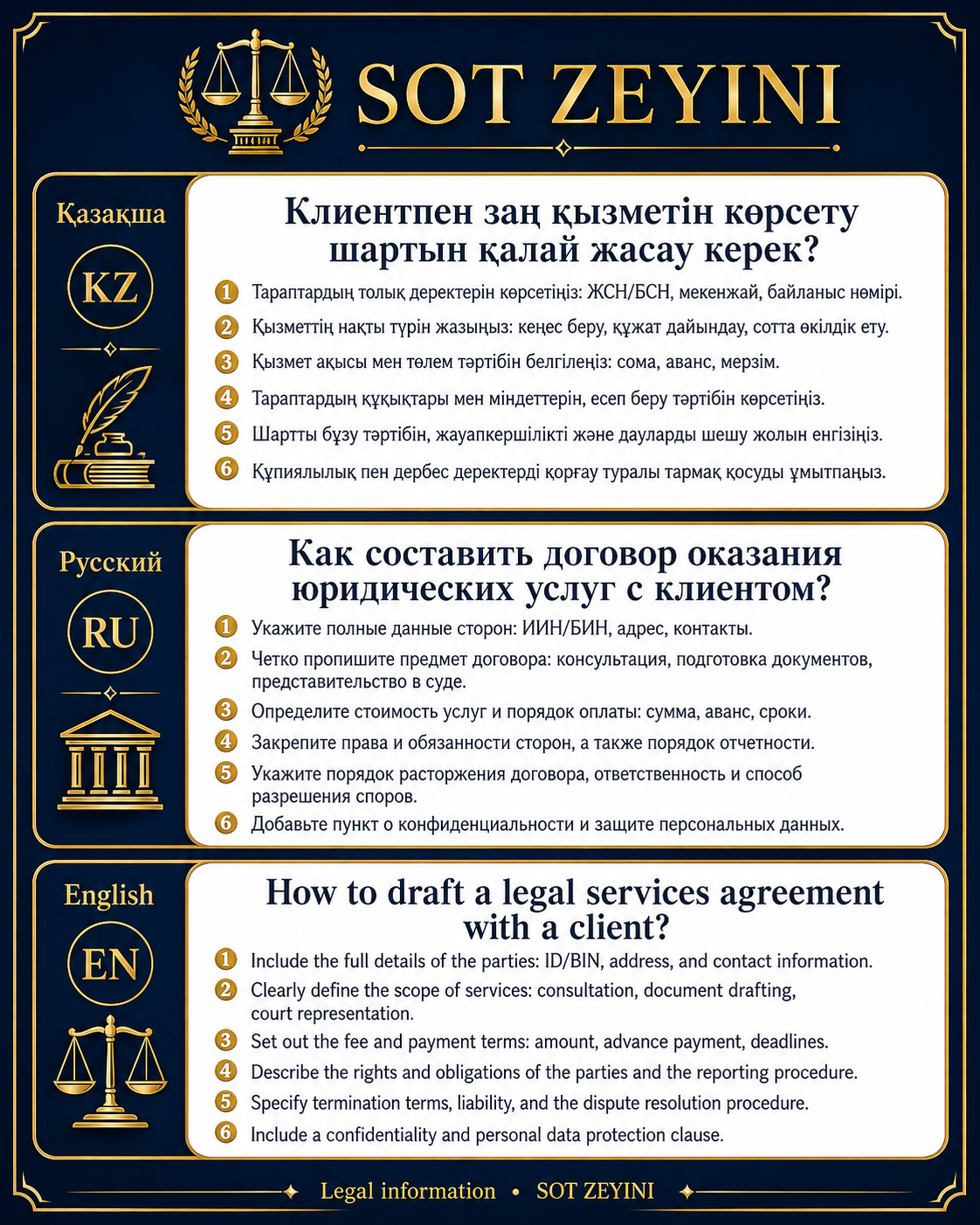
How to Draft a Legal Services Agreement With a Client
Why Do You Need a Legal Services Agreement?
A legal services agreement is the main document between a lawyer and a client. It defines what services will be provided, how much the client will pay, what documents are required, and what responsibilities each party has.
Without a written agreement, disputes may arise:
- the client may believe the lawyer guaranteed a win;
- the lawyer may believe the agreement covered only document preparation;
- the parties may disagree about fees;
- court expenses may be unclear;
- the client may request additional services for free;
- refund issues may arise if the agreement is terminated.
A written agreement helps make the relationship clear and professional.
What Is a Legal Services Agreement?
A legal services agreement is a contract under which the lawyer or legal company provides legal assistance to the client, and the client pays for those services.
Legal services may include:
- legal consultation;
- preparation of a claim;
- drafting complaints or motions;
- court representation;
- contract review;
- legal analysis of documents;
- negotiations;
- enforcement support;
- appeal preparation;
- applications to government authorities.
The agreement should not simply say “legal services.” It should clearly describe what the lawyer will actually do.
Details of the Parties
The agreement should include full details of both parties.
Service provider:
- lawyer’s name or legal company name;
- business or tax identification number;
- address;
- phone number;
- email;
- bank details;
- professional status, if applicable.
Client:
- full name or company name;
- identification number;
- address;
- phone number;
- email;
- representative’s details, if the agreement is signed by a representative.
If the client is a company, the authority of the person signing the agreement should be checked.
Subject of the Agreement
The subject of the agreement is the key clause. It should clearly state what the lawyer will do.
Example:
“The service provider undertakes to prepare a statement of claim for debt recovery and represent the client in the court of first instance.”
If the lawyer provides only a consultation, this should be stated clearly:
“The services are limited to oral legal consultation and do not include document preparation or court representation.”
The more specific the subject, the lower the risk of misunderstanding.
Scope of Legal Services
The agreement should describe the scope of work in detail.
The fee may include:
- review of documents;
- legal analysis;
- consultation;
- preparation of a claim;
- preparation of attachments;
- filing documents online;
- participation in court hearings;
- preparation of motions;
- obtaining a court decision.
If the matter is related to litigation, the agreement should specify which stage is included: first instance, appeal, cassation, or enforcement.
What Is Not Included?
This is one of the most important clauses. The client should understand what is not included in the fee.
Separate costs may include:
- state fee;
- notary expenses;
- document translation;
- expert examination;
- postal expenses;
- bailiff fees;
- travel expenses;
- appeal;
- cassation;
- counterclaim;
- additional applications;
- participation in another case.
Example:
“Appeal, cassation, and enforcement proceedings are not included in the service fee and require a separate agreement.”
Legal Fees and Payment Terms
The agreement should clearly state the fee and payment procedure.
Payment models may include:
- 100% advance payment;
- partial advance payment;
- payment by stages;
- monthly retainer;
- hourly fee;
- separate fee for each document;
- separate fee for each court hearing;
- additional success fee.
Example:
“The service fee is KZT 300,000. The client pays 100% of the fee in advance on the date of signing this agreement.”
Or:
“50% of the fee is paid upon signing the agreement, and the remaining 50% is paid after the statement of claim is filed with the court.”
If the lawyer starts work only after payment, this should be clearly stated.
Can a Lawyer Guarantee the Result?
A lawyer cannot guarantee a court decision, a government authority’s response, or the behavior of the opposing party. Therefore, the agreement should state that the lawyer does not guarantee a specific result but undertakes to provide services professionally and in good faith.
Example:
“The service provider does not guarantee a specific decision by a court or government authority, as the outcome depends on evidence, the parties’ positions, and the assessment of the competent authority.”
This clause is very important. A lawyer is responsible for the quality of legal work, not for the judge’s decision.
Client’s Obligations
The client should also have clear obligations.
The client must:
- pay the fee on time;
- provide documents;
- provide accurate information;
- respond to the lawyer’s requests;
- issue a power of attorney, if needed;
- pay state fees and additional expenses;
- attend court or authority meetings when required;
- not demand illegal actions.
If the client provides false information or hides important documents, the consequences should be the client’s responsibility.
Lawyer’s Obligations
The lawyer should:
- provide services professionally;
- comply with the law;
- review documents;
- prepare necessary legal documents;
- inform the client about important steps;
- maintain confidentiality;
- not disclose client information;
- warn about conflicts of interest;
- act within granted authority.
A lawyer should not promise the impossible. It is better to explain risks honestly than to sell a “100% win” that no one can guarantee.
Court Representation
If the agreement includes court representation, it should specify:
- the case in which the lawyer represents the client;
- the court;
- the instance included in the agreement;
- number of court hearings included;
- whether online participation is included;
- who prepares the power of attorney;
- whether motions and applications are included;
- whether obtaining the court decision is included.
Example:
“The service provider represents the client in the court of first instance. Appeal, cassation, and enforcement proceedings are not included in the service fee.”
Confidentiality
A lawyer may receive personal, family, financial, commercial, and other sensitive information from the client. Therefore, confidentiality must be included in the agreement.
Confidential information may include:
- client documents;
- facts of the case;
- financial data;
- commercial information;
- negotiations;
- correspondence;
- legal strategy;
- evidence;
- personal data.
The lawyer must not disclose this information to third parties without the client’s consent, except when required by law.
Personal Data
If the lawyer processes the client’s personal data, it is advisable to include consent for processing in the agreement or prepare a separate consent form.
This is especially important when documents are submitted to courts, government authorities, banks, notaries, bailiffs, or other parties as part of legal services.
Liability of the Parties
The agreement should define liability.
For example:
- if payment is delayed, the lawyer may suspend services;
- if documents are not provided, deadlines may be extended;
- the client is responsible for the accuracy of information;
- the lawyer is responsible for breach of confidentiality;
- the lawyer is responsible for failure to provide agreed services;
- the parties are not liable for force majeure events.
Liability should be reasonable and clear.
Termination of the Agreement
The agreement should include a termination procedure.
Termination may occur:
- by mutual agreement;
- at the client’s initiative;
- at the lawyer’s initiative;
- due to non-payment;
- due to failure to provide documents;
- if the client demands illegal actions;
- if further performance becomes impossible.
It is important to state how payment is calculated upon termination.
Example:
“In case of early termination, the service provider retains payment for the services actually rendered.”
Act of Services Rendered
For companies and business clients, it is advisable to provide for signing an act of services rendered. This document confirms that the service was provided and accepted.
The agreement may specify:
- deadline for signing the act;
- method of sending the act;
- what happens if the client does not sign or object;
- electronic signing procedure.
This helps confirm completion of services and close payment issues.
Common Mistakes in Legal Services Agreements
The most common mistakes are:
- Unclear scope of services
- No separation between consultation, documents, and court work
- No payment terms
- Additional expenses are not described
- The lawyer promises a guaranteed result
- The litigation stage is not specified
- No confidentiality clause
- Client obligations are not described
- No termination procedure
- All arrangements remain only in WhatsApp
These mistakes may lead to conflicts, complaints, fee disputes, or litigation.
What Should a Legal Services Agreement Include?
A legal services agreement should include:
- details of the parties;
- subject of the agreement;
- scope of services;
- exclusions;
- fee;
- payment terms;
- deadlines;
- client’s obligations;
- lawyer’s obligations;
- no guarantee of result;
- confidentiality;
- personal data;
- additional expenses;
- court representation;
- liability;
- termination;
- act of services rendered;
- signatures and details.
Conclusion
A legal services agreement protects both the client and the lawyer. The client understands what they pay for, and the lawyer understands what work must be performed.
The most important points are the scope of services, fees, deadlines, additional expenses, no guarantee of result, confidentiality, and termination procedure.
A properly drafted agreement reduces disputes and makes cooperation transparent.
FAQ
Is a written agreement with a lawyer necessary?
Yes. A written agreement helps define the scope of services, fees, and responsibilities of the parties.
Can a lawyer guarantee winning a case?
No. A lawyer can guarantee professional service, but not a court decision.
Are court expenses included in legal fees?
Usually no. State fees, notary costs, expert fees, translation, and other expenses are paid separately unless otherwise agreed.
Is an appeal included in the agreement?
Only if it is expressly stated. Usually, appeal work requires a separate agreement.
What if the client does not provide documents?
The agreement should state that deadlines may be extended or services may be suspended.
Can a legal services agreement be signed remotely?
Yes, the parties may use email, electronic signatures, and scanned copies if they agree to that procedure.
Should an act of services rendered be signed?
For companies and business clients, it is advisable. It confirms that the service was provided.
What if the client asks the lawyer to do something illegal?
The lawyer is not required and not allowed to perform illegal actions.