 +7 775 858 9294
 WhatsApp
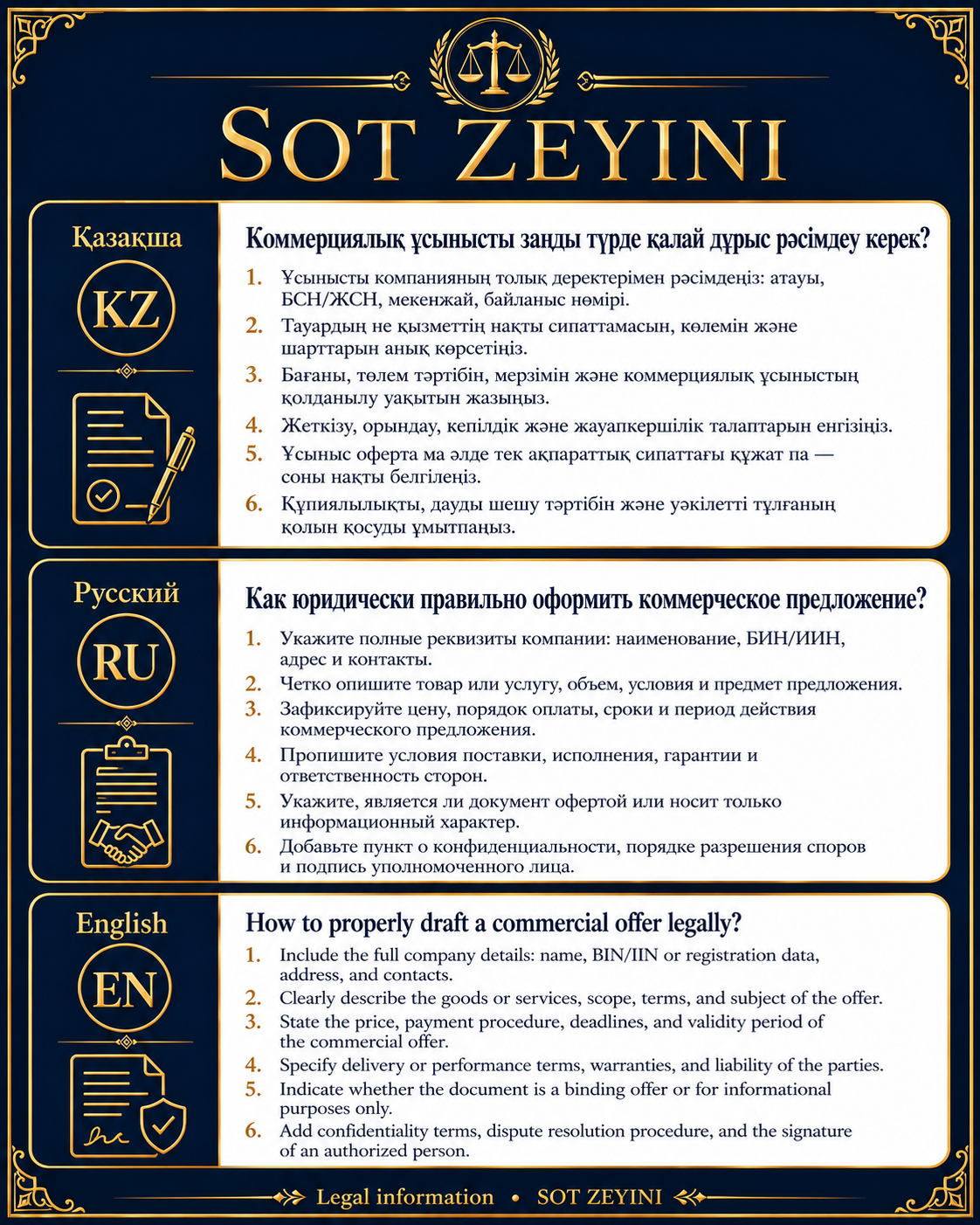
How to Legally Prepare a Commercial Proposal?
What Is a Commercial Proposal?
A commercial proposal is a document in which a company, entrepreneur, or professional offers goods, works, or services to a potential client under specific conditions.
A commercial proposal usually includes:
- the product or service offered;
- price;
- payment terms;
- deadlines;
- scope of work;
- advantages of the company;
- cooperation terms;
- contact details and bank details.
In practice, commercial proposals are used to attract clients, start negotiations, and present the main terms of a future deal.
However, it is important to understand that a commercial proposal may be just an informational document, or it may have legal consequences and be treated as an offer.
Is a Commercial Proposal a Legal Document?
Yes, in some cases a commercial proposal may have legal effect. If it contains essential terms of a transaction, including the subject matter, price, deadlines, payment procedure, and method of acceptance, it may be treated as an offer.
An offer is a proposal to enter into a contract. Acceptance is the confirmation of that proposal. For example, if a client pays an invoice, sends written consent, or confirms an order, this may be considered acceptance if the proposal states so.
This is why a commercial proposal should not be drafted casually. One careless sentence can turn a sales document into a binding obligation. Legal plot twist — not always fun.
What Is the Difference Between a Commercial Proposal and an Offer?
A commercial proposal is a broad term. It can be informational, promotional, presentational, or contractual.
An offer is a specific proposal to enter into a contract. If the recipient accepts it, rights and obligations may arise between the parties.
The main difference is:
- a commercial proposal may not create obligations;
- an offer may lead to a binding contract after acceptance.
Therefore, the text should clearly state whether the commercial proposal is an offer or only an informational document.
What Should Be Included in a Commercial Proposal?
A legally safe commercial proposal should contain several key sections.
1. Title of the Document
The document should have a clear title:
“Commercial Proposal”
or
“Commercial Proposal for Services”
or
“Commercial Proposal for Supply of Goods”
If the proposal should not be treated as an offer, it is advisable to add:
“This commercial proposal is for informational purposes only and does not constitute a public offer.”
This helps reduce the risk that the client will treat the document as a binding agreement.
2. Company or Entrepreneur Details
The proposal should include information about the party making the offer:
- company name;
- business identification number or tax number;
- legal address;
- actual address;
- phone number;
- email;
- website;
- bank details;
- name of the responsible person.
This confirms who sent the proposal and increases the client’s trust.
3. Client Details
If the proposal is addressed to a specific client, it is better to include the client’s details:
- company name;
- name of the director or responsible person;
- business identification number;
- address;
- contact details.
For example:
To: Director of Alpha LLP, Mr. Ivanov
An addressed commercial proposal looks more official and may have stronger evidentiary value.
4. Subject of the Proposal
The proposal must clearly describe what is being offered:
- legal services;
- accounting services;
- website development;
- advertising services;
- supply of goods;
- construction works;
- installation of equipment;
- consulting services.
The wording should be specific.
Poor wording:
“We provide marketing services.”
Better wording:
“We provide services for preparing a monthly content plan, writing scripts, and producing 20 videos for Instagram and TikTok.”
The more specific the description, the lower the risk of disputes.
5. Scope of Services
The proposal should clearly state what is included in the price.
For example:
- consultation;
- document preparation;
- legal analysis;
- delivery;
- installation;
- technical support;
- report;
- number of revisions;
- support period.
It is also important to state what is not included.
For example:
The price does not include: state fees, notary expenses, court representation, third-party services, or additional documents not specified in this proposal.
This section is very important because many disputes arise from different expectations about the scope of work.
6. Price
The price should be clear and understandable.
You may specify:
- total price;
- unit price;
- monthly service fee;
- price of each stage;
- whether VAT is included;
- additional expenses;
- discounts;
- validity period of the price.
Example:
The service fee is KZT 300,000. VAT is not included. Additional expenses are paid separately upon agreement of the parties.
If the price is valid only for a limited period, this should be stated:
“The price is valid for 7 calendar days from the date of this proposal.”
7. Payment Terms
The commercial proposal should explain how the client pays for the service or product.
Payment options may include:
- 100% advance payment;
- 50% advance payment and 50% after completion;
- stage-by-stage payment;
- monthly payment;
- payment based on invoice;
- installment payment.
Example:
Payment procedure: 50% advance payment and 50% within 3 business days after completion of the service.
If work begins only after advance payment, this should be clearly stated:
“The service period begins from the date of receipt of advance payment and all required documents.”
8. Deadlines
Deadlines should be specific.
They may be stated as:
- 5 business days;
- 10 calendar days;
- 1 month;
- from the date of payment;
- from the date of contract signing;
- from the date of receiving all required documents.
It is safer to link the deadline to a specific event:
“The service period is 10 business days from the date of receipt of advance payment and all necessary documents from the client.”
This protects the service provider if the client delays documents or information.
9. Validity Period of the Proposal
A commercial proposal should not remain valid forever. It should state its validity period.
Examples:
“This commercial proposal is valid for 5 business days from the date of sending.”
or
“This proposal is valid until June 30, 2026.”
This prevents the client from requesting old prices or terms months later.
10. Acceptance Procedure
If the commercial proposal is intended to operate as an offer, it should state how the client may accept it.
Acceptance may include:
- signing a contract;
- paying an invoice;
- making an advance payment;
- written confirmation by email;
- confirmation via WhatsApp;
- completing an order form;
- clicking a button on a website.
Example:
“Payment of the invoice by the client means full and unconditional acceptance of the terms of this commercial proposal.”
This wording should be used carefully because payment may create contractual obligations.
11. Liability of the Parties
The proposal may briefly describe liability terms.
For example:
- work does not begin if payment is delayed;
- deadlines are extended if the client delays documents;
- the service provider is not liable for inaccurate information provided by the client;
- additional work is paid separately;
- third-party services are paid separately.
Example:
“If the client fails to provide documents on time, the service period shall be extended for the corresponding period.”
12. Confidentiality
If the proposal includes prices, discounts, business models, strategies, or other commercial information, a confidentiality clause should be added.
Example:
“The information contained in this commercial proposal is confidential and may not be disclosed to third parties without the sender’s written consent.”
This is especially relevant for B2B, legal, accounting, IT, marketing, and consulting services.
13. Reference to a Separate Contract
To prevent the commercial proposal from replacing a full contract, it is advisable to state that services will be provided under a separate agreement.
Example:
“The services shall be provided under a separate agreement to be concluded between the parties.”
or
“This commercial proposal sets out preliminary cooperation terms. Final rights and obligations of the parties shall be determined in a separate contract.”
This reduces legal risks.
14. Signature and Date
At the end of the proposal, include:
- position;
- full name;
- signature;
- date;
- company name;
- contact details.
If the company uses a seal, it may be added. For electronic communication, it is better to send the proposal as a PDF on company letterhead.
How to State That a Commercial Proposal Is Not an Offer
You may use the following wording:
“This commercial proposal is provided for informational purposes only and does not constitute a public offer. Specific rights and obligations of the parties arise only after signing a separate agreement.”
This wording helps show that the document does not create obligations by itself.
How to Prepare a Commercial Proposal as an Offer
If the company wants the proposal to function as an offer, all essential terms should be included:
- subject matter;
- price;
- payment terms;
- deadlines;
- validity period;
- acceptance procedure;
- liability;
- party details.
Example wording:
“This commercial proposal constitutes an offer. Payment of the invoice by the client means full and unconditional acceptance of the terms of this proposal.”
This option is suitable when the company is ready to perform immediately after payment or another form of acceptance.
Common Mistakes in Commercial Proposals
The most common mistakes are:
- No exact price
- Unclear scope of services
- No deadline
- No validity period
- No payment procedure
- No acceptance procedure
- No list of exclusions
- No confidentiality clause
- No reference to a separate contract
- No signature or company details
These mistakes may lead to disputes with the client, payment problems, or claims regarding service quality.
Short Sample Commercial Proposal
COMMERCIAL PROPOSAL
Dear __________________,
__________ LLP offers you services related to __________________.
Service name: __________________
Scope of service: __________________
Price: __________________ KZT
Payment terms: __________________
Service period: __________________
Validity period of proposal: __________________
The services shall be provided under a separate agreement to be concluded between the parties.
This commercial proposal is for informational purposes only and does not constitute a public offer until a separate agreement is signed.
Sincerely,
Position: __________________
Company: __________________
Contact details: __________________
Date: __________________
Conclusion
A commercial proposal is not just a sales document. If drafted incorrectly, it may create legal obligations.
To reduce risks, the proposal should clearly state the subject matter, price, deadlines, payment terms, validity period, acceptance procedure, liability, and reference to a separate contract.
If the proposal is only informational, this should be clearly stated. If it is intended to be an offer, all essential terms must be described accurately.
A properly drafted commercial proposal helps build trust, simplify negotiations, and protect the business legally.
FAQ
Is a commercial proposal a contract?
Usually, a commercial proposal is not a contract by itself. However, if it contains all essential terms and the client accepts it, contractual obligations may arise.
Should the price be included in a commercial proposal?
Yes, if the proposal is related to a specific transaction. Without a clear price, payment disputes may arise.
Can a commercial proposal be sent via WhatsApp?
Yes. However, for important transactions, it is better to send a PDF document on company letterhead by email as well.
Should a commercial proposal be signed?
Yes, it is advisable. A signature confirms who sent the proposal and on what terms.
What should be written so that the proposal is not treated as an offer?
You may state: “This commercial proposal is for informational purposes only and does not constitute a public offer.”
Can invoice payment be considered acceptance?
Yes, if the proposal or invoice states that payment means acceptance of the terms.
Should a contract be attached to a commercial proposal?
For large or complex transactions, it is better to attach a draft contract. This reduces misunderstanding.
Who should prepare a commercial proposal?
A manager or business owner may prepare it, but legally important terms should be reviewed by a lawyer