 +7 775 858 9294
 WhatsApp
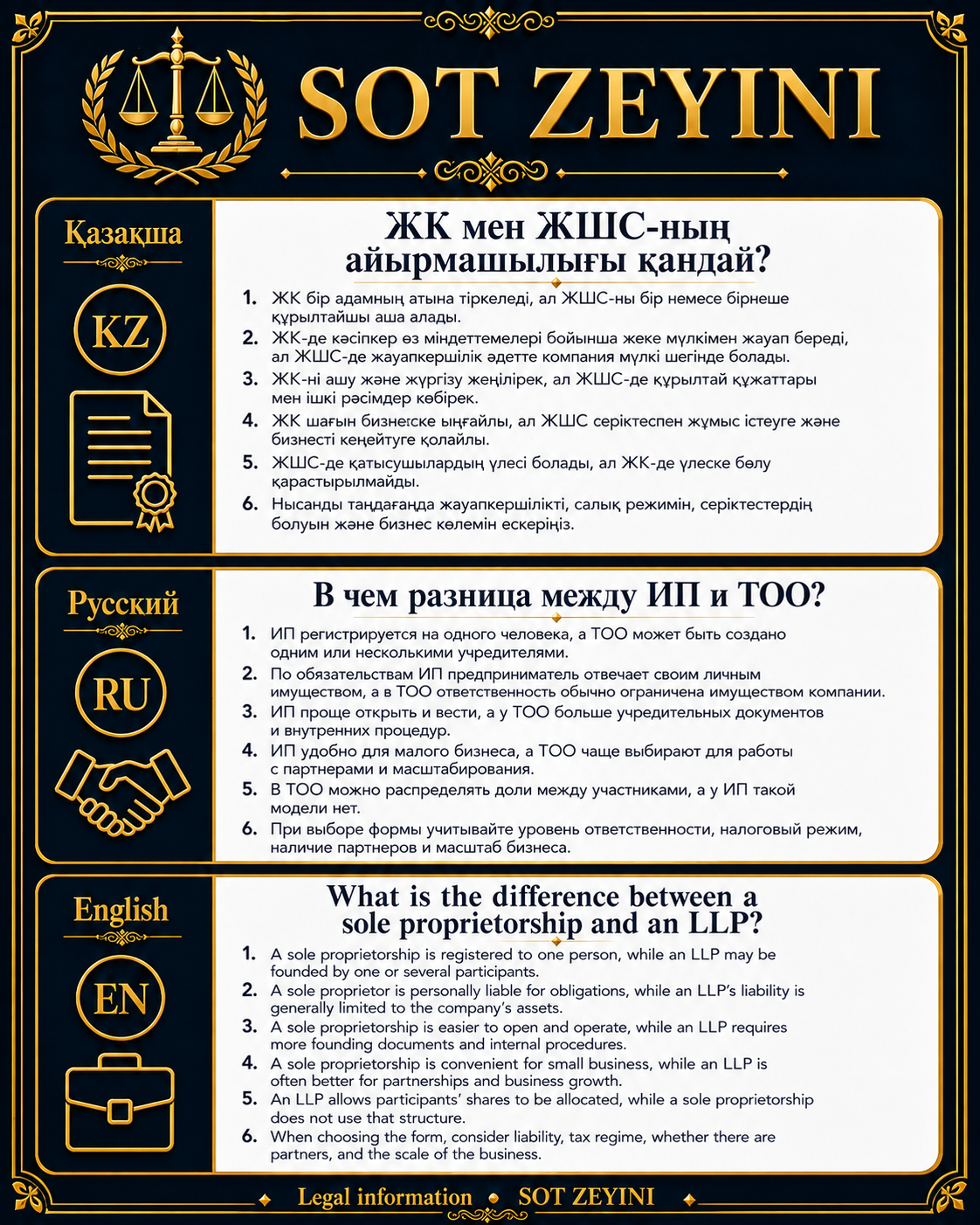
What Is the Difference Between a Sole Proprietor and an LLP?
What are a sole proprietor and an LLP?
When starting a business in Kazakhstan, many entrepreneurs choose between registering as a sole proprietor and opening an LLP.
A sole proprietor is an individual who carries out business activity in their own name. In Kazakhstan, this is commonly referred to as IP or individual entrepreneur.
An LLP, or Limited Liability Partnership, is a separate legal entity. It has its own name, business identification number, director, bank account, charter, and participants.
In simple terms, a sole proprietor means “I am doing business,” while an LLP means “I have created a company.”
Main difference between a sole proprietor and an LLP
The key difference is legal status and liability.
A sole proprietor does not create a separate legal entity. The individual carries out business personally and may be liable for business obligations with personal property.
An LLP is a separate legal entity. In general, participants are not personally liable for the LLP’s obligations and usually risk only within the value of their contributions. However, there may be exceptions in cases of unlawful conduct, tax issues, or director liability.
Therefore, for a small and low-risk business, sole proprietorship may be convenient. For a growing business with partners, large contracts, employees, investors, or higher risks, an LLP is often safer.
Who is a sole proprietorship suitable for?
A sole proprietorship is usually suitable for small and personally managed businesses.
For example:
- individual services;
- small retail;
- online sales;
- freelance work;
- consulting;
- repair services;
- small café;
- beauty services;
- private courses;
- delivery;
- personal practice.
It is usually easier to register, manage, and close. If the business is small and operated by one person, this format may be a good starting point.
Who is an LLP suitable for?
An LLP is often more suitable for businesses that plan to grow, work with partners, attract investors, sign major contracts, or participate in tenders.
An LLP may be better if:
- there are several founders;
- an investor may join;
- large contracts are expected;
- employees will be hired;
- the business involves legal or financial risks;
- public procurement is planned;
- corporate image matters;
- the business has assets or branches;
- the company works in B2B.
An LLP often looks more structured and reliable to banks, investors, corporate clients, and state customers.
Liability of a sole proprietor and an LLP
The main risk for a sole proprietor is personal liability. If debts, lawsuits, or unfulfilled obligations arise, the entrepreneur’s personal property may be at risk, except for property that cannot be seized under the law.
In an LLP, liability is usually limited to the property of the partnership. Participants generally do not answer for the LLP’s debts with their personal property unless special legal grounds exist.
For higher-risk businesses, an LLP is usually a safer structure.
Registration process
A sole proprietor is generally easier to register. An individual usually submits a notification of starting business activity through electronic services and signs it with a digital signature.
Registering an LLP requires more information and documents, including:
- company name;
- legal address;
- director;
- founder or founders;
- charter;
- decision or minutes;
- business activity;
- information about shares, if there are several participants.
If there is one founder, LLP registration is simpler. If there are several founders, it is important to define shares, rights, and management rules in advance.
Taxes and accounting
A sole proprietor and an LLP may use different tax regimes depending on the type of activity, turnover, number of employees, and other conditions. In some cases, both may use special tax regimes if they meet the requirements.
Accounting for a sole proprietor is often simpler. An LLP usually requires more accounting and corporate documentation.
However, the choice should not be based only on taxes. It is also important to consider:
- who the clients are;
- whether VAT is needed;
- expected turnover;
- employees;
- business expenses;
- investors;
- client requirements;
- contractual risks.
A form that saves taxes at the beginning may create legal risks later.
Working with banks and clients
A sole proprietor opens an account and signs contracts in their own name as an entrepreneur. This is convenient for small services and simple trade.
An LLP works as a company. For corporate clients, banks, investors, and public procurement, an LLP often looks more reliable because it has a director, charter, participants, and corporate structure.
If the business is focused on B2B, tenders, or large contracts, an LLP is often preferred.
Partners and ownership shares
A sole proprietorship is usually a one-person business. Adding another person as a formal co-owner is difficult.
An LLP may have several participants. Their shares can be fixed in documents: for example, 50/50, 70/30, or 60/40. This helps regulate:
- profit distribution;
- voting;
- exit of a participant;
- sale of a share;
- management;
- corporate disputes.
If the business is started with a partner, an LLP is usually the better choice.
Attracting investors
An LLP is more convenient for investment. An investor can receive a share, the participant structure can be changed, the charter capital can be increased, and corporate arrangements can be documented.
In a sole proprietorship, an investor does not receive a formal share in a separate company. It looks more like financing an individual.
If investment, scaling, or sale of shares is planned, an LLP is usually better.
Can employees be hired?
Yes, both a sole proprietor and an LLP can hire employees. However, when the team grows, departments appear, and accounting becomes more complex, an LLP may be more convenient for management.
For one or two employees, a sole proprietorship may be enough. For a systematic business with a team, an LLP is often more practical.
Public procurement and tenders
Participation depends on the requirements of a specific tender. Some tenders allow sole proprietors, while others may be more suitable for LLPs.
If the business is focused on tenders, supplies, construction, services to legal entities, or large contracts, an LLP often fits better.
Which is easier to close?
A sole proprietorship is usually easier to close. The entrepreneur settles tax obligations and submits an application to stop activity.
Closing an LLP is more complex because it is a legal entity. Liquidation procedures, creditors, tax issues, and corporate documents may be involved.
If the business is only a test project, sole proprietorship may be easier. If the goal is to build a long-term company, an LLP offers more structure.
What should you choose?
A sole proprietorship may be suitable if:
- the business belongs to one person;
- risks are low;
- turnover is still modest;
- the activity is simple;
- there are no investors;
- there are no major partners;
- a fast start is needed;
- accounting should be simple.
An LLP may be better if:
- there are several founders;
- an investor may join;
- large clients are expected;
- risks are higher;
- employees will be hired;
- the business works with legal entities;
- tenders are planned;
- corporate image matters;
- business risks should be separated from personal property.
Can a sole proprietor later open an LLP?
Yes. Many entrepreneurs start as sole proprietors, test the business model, build a client base, and then open an LLP.
However, switching may require:
- new contracts with clients;
- new bank account;
- tax regime changes;
- transfer of assets;
- brand and domain arrangements;
- employee transfer;
- accounting changes;
- notifying clients.
If the business is planned as a larger project from the beginning, it may be better to consider an LLP right away.
Common mistakes when choosing
Common mistakes include:
- choosing based only on taxes;
- ignoring personal liability of a sole proprietor;
- starting a partnership through a sole proprietorship;
- failing to check client requirements;
- not considering future investors;
- ignoring contract risks;
- opening an LLP without internal documents;
- delaying accounting from the first day.
Choosing the right form helps reduce tax, court, and partner disputes.
Conclusion
A sole proprietor and an LLP differ in legal status, liability, accounting, management, work with partners, and growth opportunities.
A sole proprietorship is a simple and fast format for a small business. An LLP is a more structured format for a growing business with partners, investors, employees, and larger clients.
If the business is small and owned by one person, sole proprietorship may be enough. If the business involves risks, partners, large contracts, or investors, an LLP is usually the better choice.
FAQ
What is the main difference between a sole proprietor and an LLP?
A sole proprietor is an individual doing business. An LLP is a separate legal entity.
Which is easier to register?
A sole proprietorship is usually easier. An LLP requires more corporate information and documents.
Is a sole proprietor personally liable?
Yes, a sole proprietor may be liable for business obligations with personal property.
Are LLP participants personally liable?
Usually no. Participants generally risk within their contributions, but exceptions may apply.
Which is better for a business with a partner?
An LLP is better because shares, management, and profit distribution can be formally regulated.
Can a sole proprietor later open an LLP?
Yes. Many entrepreneurs start as sole proprietors and later move the business to an LLP.
Which is better for large clients?
Usually an LLP, because it is viewed as a more structured and reliable business form.