 +7 775 858 9294
 WhatsApp

What Is Online Fraud?
Online fraud is deception through internet platforms, social networks, messengers, websites, online stores, or banking applications in order to obtain money, property, or personal data.
Online fraud may happen through:
- WhatsApp;
- Instagram;
- Telegram;
- TikTok;
- OLX;
- Kaspi;
- fake online stores;
- phishing websites;
- fake investment platforms;
- job advertisements;
- dating platforms;
- fake bank calls.
If a person loses money or gives personal data because of deception, they should contact the bank and file a police complaint as soon as possible.
What Situations May Be Online Fraud?
Online fraud may include:
- a seller receives advance payment and does not send the goods;
- an online store turns out to be fake;
- money is transferred through Kaspi and the seller disappears;
- a person promises goods or services on Instagram and does not deliver;
- someone asks for money on WhatsApp pretending to be a friend;
- someone calls pretending to be a bank employee and asks for an SMS code;
- a fake investment project promises guaranteed income;
- someone promises to arrange a loan for a fee;
- money is taken for fake employment services;
- a phishing link steals banking data;
- a loan is issued using another person’s data.
The key element is that the person transfers money or data because of false promises, deception, or abuse of trust.
What Should You Do First?
If you were scammed online, act quickly.
Recommended steps:
- Call your bank and report a suspicious transaction
- Block your card or account if needed
- Save all messages and receipts
- Take screenshots of the scammer’s account
- Save the phone number, card number, and recipient name
- Prepare a police complaint
- Attach evidence
- Obtain registration confirmation
- Check that the complaint was registered
Do not delete messages. In online fraud cases, one screenshot may become crucial evidence.
Where Can You File the Complaint?
A police complaint may be filed:
- at the nearest police department;
- at the place of residence;
- at the place where the offense occurred;
- through an online police complaint service;
- through eOtinish;
- through the prosecutor’s office;
- after calling 102 if the situation is urgent.
If the money was transferred recently, contact the bank first and then file a police complaint immediately.
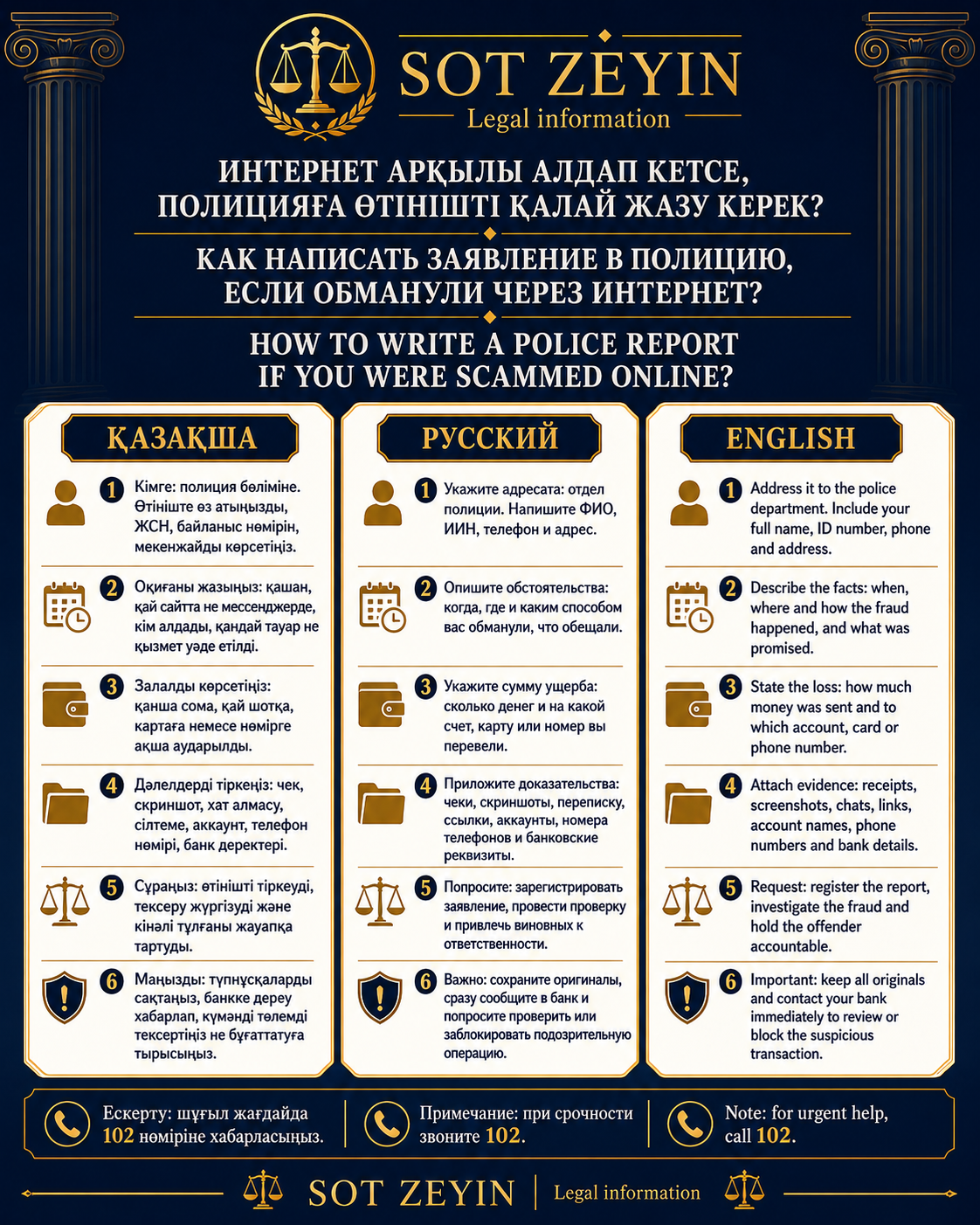
What Should Be Written in the Complaint?
The complaint should describe the situation in detail and in chronological order.
Include:
- applicant’s full name;
- identification number;
- address;
- phone number;
- date and time of the incident;
- platform where the fraud happened;
- scammer’s account, phone number, or website;
- card or account number of the recipient;
- amount transferred;
- what the scammer promised;
- what the money was sent for;
- what happened after payment;
- amount of damage;
- available evidence;
- request to accept and register the complaint.
At the end, you may write:
“I request that this complaint be accepted and registered, that registration confirmation be issued, that the circumstances be reviewed, that the person who received the money be identified, and that a procedural decision be made in accordance with the law.”
What Evidence Should Be Attached?
Attach everything that confirms the fraud.
Evidence may include:
- Kaspi receipt;
- bank transfer receipt;
- WhatsApp messages;
- Telegram messages;
- Instagram messages;
- OLX advertisement;
- screenshot of the profile;
- phone number;
- card or account number;
- audio messages;
- call recordings;
- videos;
- product photos;
- website link;
- email address;
- phishing link;
- witness details.
Screenshots should show the date, time, phone number, account name, and message content.
What If the Money Was Sent Through Kaspi?
If the money was transferred through Kaspi:
- save the receipt;
- record the recipient’s name;
- save the phone or card number;
- contact the bank;
- report a suspicious transaction;
- attach the receipt to the police complaint;
- save the messages where payment was requested.
A receipt proves that the money was transferred, but fraud should also be supported by messages, promises, account details, and other facts.
What If the Scam Happened on WhatsApp or Instagram?
If the scam happened through WhatsApp or Instagram, save:
- full conversation;
- account link;
- username;
- profile photo;
- phone number;
- audio messages;
- payment request message;
- promise to send goods or provide services;
- proof of being blocked;
- screenshots of the account before deletion, if available.
It is better to preserve the full timeline, not just one or two screenshots.
What If You Shared Card Details?
If you shared a CVV code, SMS code, banking password, electronic signature data, or banking access, act immediately:
- call the bank;
- block the card;
- change passwords;
- disconnect suspicious devices;
- check transactions;
- block online banking if necessary;
- file a police complaint;
- reissue or revoke electronic signature if needed.
Never share SMS codes. A real bank employee will not ask for them.
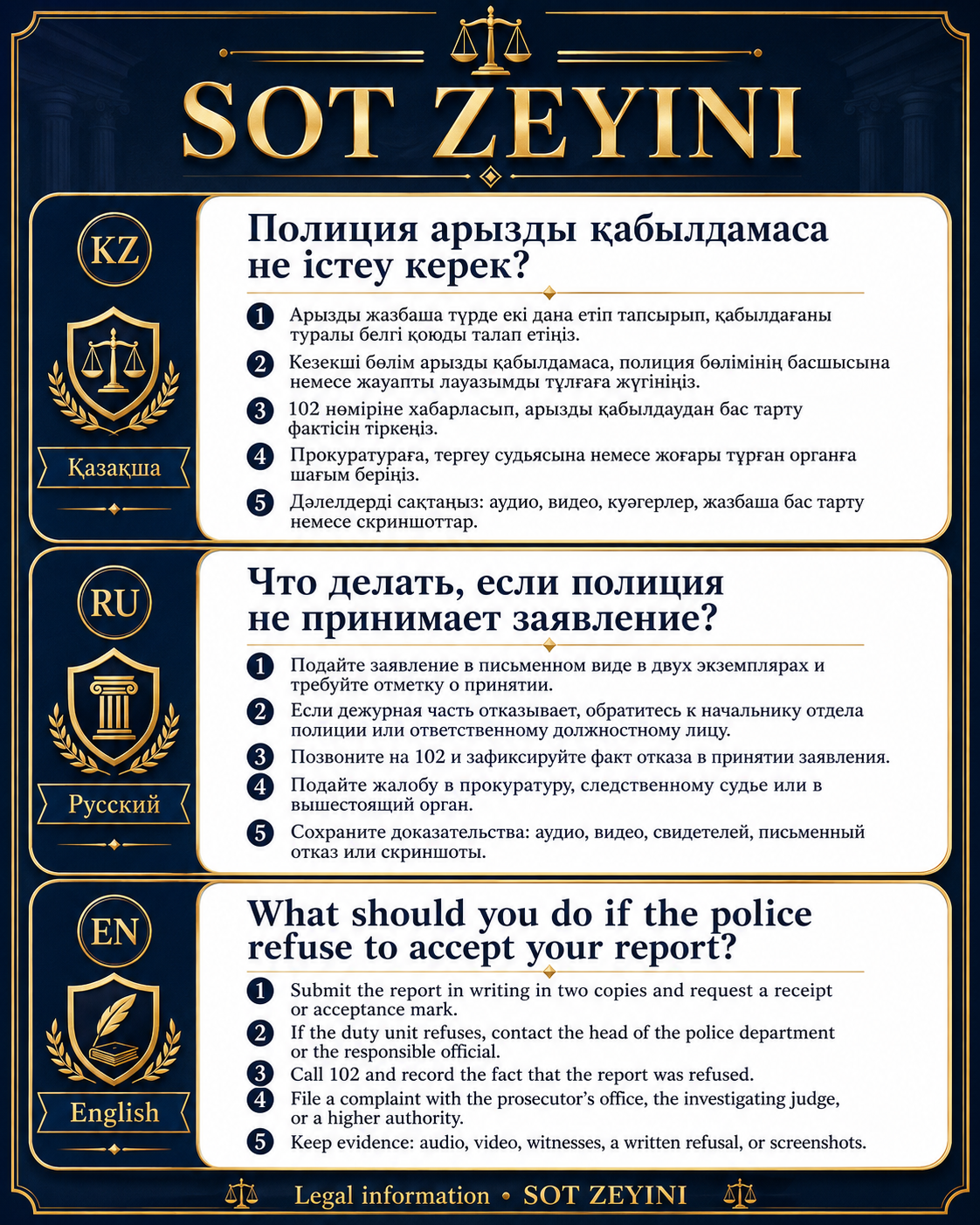
What If the Police Refuse to Accept the Complaint?
If the police say “this is a civil dispute,” “you transferred the money yourself,” or “it is hard to find the person,” you should still request registration of the complaint.
Steps:
- submit the complaint in writing;
- request a stamp or mark on your copy;
- request registration confirmation;
- write down the officer’s details;
- contact the head of the department;
- complain to the prosecutor’s office;
- apply to the investigative court if necessary.
The difficulty of identifying the suspect is not a reason to refuse a complaint.
Can You File a Complaint If the Scammer’s Name Is Unknown?
Yes. In online fraud cases, the scammer’s real identity is often unknown.
Include all available information:
- phone number;
- card number;
- recipient name;
- account;
- username;
- website;
- link;
- receipt;
- messages;
- email;
- other digital traces.
The police should check this information and identify the person.
Sample Police Complaint
To the Police Department
I, __________________, submit this complaint regarding online fraud.
On “_” ________ 20, through the platform __________________, I contacted a person using the account / phone number __________________.
The person offered me __________________ and asked for advance payment / payment in the amount of __________________ KZT.
On “_” ________ 20, I transferred __________________ KZT to the card / Kaspi number / account __________________.
After receiving the money, the person did not provide the promised goods / services, stopped responding / blocked me / deleted the account.
As a result, I suffered material damage in the amount of __________________ KZT.
I attach the following evidence: messages, receipt, screenshots of the account, phone number, banking details, and other materials.
Based on the above, I request that you:
- Accept and register my complaint;
- Issue registration confirmation;
- Review the circumstances;
- Identify the person who received the money;
- Take measures to recover the damage;
- Make a procedural decision in accordance with the law.
Attachments:
- Kaspi receipt / bank transfer
- WhatsApp / Instagram / Telegram messages
- Account screenshots
- Phone number and banking details
- Other evidence
Date: __________
Signature: __________
Common Mistakes
Common mistakes include:
- Deleting messages
- Not saving the receipt
- Not taking screenshots of the account
- Contacting the bank too late
- Not filing a police complaint
- Not obtaining registration confirmation
- Not describing signs of deception
- Writing only “please return my money”
- Opening phishing links again
- Not complaining if the police remain inactive
Even if the amount is small, filing a complaint may be important because there may be many victims.
Conclusion
If you were scammed online, you should quickly save evidence, contact the bank, and file a police complaint. The complaint should describe the full timeline: where you found the scammer, what was promised, where the money was transferred, and what happened after payment.
If the police refuse to accept the complaint or do not respond, you may complain to the prosecutor’s office, police management, or the investigative court.
The faster you act, the higher the chances of identifying the person, preventing further damage, and recovering money.
FAQ
Where should I report online fraud?
You should report it to the police. You should also contact your bank immediately if money or card data was involved.
Can I file a complaint if the scammer is unknown?
Yes. Provide the phone number, card details, account, website, receipt, and messages.
Is a Kaspi receipt evidence?
Yes. It proves the transfer. Messages and other evidence should also be attached.
Can WhatsApp messages be used as evidence?
Yes. WhatsApp messages may be used as evidence if properly saved.
What if the police refuse to accept the complaint?
You may complain to police management, the prosecutor’s office, or the investigative court.
Can the money be returned?
Sometimes, but it depends on how quickly you act, where the money went, and whether the recipient is identified.
What should I do after clicking a phishing link?
Block the card, change passwords, contact the bank, and file a police complaint.
Is a lawyer necessary?
If the amount is large, the police are inactive, or the fraud scheme is complex, legal assistance may be useful.