 +7 775 858 9294
 WhatsApp
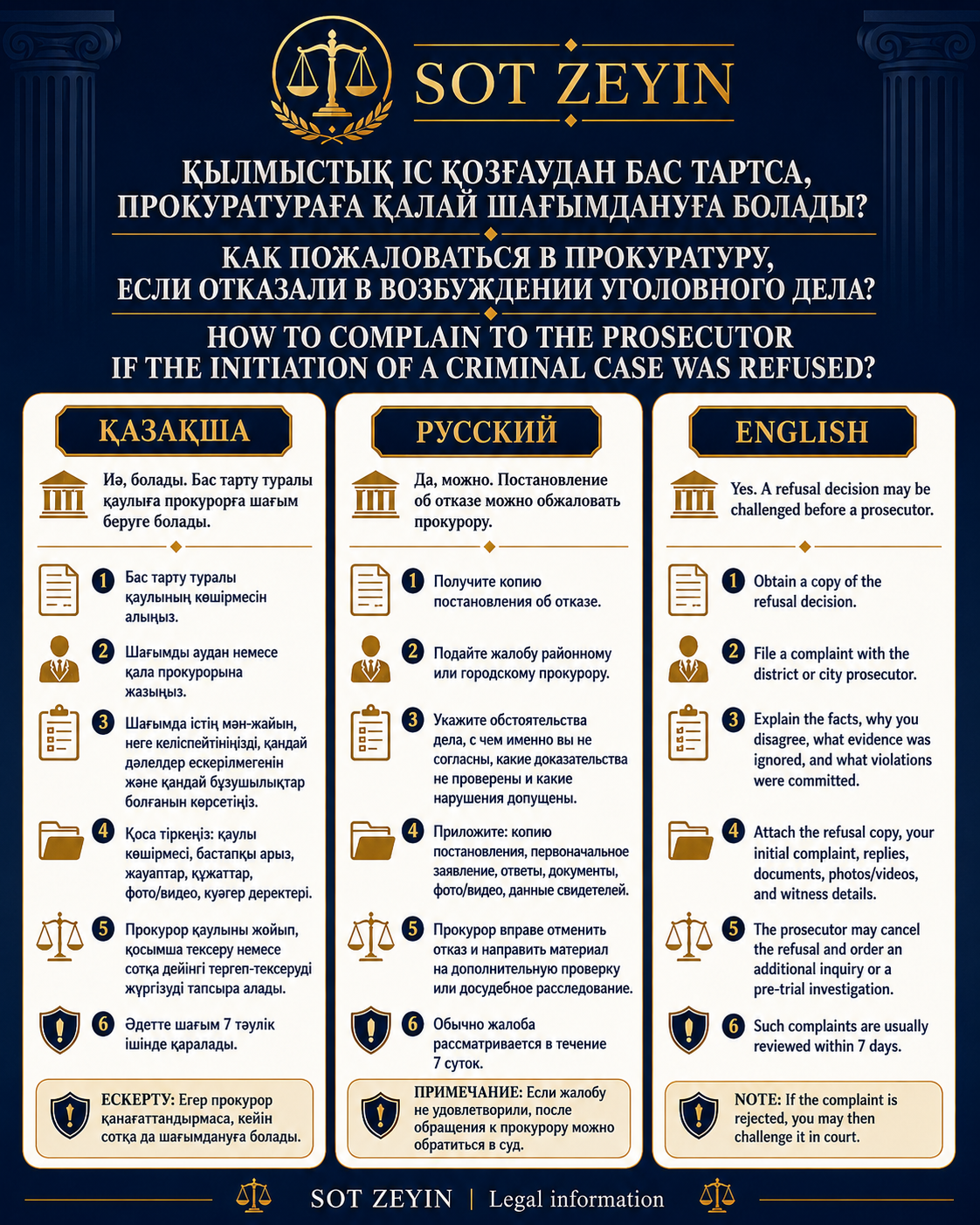

What Does Refusal to Open a Criminal Case Mean?
People often say, “The police refused to open a criminal case.” In Kazakhstan’s current criminal procedure, it is important to understand what this may actually mean.
In practice, it may mean that:
- the police refused to accept the complaint;
- the complaint was not registered in the ERDR;
- the material was treated as a non-criminal matter;
- the police replied that it was a civil dispute;
- the review was only formal;
- no pre-trial investigation was started;
- proceedings were terminated;
- the investigator or inquiry officer is inactive.
These situations may be challenged. A formal police reply does not mean that the matter is over.
When Can You Complain to the Prosecutor’s Office?
A complaint to the prosecutor’s office may be filed if:
- the police did not accept the complaint;
- the complaint was not registered;
- no registration confirmation was issued;
- the material was not entered into the ERDR;
- the police called the matter a civil dispute without proper review;
- witnesses were not questioned;
- messages, bank transfers, or video were not checked;
- the person who received money was not identified;
- no procedural decision was made;
- the decision is formal or unfounded;
- the investigator is inactive.
The prosecutor’s office supervises the legality of actions by criminal prosecution authorities. Therefore, a complaint to the prosecutor is a normal procedural remedy.
What Documents Should Be Collected?
Before filing a complaint, it is useful to collect:
- copy of the police complaint;
- registration confirmation;
- police reply;
- investigator’s decision;
- screenshot of the complaint status;
- eOtinish response;
- evidence related to the case;
- correspondence;
- receipts and bank documents;
- witness details.
If no registration confirmation was issued, this should be specifically mentioned in the complaint.
What Should Be Written in the Complaint?
The complaint should be clear and specific. It is not enough to write “please investigate.” You should explain what was unlawful and what action you request.
The complaint should include:
- name of the prosecutor’s office;
- applicant’s details;
- when and where the police complaint was filed;
- what incident was reported;
- what signs of a criminal offense exist;
- what decision or response the police gave;
- why you disagree with it;
- what evidence was not checked;
- what actions were not taken;
- what you request from the prosecutor.
What Can You Request?
In the complaint, you may request that the prosecutor:
- recognize police action or inaction as unlawful;
- assess the legality of the refusal;
- ensure registration of the complaint in the ERDR;
- cancel an unlawful decision;
- require a full review;
- require necessary investigative actions;
- question witnesses;
- request bank information;
- examine messages and screenshots;
- request CCTV footage;
- identify the person involved;
- provide a written response.
Specific requests make the complaint stronger.
If the Police Say “This Is a Civil Dispute”
This is a common response in cases involving debts, receipts, transfers, contracts, goods, services, and online fraud.
Sometimes the dispute is indeed civil. However, if there are signs of deception, abuse of trust, initial intent not to perform, misappropriation of money, forged documents, or extortion, the matter should be properly checked.
You may write:
“The police conclusion that the dispute is civil is premature, because circumstances indicating deception, abuse of trust, and unlawful taking of money were not properly examined.”
What Evidence Should Be Attached?
Attach relevant documents and evidence, such as:
- initial police complaint;
- police reply;
- investigator’s decision;
- registration confirmation;
- WhatsApp messages;
- SMS;
- audio;
- video;
- Kaspi receipt;
- bank statement;
- contract;
- promissory note;
- photos;
- screenshots of accounts;
- witness details;
- medical documents;
- other materials.
If there are many documents, prepare a separate list of attachments.
How to Submit the Complaint
A complaint may be submitted:
- in person to the prosecutor’s office;
- through eOtinish;
- by registered mail;
- using electronic signature;
- during a personal appointment.
If submitted in paper form, prepare two copies and request a stamp or incoming number on your copy. If submitted online, save the application number.
Can You Also Apply to the Investigative Court?
Yes. If the prosecutor’s office does not help or the police remain inactive, you may apply to the investigative court.
The court may be asked to:
- recognize police inaction as unlawful;
- recognize the decision as unlawful;
- require the complaint to be reviewed;
- require registration of the material;
- require a procedural decision.
An investigative court complaint is often used when police and prosecutor responses remain formal.
Sample Complaint to the Prosecutor’s Office
To the Prosecutor’s Office of __________________ district
From: __________________
Identification number: __________________
Address: __________________
Phone: __________________
COMPLAINT
against police refusal / inaction regarding a criminal offense complaint
On “_” ________ 20, I filed a complaint with __________________ police department regarding __________________.
The complaint described circumstances indicating signs of a criminal offense, namely: __________________.
However, the police did not register the complaint in the ERDR / did not issue registration confirmation / gave a formal reply / stated that the dispute was civil / did not conduct the necessary review.
I disagree with this response because the review was incomplete and formal. The following actions were not performed:
- witnesses were not questioned;
- bank information was not requested;
- correspondence was not examined;
- submitted evidence was not reviewed;
- the person who received money was not identified;
- no legal assessment was given to the signs of a criminal offense;
- no lawful procedural decision was made.
Based on the above, I request that you:
- Review the legality of police actions / inaction;
- Provide a legal assessment of the refusal / reply / decision;
- Ensure registration of the complaint in the ERDR;
- Cancel the unlawful decision or reply if grounds exist;
- Require a full, comprehensive, and objective review;
- Require necessary investigative actions;
- Provide me with a written response regarding the measures taken.
Attachments:
- Copy of the police complaint
- Police reply
- Registration confirmation
- Evidence
- Screenshots
- Other documents
Date: __________
Signature: __________
Common Mistakes
Common mistakes include:
- Not attaching the original complaint
- Not attaching the police reply
- Not explaining which actions were not performed
- Writing only “please open a case”
- Not requesting ERDR registration
- Not describing signs of a criminal offense
- Not attaching evidence
- Not saving the application number
- Not using the investigative court remedy
- Missing important deadlines
A strong complaint should be procedural, not emotional.
Conclusion
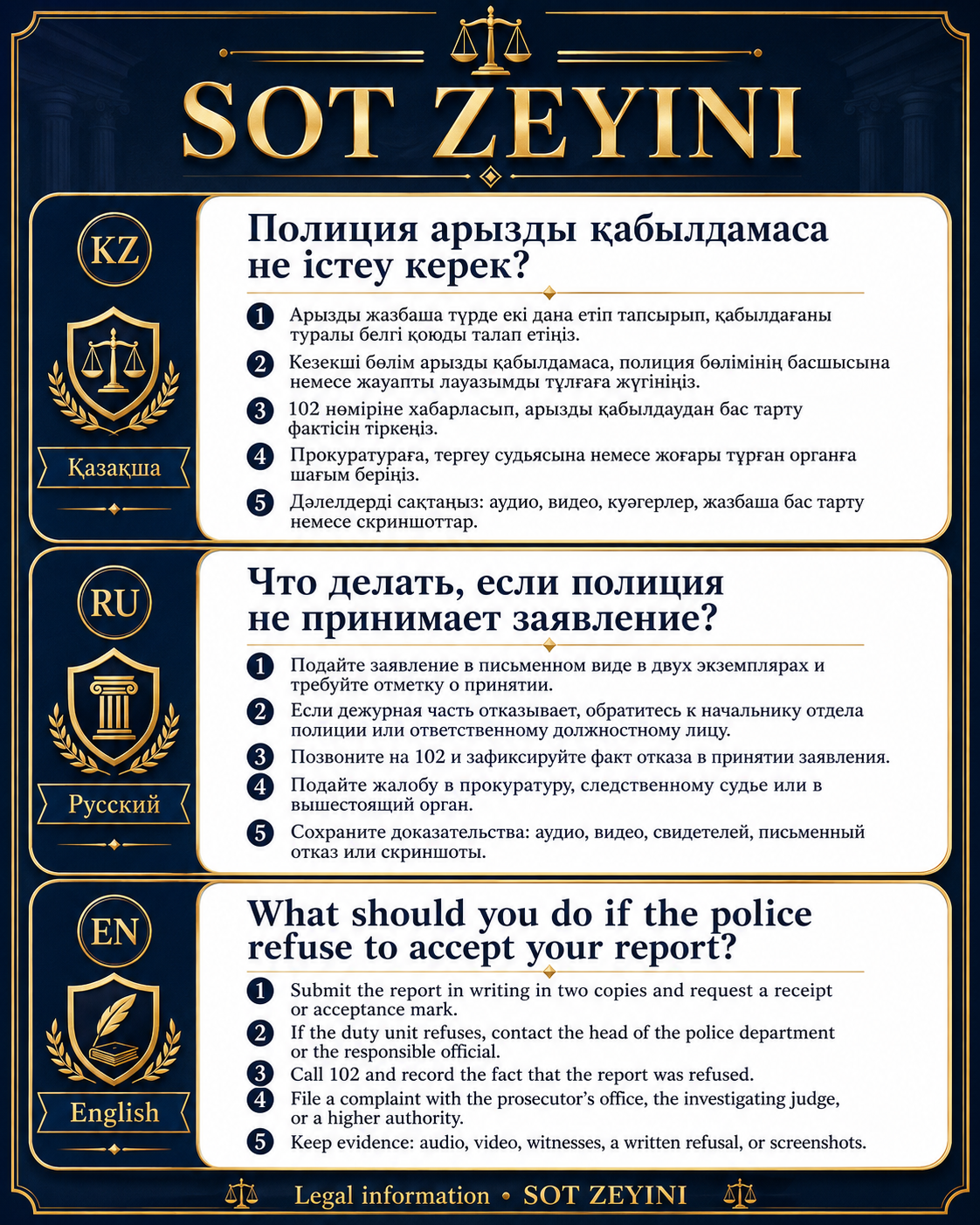
If the police refused to open a criminal case, did not register the complaint in the ERDR, or formally called the matter a civil dispute, you may file a complaint with the prosecutor’s office.
The complaint should explain what signs of a criminal offense exist, what evidence was not checked, and what actions the police failed to take. It should also request specific measures: ERDR registration, cancellation of an unlawful decision, a proper review, and a procedural decision.
If the prosecutor’s office does not respond effectively, the next step may be an appeal to the investigative court.
FAQ
Where can I complain after refusal to open a criminal case?
You may complain to the prosecutor’s office, police management, or the investigative court.
Can the complaint be submitted online?
Yes, it may be submitted through eOtinish.
What should I request in the complaint?
You may request review of the refusal, ERDR registration, cancellation of an unlawful decision, and a proper investigation.
What if the police say it is a civil dispute?
You should describe signs of deception, abuse of trust, misappropriation of money, or other criminally relevant facts.
Should evidence be attached?
Yes. Evidence makes the complaint much stronger.
Can the prosecutor require the police to review the material?
Yes, the prosecutor may review the legality of police actions and take prosecutorial measures.
When should I apply to the investigative court?
If the police or prosecutor remain inactive or the decision is still unlawful.
Is a lawyer necessary?
If the case is complex, the damage is significant, or the police remain inactive, legal assistance is recommended.