 +7 775 858 9294
 WhatsApp
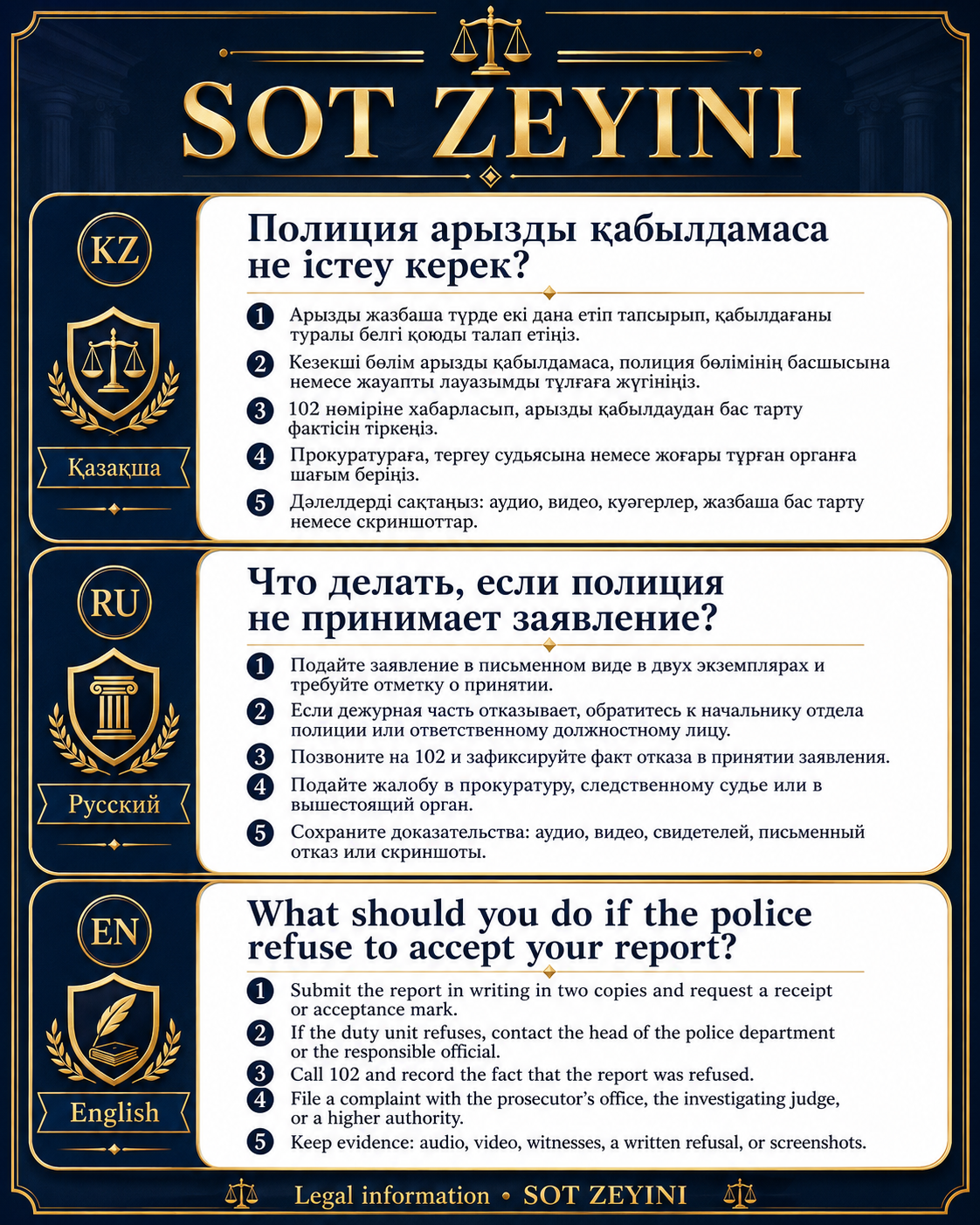
What Should You Do If the Police Refuse to Accept Your Complaint?
Meta title: What to Do If the Police Refuse to Accept Your Complaint
Meta description: Learn what to do if the police refuse to accept or register a complaint in Kazakhstan: registration, notification slip, prosecutor complaint, and investigative court appeal.
URL slug: police-refuse-to-accept-complaint-kazakhstan
Keywords: police refuse complaint Kazakhstan, file police complaint, criminal complaint registration, ERDR, notification slip, prosecutor complaint, investigative court appeal
Can the Police Refuse to Accept a Complaint?
If a person reports a possible criminal offense, the police must accept and register the complaint. A police officer should not simply say: “This is not our issue,” “This is a civil dispute,” “Go to another department,” or “Come back later.”
If the complaint contains signs of a criminal offense, it should be accepted, registered, and reviewed. If the police refuse to accept or register the complaint, the applicant may file a complaint with police management, the prosecutor’s office, or the investigative court.
A refusal to accept a complaint is not just an administrative inconvenience. It may affect a person’s right to protection and access to justice.
When Must the Police Accept a Complaint?
The police must accept a complaint if it contains information about a possible criminal offense.
For example:
- fraud;
- theft;
- threats;
- bodily harm;
- extortion;
- property damage;
- online fraud;
- misappropriation of money;
- forged documents;
- unlawful possession of property;
- other signs of a criminal offense.
After receiving the complaint, the police should issue a document confirming registration, such as a notification slip.
What Is a Notification Slip?
A notification slip is a document confirming that a complaint has been registered. It usually contains a registration number that allows the applicant to check the status of the complaint.
If the police accept the complaint but do not issue any confirmation, this is a problem. Without confirmation, it may be difficult to prove that the complaint was registered.
When filing a complaint, the applicant should request:
- notification slip;
- incoming registration number;
- stamp on a copy of the complaint;
- details of the officer who accepted it.
How to File a Complaint Properly
A complaint may be filed in several ways:
- In person at a police department
- Through the duty unit
- Through eOtinish
- Through the prosecutor’s office
- By registered mail
- Through online services with later status verification
It is best to prepare the complaint in writing in two copies. One copy is submitted to the police, and the second copy should be stamped or marked as received.
What If the Police Verbally Refuse to Accept the Complaint?
If a police officer refuses to accept the complaint, the applicant should act calmly and document everything.
Recommended steps:
- Ask for the officer’s full name and position
- Demand that the written complaint be accepted
- Request a mark on the copy of the complaint
- Request a notification slip
- Ask to speak to the head of the department
- Request a written refusal
- File a complaint with the prosecutor’s office
- If necessary, apply to the investigative court
The key point is not to rely on a verbal dispute. Everything should be recorded in writing.
How to File a Complaint With the Prosecutor’s Office
If the police refuse to accept or register a complaint, the applicant may submit a complaint to the prosecutor’s office.
The complaint should state:
- which police department you contacted;
- the date of the visit;
- what incident you wanted to report;
- who refused to accept the complaint;
- what reason was given;
- that the complaint was not registered;
- that no notification slip was issued;
- a request to require the police to accept and register the complaint.
The complaint may be submitted through eOtinish. Attach a copy of the original complaint, evidence, screenshots, audio or video materials, and other documents.
Can You Apply to the Investigative Court?
Yes. If the police refuse to accept the complaint, do not register it, or remain inactive, the applicant may apply to the investigative court.
The complaint may request the court to:
- recognize police inaction as unlawful;
- order the police to accept the complaint;
- order registration of the complaint;
- require a procedural decision;
- review the actions of officials.
This step is especially useful if the police repeatedly refuse to accept the complaint and provide only verbal explanations.
What If the Police Say “This Is a Civil Dispute”?
The police often say “this is a civil dispute” in cases involving debt, contracts, money transfers, delivery of goods, repairs, services, or refunds.
Sometimes this is correct. However, if there are signs of deception, abuse of trust, misappropriation of money, forged documents, or initial intent not to perform obligations, the situation may contain signs of a criminal offense.
The complaint should not simply say “they did not return my money.” It should describe specific signs such as:
- the person never intended to perform the promise;
- false information was provided;
- money was taken from several people;
- forged documents were used;
- the person disappeared after receiving money;
- the person had no real ability to perform;
- the person used a false identity;
- fake receipts or messages were used.
The more specific the complaint is, the harder it is to dismiss it formally as a civil dispute.
What Should Be Included in the Complaint?
A police complaint should include:
- applicant’s full name;
- identification number;
- address;
- phone number;
- date of the incident;
- place of the incident;
- details of the suspected person;
- detailed description of events;
- amount of damage;
- evidence;
- witnesses;
- signs of a criminal offense;
- request to accept and register the complaint;
- request to issue a notification slip.
At the end, it is useful to write:
“I request that this complaint be accepted and registered, that a notification slip be issued, and that a procedural decision be made in accordance with the law.”
What Evidence Should Be Attached?
Attach as much evidence as possible:
- WhatsApp messages;
- audio recordings;
- videos;
- Kaspi receipts;
- bank transfers;
- contracts;
- promissory notes;
- screenshots;
- advertisements;
- Instagram, OLX, or other online pages;
- photos;
- witness details;
- copies of documents.
The more evidence is provided, the stronger the complaint will be.
What If the Complaint Was Accepted but Nothing Happens?
If the complaint was accepted and a notification slip was issued, but the police do not take action, the applicant may:
- check the status of the complaint;
- submit a written motion to the investigator;
- complain to the head of the police department;
- complain to the prosecutor’s office;
- apply to the investigative court.
The complaint should state that the material was registered, but no real investigative actions have been taken or no procedural decision has been made.
Common Mistakes
Applicants often make these mistakes:
- Reporting only verbally
- Not receiving a notification slip
- Not keeping a copy of the complaint
- Not attaching evidence
- Not describing criminal elements
- Writing only “return my money”
- Not recording the officer’s details
- Not complaining to the prosecutor’s office
- Not applying to the investigative court
- Trying to resolve everything only through WhatsApp
These mistakes may make it harder to protect your rights.
Sample Complaint
To the Prosecutor’s Office / Head of the Police Department
I, _____________, on “” ________ 20, contacted __________________ police department to file a complaint regarding a possible criminal offense.
However, police officers refused to accept and register my complaint. No notification slip was issued. The refusal was explained as follows: __________________.
My complaint contains signs of a criminal offense, specifically: __________________.
Based on the above, I request that you:
- Provide a legal assessment of the refusal to accept my complaint;
- Ensure that my complaint is accepted and registered;
- Ensure that a notification slip is issued;
- Require the competent authority to make a procedural decision;
- Provide a written response regarding the measures taken.
Attachments:
- Copy of the complaint
- Evidence
- Screenshots
- Other documents
Date: __________
Signature: __________
Conclusion
If the police refuse to accept a complaint, the situation should not be ignored. The complaint should be submitted in writing, and the applicant should request a notification slip and proof of registration.
If the police refuse to accept or register the complaint, it is possible to complain to the prosecutor’s office, police management, or the investigative court. The most important thing is to act in writing and keep all evidence.
A properly prepared complaint and well-drafted appeal increase the chances of registration and proper review.
FAQ
Can the police refuse to accept a complaint?
If the complaint concerns a possible criminal offense, the police must accept and register it.
What if no notification slip is issued?
Request it in writing and file a complaint with police management or the prosecutor’s office.
Can a complaint be submitted through eOtinish?
Yes. After submission, it is important to check whether the complaint was properly registered.
What if the police say it is a civil dispute?
The complaint should describe signs of deception, intent, misuse of money, forged documents, or other criminally relevant facts.
Can I appeal to the investigative court?
Yes. Police refusal or inaction may be challenged before the investigative court.
Can WhatsApp messages be used as evidence?
Yes, they may be used as evidence, but they should be properly saved and, if necessary, notarized.
What if the complaint was accepted but not investigated?
You may file a motion with the investigator, complain to the prosecutor, or apply to the investigative court.
Is a lawyer necessary?
If the police refuse to accept the complaint or the case is complex, a lawyer can help correctly describe the criminal elements and prepare complaints.