 +7 775 858 9294
 WhatsApp
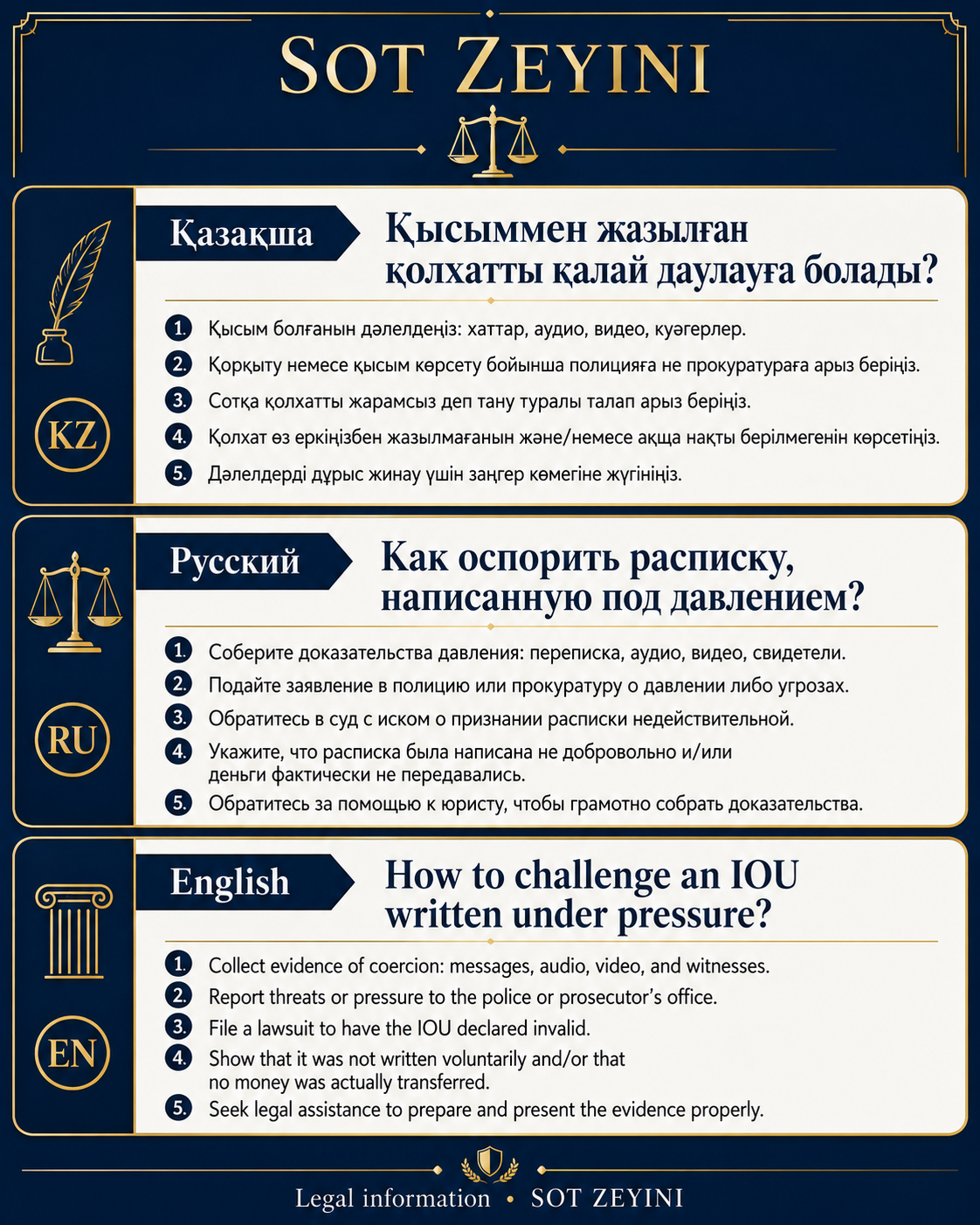
How to Challenge a Promissory Note Written Under Pressure
Can a Promissory Note Written Under Pressure Be Challenged?
Yes. A promissory note, debt receipt, or written acknowledgment of debt may be challenged if it was written or signed under threats, pressure, violence, blackmail, or coercion.
The key issue is whether the person acted freely. A signature alone does not always mean that the person voluntarily accepted a debt. If the document was obtained through threats or pressure, it may be disputed in court.
What Does “Written Under Pressure” Mean?
A document is considered written under pressure when a person writes or signs it not because they freely agree, but because they are afraid or forced.
Examples include:
- threats of physical violence;
- threats against family members;
- threats to publish private photos or videos;
- threats to file a false police report;
- being forced to sign in front of several people;
- being prevented from leaving a room;
- being forced to admit a debt that does not exist;
- threats to damage business or property;
- being forced to sign after a conflict.
In such cases, the main question is not only whether the signature belongs to the person, but whether the person’s will was free.
Is a Promissory Note Proof of Debt?
Usually, a promissory note or debt receipt may be used as evidence of a loan or obligation to repay money. If the document states that a person received a certain amount and must return it, the creditor may rely on it in court.
However, it is not absolute proof. It may be challenged if:
- the money was never actually transferred;
- the note was written under threats;
- the document was signed under psychological or physical pressure;
- the text was altered;
- the person did not understand the meaning of the document;
- the signature was forged;
- the debt was already repaid;
- the note was written for a different purpose.
So, the existence of a promissory note does not automatically mean losing the case.
How Can the Note Be Challenged?
There are several legal defense strategies.
1. Filing a Claim to Declare the Note Invalid
If the promissory note is used as a basis for collecting money, the person may file a claim asking the court to declare it invalid.
The claim may request the court to:
- declare the note invalid;
- recognize that no debt exists;
- refuse debt recovery based on the note;
- apply consequences of invalidity;
- award damages or moral harm if appropriate.
The person must prove that the note was written under threats, violence, or pressure.
2. Filing Objections to a Debt Recovery Claim
If the other party has already filed a lawsuit to recover money based on the note, the defendant should submit written objections.
The objections may state that:
- the note was written under pressure;
- the money was not actually transferred;
- there was no real debt;
- the document was obtained through threats;
- a police complaint was filed;
- evidence of pressure exists.
If necessary, a counterclaim may be filed to declare the note invalid.
3. Filing a Police Complaint
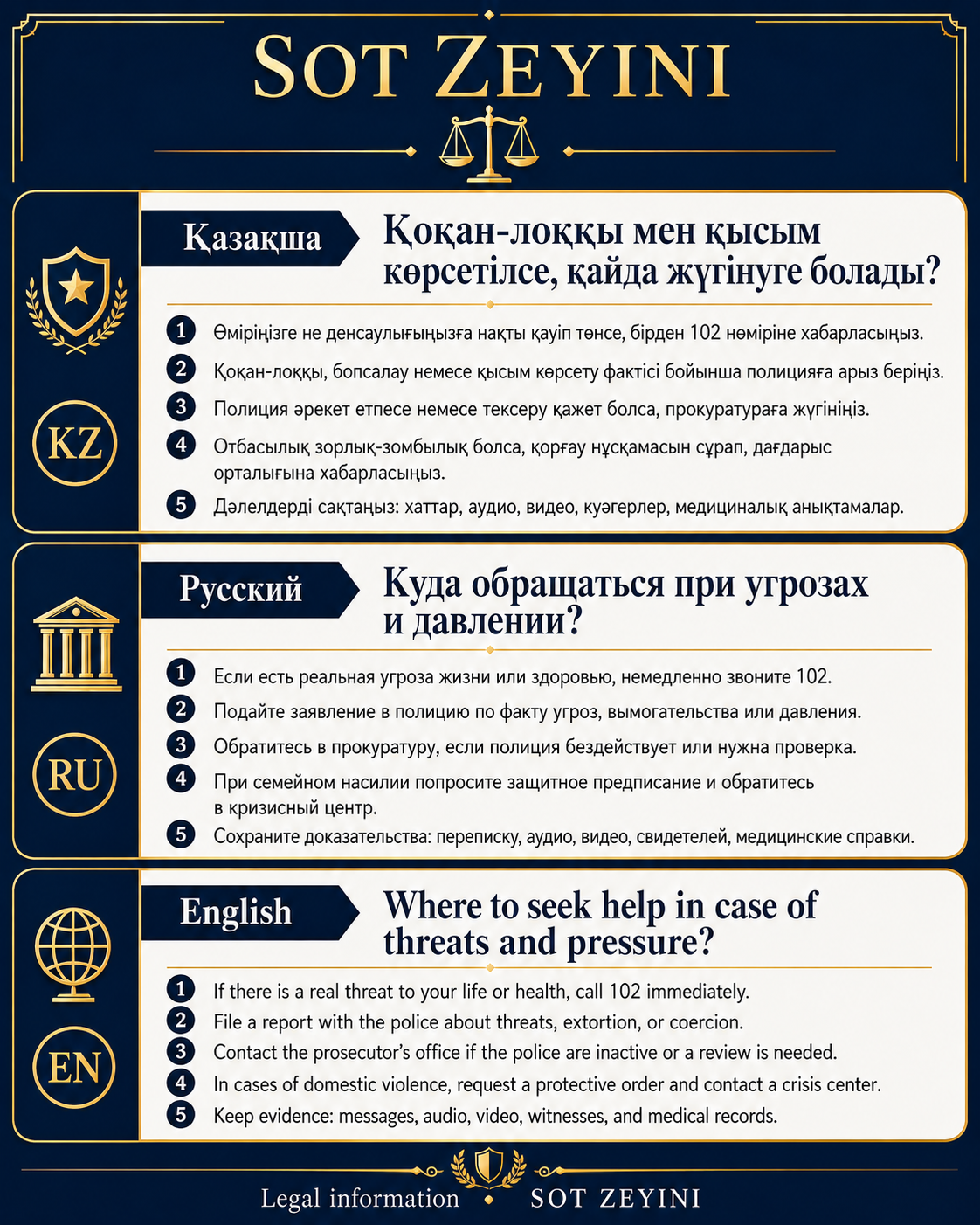
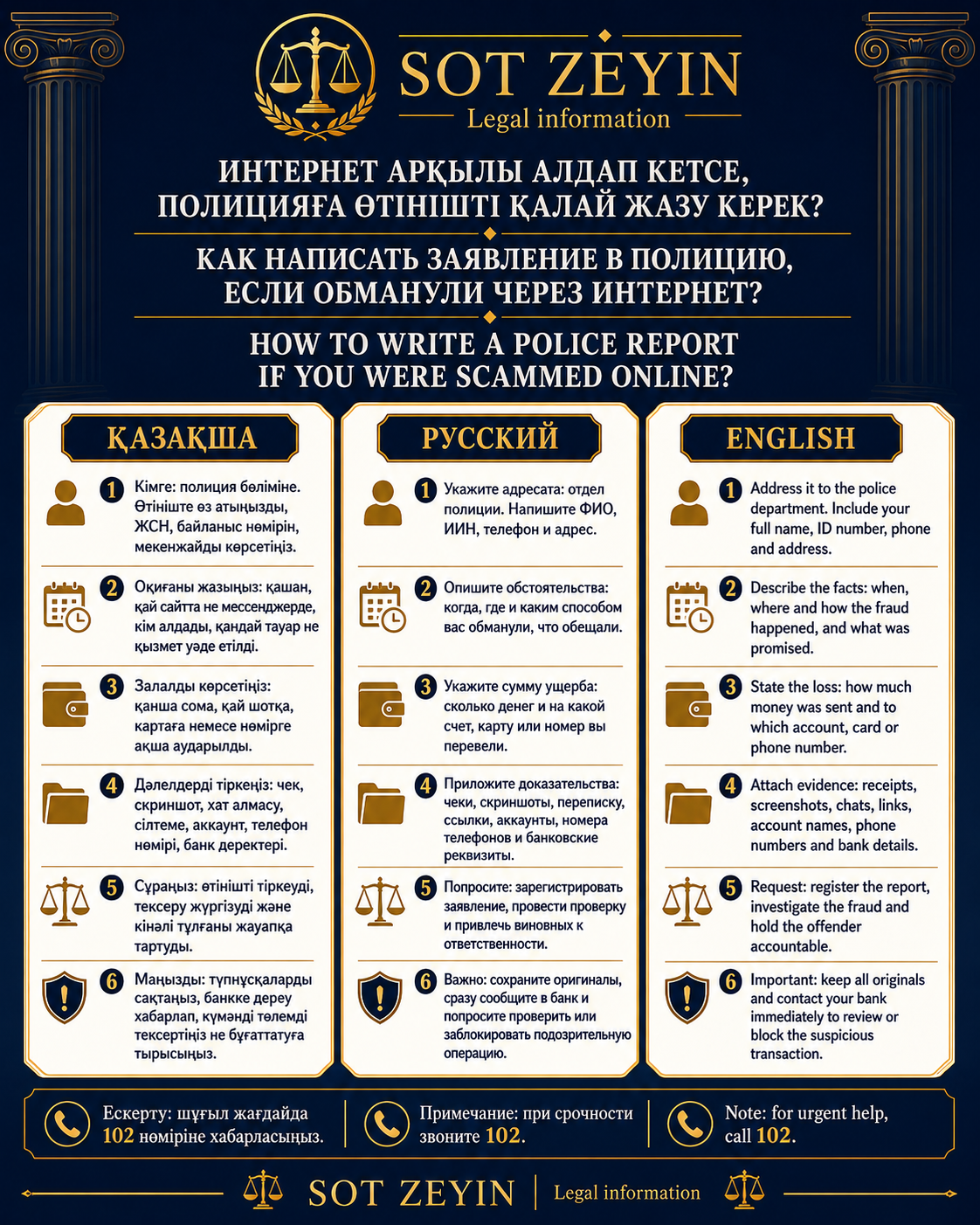
If the note was obtained through threats, blackmail, extortion, or physical pressure, a police complaint should be filed.
The complaint should describe:
- who forced the person to write the note;
- when it happened;
- where it happened;
- who was present;
- what threats were made;
- whether money was transferred;
- why the note was not written voluntarily;
- what evidence is available.
If a person demanded money, property, or a written debt acknowledgment under threat, the situation may have signs of a criminal offense.
4. Claiming That No Debt Exists
If the money mentioned in the note was never actually transferred, the person may challenge not only the note but also the existence of the debt.
For example, a person may be forced to write: “I received KZT 5,000,000,” even though no money was transferred. In that case, it is important to prove both pressure and the absence of money transfer.
What Evidence Is Needed?
Evidence is crucial. A court will usually not rely only on the statement “I was forced.”
Possible evidence includes:
- WhatsApp messages;
- SMS;
- audio recordings;
- video recordings;
- call recordings;
- witnesses;
- police complaint;
- registration confirmation from police;
- medical certificates;
- documents confirming injuries;
- screenshots of threats;
- CCTV footage;
- lack of bank transfers;
- lack of proof of money transfer;
- documents confirming the circumstances of signing.
If the money was allegedly transferred in cash, the court may analyze whether the creditor had that amount, where the transfer happened, and whether there is evidence of the transfer.
Importance of Witnesses
Witnesses may confirm important facts:
- the person was afraid;
- several people applied pressure;
- threats were made;
- no money was transferred;
- the note was written during a conflict;
- the person did not act freely.
Witnesses who personally saw the signing or observed the person’s condition immediately after the event are especially important.
What If the Money Was Never Transferred?
If the note says that money was received, but in reality no money was transferred, the fact of the loan should be disputed.
Important questions include:
- was there a bank transfer;
- where was the money allegedly given;
- who saw the transfer;
- did the creditor have the financial ability to give such an amount;
- why was the money allegedly given in cash;
- is there proof of the origin of funds;
- do the date of the note and the alleged transfer match.
For large cash amounts, the creditor may need to explain how the money was actually transferred.
Is Handwriting Expertise Needed?
If the person claims that the signature or text is not theirs, the court may be asked to appoint handwriting expertise.
However, if the position is “the signature is mine, but I signed under pressure,” handwriting expertise will not answer the main question. It can confirm who wrote the document, but pressure must be proven by other evidence.
Does a Police Complaint Help?
Yes, a police complaint may help. It shows that the person officially reported threats, pressure, or extortion.
A police complaint may:
- record the fact of reporting;
- confirm the existence of a conflict;
- serve as additional evidence in civil court;
- lead to an investigation of the other party’s actions.
However, a police complaint does not automatically make the promissory note invalid. A civil claim or counterclaim may still be required.
What Can Be Requested in Court?
Depending on the situation, the person may ask the court to:
- declare the promissory note invalid;
- recognize that no debt exists;
- refuse recovery based on the note;
- apply consequences of invalidity;
- award damages;
- award moral harm;
- attach police materials;
- call witnesses;
- request CCTV footage;
- appoint expert examination.
The correct claims depend on the facts of the case.
Common Mistakes
Common mistakes include:
- Not collecting evidence
- Not filing a police complaint
- Waiting too long after signing
- Deleting messages
- Not describing exact threats
- Not disputing the transfer of money
- Not filing objections in court
- Ignoring the lawsuit
- Not calling witnesses
- Choosing the wrong defense position
If the document was really written by you but under pressure, it may be better to argue that there was no free will, rather than falsely claiming that the handwriting is not yours.
How to Prove Pressure
It is important to reconstruct the full timeline:
- when pressure started;
- who made threats;
- what words were used;
- where the note was written;
- who was present;
- whether money was transferred;
- what happened after signing;
- when the police complaint was filed;
- what messages or calls were preserved.
A court needs a logical and evidence-supported story.
Sample Objection Wording
“I disagree with the claim because the promissory note was written by me not voluntarily, but under psychological pressure and threats from the claimant. The money stated in the note was not actually transferred to me. I filed a police complaint regarding the pressure and threats. I ask the court to critically assess the note, request additional evidence, call witnesses, and dismiss the claim.”
Conclusion
A promissory note written under pressure may be challenged. However, evidence is necessary: threats, messages, audio, video, witnesses, police complaint, medical documents, and proof that money was not transferred.
It is usually best to act in two directions: file a police complaint regarding threats or extortion and prepare a civil defense or claim in court.
The most important step is to act quickly and preserve evidence. A promissory note may look like a simple piece of paper, but in court it can become a document worth millions.
FAQ
Can a promissory note signed under pressure be challenged?
Yes, if threats, violence, pressure, or coercion can be proven.
Can I dispute the note if the signature is mine?
Yes. The key argument may be that the signature was made without free will.
What if the money was never transferred?
The fact of the loan should be challenged, and the creditor should prove that money was actually transferred.
Should I file a police complaint?
Yes, if there were threats, blackmail, extortion, or physical pressure.
What evidence is needed?
Messages, audio, video, witnesses, police complaint, medical documents, and lack of proof of money transfer.
What if a lawsuit has already been filed against me?
You should file written objections and, if necessary, a counterclaim to declare the note invalid.
Will handwriting expertise help?
It helps if the signature or text is disputed. But pressure must be proven with other evidence.
Is a lawyer needed?
Yes. These cases require a clear legal position, proper evidence collection, and accurate court claims.