 +7 775 858 9294
 WhatsApp
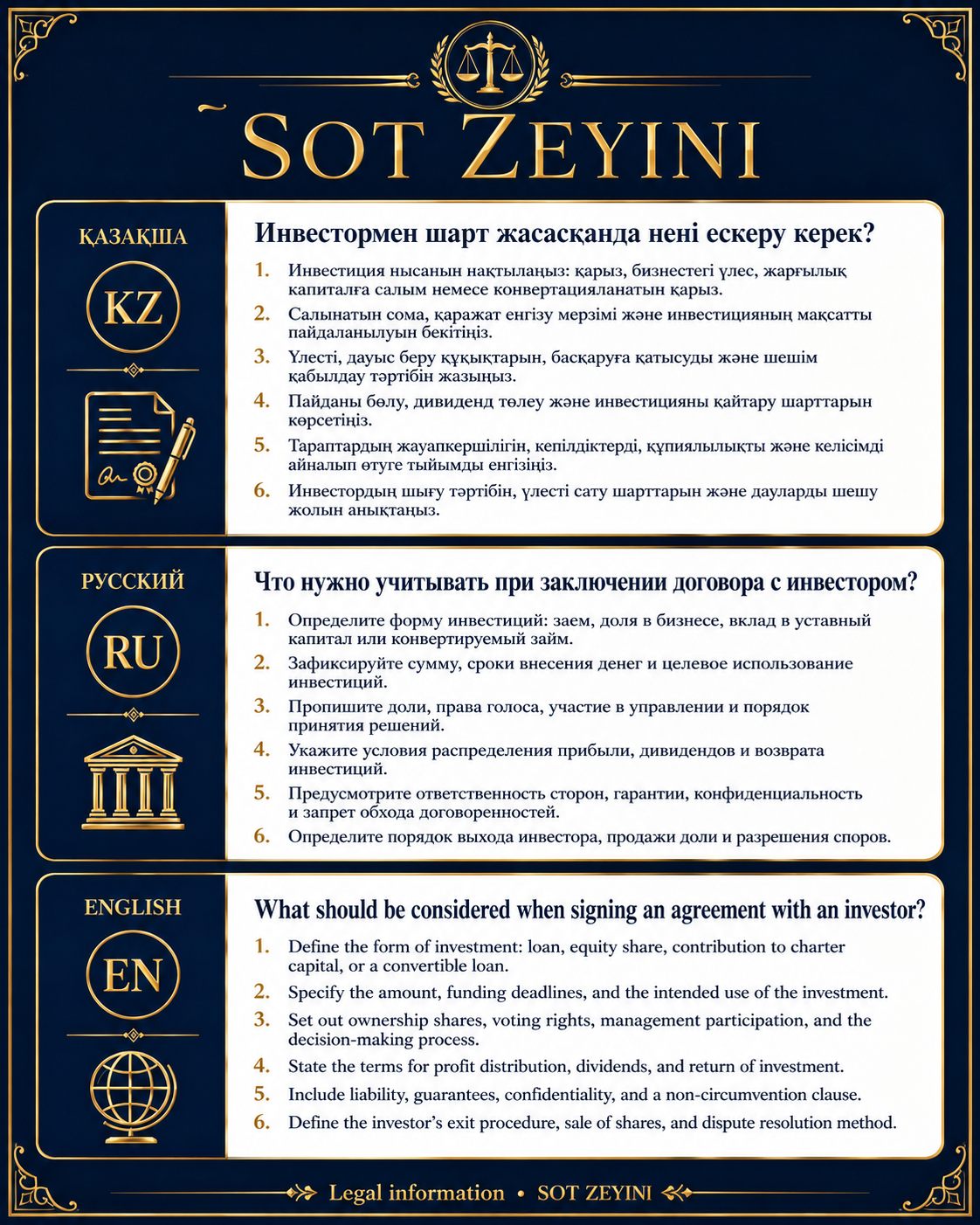
What Should You Consider When Signing an Agreement With an Investor?
Why Do You Need an Agreement With an Investor?
Attracting an investor can help a business grow faster: open a new branch, buy equipment, launch advertising, hire employees, or scale a project. However, if the relationship with the investor is not properly documented, the investment may turn into a dispute.
The main issue is that the parties may understand the money differently. The investor may believe the money was provided as a loan and must be repaid. The entrepreneur may believe the money was invested into the business and is subject to business risk.
An investor agreement helps clearly define the rights and obligations of both parties.
Investment, Loan, or Equity?
Before signing an agreement, the parties must choose the legal model.
The most common options are:
- Loan — the investor provides money, and the business must repay it within an agreed period.
- Equity investment — the investor becomes a participant or shareholder and receives a share in the company.
- Investment agreement — money is invested into a project, and the result is distributed according to the agreement.
- Mixed model — part of the amount is treated as a loan, and part as equity.
It is risky to simply state that “the investor transfers money” without defining the legal nature of the transaction. The agreement must clearly state what the investor receives: repayment, equity, profit share, or another right.
If the Investor Receives Equity
If the investor enters the business through equity, the agreement should specify:
- investment amount;
- investor’s ownership share;
- how the share will be formalized;
- whether the investor becomes a participant of the company;
- whether the charter capital changes;
- whether approval of other participants is required;
- how changes will be registered;
- whether the investor may sell the share;
- valuation method upon exit.
For example, if the investor contributes KZT 20,000,000 and receives 30% of the company, it is not enough to sign a simple receipt. Corporate documents, participant resolutions, charter amendments, and registration procedures may be required.
If the Money Is Structured as a Loan
If the investor provides money with repayment obligations, a loan agreement should be signed.
It should include:
- loan amount;
- repayment period;
- interest or remuneration;
- payment schedule;
- early repayment rules;
- pledge or guarantee;
- liability for late payment;
- purpose of using the money.
A loan may be safer for the investor but riskier for the entrepreneur, because the debt may need to be repaid even if the business does not generate profit.
Purpose of the Investment
The agreement should clearly state how the investor’s money will be used.
For example:
- purchase of equipment;
- opening a branch;
- lease or purchase of premises;
- marketing and advertising;
- hiring employees;
- purchase of goods;
- website or app development;
- working capital.
If the purpose is not specified, the investor may later claim that the funds were misused.
Profit Distribution
One of the most important parts of an investor agreement is how the investor receives income.
The agreement should state:
- whether profit is distributed according to ownership shares;
- whether payment depends on net profit or revenue;
- whether payments are monthly, quarterly, or annual;
- whether taxes, salaries, rent, and debts are paid first;
- whether a company reserve is created;
- who approves the financial result.
It is important not to confuse revenue with profit. Money received by the company is not automatically net profit. Business expenses must be deducted first.
Can You Promise Guaranteed Profit to an Investor?
Guaranteed profit should be treated carefully. If the agreement states that the investor receives fixed income regardless of business results, the relationship may look like a loan or financial obligation.
If the investment is linked to business risk, the agreement should state that the investor’s income depends on the financial results of the project.
Example:
“Payment of income to the investor shall be made only if the company has net profit for the reporting period.”
Does the Investor Participate in Management?
An investor may be passive or active.
A passive investor:
- provides money;
- receives reports;
- receives income;
- does not interfere with daily operations.
An active investor may:
- approve major expenses;
- participate in strategic decisions;
- control the budget;
- participate in appointing the director;
- access financial documents.
The agreement should define the limits of control. If the investor receives too many powers, the entrepreneur may lose control of the business.
Reporting to the Investor
Reporting is an essential part of an investor agreement.
The agreement may include:
- monthly financial report;
- expense report;
- sales report;
- bank statements;
- accounting documents;
- KPI report;
- project progress report.
The reporting format should also be specified: PDF, Excel, accounting certificate, presentation, or CRM access.
Investor Exit From the Project
The investor’s exit mechanism should be agreed in advance.
The agreement should specify:
- when the investor may exit;
- how the investor’s share is valued;
- who has the first right to buy the share;
- whether payment may be made in installments;
- what happens if the business is sold;
- what happens if the project has losses;
- whether the investment is returned;
- when final settlement is made.
If the exit mechanism is not defined, the investor may demand money back at an inconvenient time for the business.
Confidentiality and Client Database
Investors often receive access to internal business information, such as:
- business plan;
- financial model;
- client database;
- suppliers;
- prices;
- marketing strategy;
- contracts;
- CRM;
- trade secrets.
The agreement should include a confidentiality clause. It may also prohibit the investor from using the client database or taking clients for a competing business.
Intellectual Property
If the investment relates to a website, brand, IT project, app, design, or content, intellectual property must be addressed.
The agreement should determine:
- who owns the domain;
- who owns the website;
- who owns the brand;
- who owns the code;
- who owns the CRM and database;
- what happens to these assets if the investor exits.
If this is not specified, the most valuable business asset may end up registered to the wrong person.
Liability of the Parties
The agreement should include liability for violations, such as:
- investor fails to transfer funds;
- entrepreneur misuses funds;
- reports are not provided;
- confidentiality is breached;
- money is withdrawn unlawfully;
- management rules are violated;
- exit procedure is breached.
Possible consequences include penalties, compensation of losses, termination of the agreement, buyout of the share, or court protection.
Common Mistakes in Investor Agreements
The most common mistakes are:
- Not defining whether the money is a loan or investment
- Not specifying the investor’s share
- Not defining the purpose of funds
- Not describing profit distribution
- Promising guaranteed income without considering risk
- Not including reporting obligations
- Not defining the investor’s exit
- Not protecting the client database
- Not addressing intellectual property
- Agreeing only verbally or via WhatsApp
These mistakes may lead to disputes, lawsuits, or loss of business control.
What Should an Investor Agreement Include?
An investor agreement should include:
- details of the parties;
- investment amount;
- legal model: loan, equity, or investment;
- purpose of funds;
- payment procedure;
- investor’s share;
- profit distribution;
- management rights;
- reporting obligations;
- expense control;
- liability;
- confidentiality;
- intellectual property;
- investor exit procedure;
- termination procedure;
- dispute resolution;
- signatures and details of the parties.
Conclusion
An investor agreement is not just a document about money transfer. It is the legal foundation of the relationship between the entrepreneur and the investor.
The most important point is to define what the investor receives: repayment, ownership share, profit share, or another right. The agreement should also cover the purpose of investment, reporting, management rights, liability, and exit procedure.
A well-drafted agreement protects both parties. A poorly drafted one may lead to loss of money, control, and time.
FAQ
What agreement should be signed with an investor?
The parties may sign an investment agreement, loan agreement, equity transfer agreement, or shareholders’ agreement.
Does an investor always receive equity?
No. An investor may provide money as a loan, receive equity, or earn income under another model agreed by the parties.
Must investment money be returned?
If the money is structured as a loan, yes. If the investor receives equity and accepts business risk, repayment may not be required.
Can guaranteed profit be promised to an investor?
It is possible, but legal consequences must be considered. Fixed income may make the relationship similar to a loan obligation.
Can an investor manage the business?
Yes, if the agreement or corporate documents provide for it. The investor’s powers should be clearly limited.
How can a business protect itself from an investor?
The agreement should define management limits, confidentiality, non-solicitation, exit procedure, and liability.
Is a lawyer needed for an investor agreement?
Yes. Investor agreements involve money, ownership shares, risks, and corporate rights.