 +7 775 858 9294
 WhatsApp
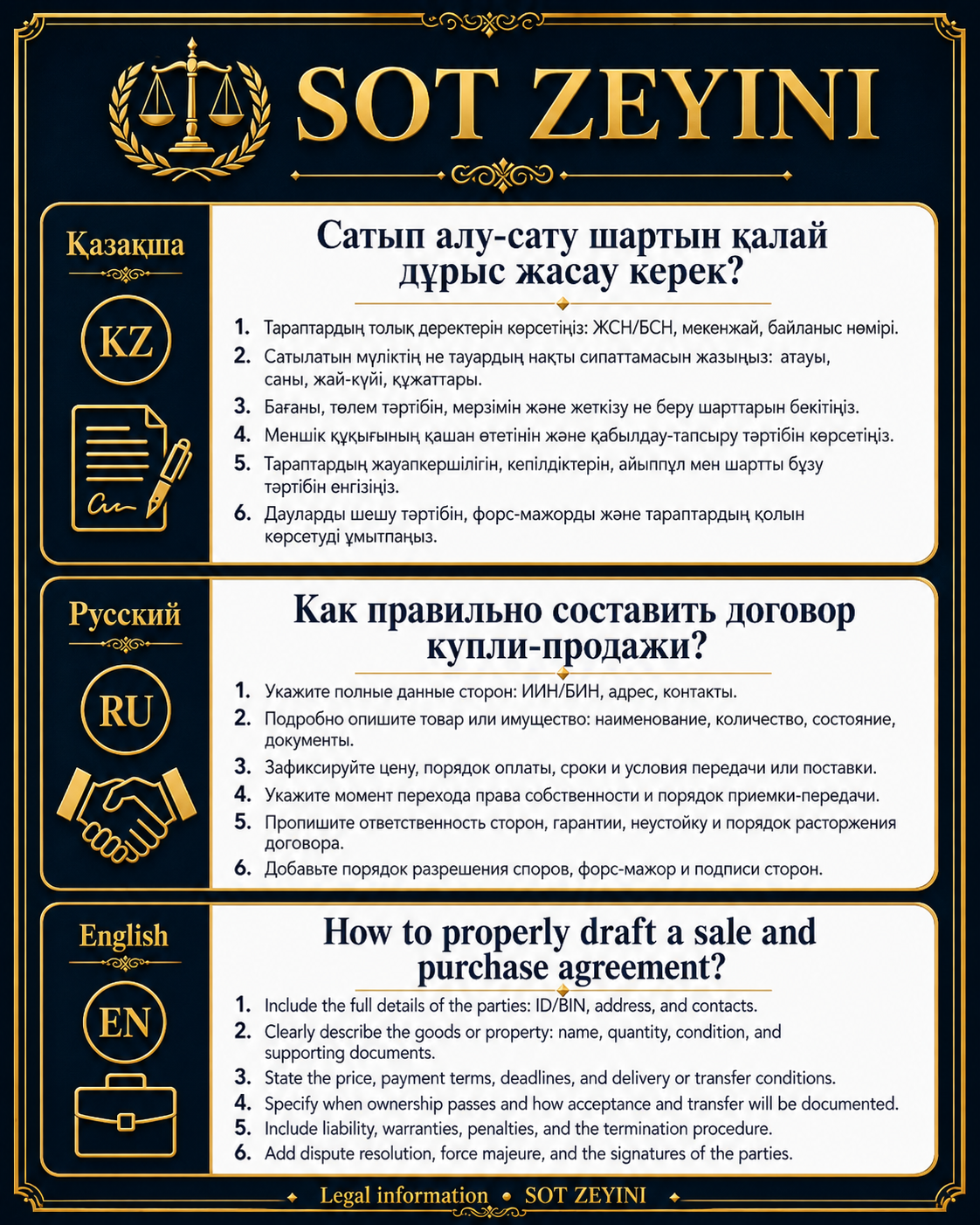
How to Properly Draft a Sale and Purchase Agreement
What is a sale and purchase agreement?
A sale and purchase agreement is a legal contract under which the seller agrees to transfer property, goods, or another asset to the buyer, and the buyer agrees to accept it and pay the agreed price.
At first glance, such an agreement may seem simple: one party sells, the other buys. However, many disputes arise precisely because the agreement was poorly drafted, incomplete, or copied from a generic online template.
A properly drafted agreement protects both parties and helps avoid disputes over payment, ownership, defects, restrictions, liens, arrests, or third-party rights.
What information must be included in the agreement?
A sale and purchase agreement should clearly identify the parties.
If a party is an individual, the agreement should include:
- full name;
- personal identification number;
- identity document details;
- residential address;
- contact number.
If a party is a legal entity, the agreement should include:
- full company name;
- business identification number;
- legal address;
- bank details;
- details of the director or authorized representative.
Incorrect or incomplete party details may create problems during registration, payment recovery, or court proceedings.
Subject of the agreement
The subject of the agreement is the asset being sold. It must be described in detail.
For real estate, the agreement should include:
- address;
- cadastral number;
- area;
- ownership documents;
- information about the owner.
For a vehicle, the agreement should include:
- make and model;
- year of manufacture;
- VIN code;
- state registration number;
- vehicle registration document details;
- technical condition.
For equipment or goods, the agreement should include:
- name;
- model;
- quantity;
- serial number;
- condition;
- комплектation or accessories included.
A vague phrase such as “the seller sells the vehicle” is not enough. The agreement must clearly state which vehicle is being sold, in what condition, and under what terms.
Price and payment procedure
The agreement must specify the exact price of the asset and the payment procedure.
Payment may be made:
- in cash;
- by bank transfer;
- through a mobile banking application;
- in installments;
- with an advance payment;
- after transfer of the asset;
- after state registration of ownership.
Bank payment is usually safer because it creates clear evidence. If payment is made in cash, the parties should sign a receipt or a separate act confirming the transfer of money.
The agreement should also state when the payment is considered completed: when the buyer sends the money or when the money is received by the seller.
Transfer of the asset
The agreement should clearly state when and how the seller transfers the asset to the buyer.
For example:
- on the date of signing the agreement;
- after full payment;
- after state registration;
- before a specific date;
- by signing a transfer and acceptance act.
If the transfer date is not specified, the parties may later disagree. The buyer may claim that the asset should already have been transferred, while the seller may argue that the deadline has not yet arrived.
Condition of the asset
The agreement should describe the condition of the asset at the time of sale.
It is important to state whether the asset:
- is new or used;
- has defects;
- has debts attached to it;
- is pledged or mortgaged;
- is under arrest or restriction;
- is subject to third-party rights.
This is especially important when buying real estate, land, vehicles, business assets, or expensive equipment.
What should be checked before buying real estate?
Before buying an apartment, house, land plot, or commercial property, the buyer should check:
- ownership documents;
- identity of the owner;
- registered rights to the property;
- arrests, pledges, mortgages, or restrictions;
- spouse’s consent, if the property was acquired during marriage;
- utility debts;
- technical characteristics;
- land purpose;
- pending court disputes;
- whether the actual area matches the documents.
If real estate is pledged, arrested, or subject to third-party rights, the buyer may face serious legal problems after the transaction. That is why legal due diligence before signing is essential.
What should be checked before buying a vehicle?
Before buying a vehicle, it is important to check:
- whether the vehicle is pledged;
- whether there are arrests or restrictions;
- unpaid fines;
- VIN code accuracy;
- actual owner;
- accident history;
- whether the vehicle is wanted by authorities;
- restrictions on registration actions.
The agreement should include the seller’s guarantee that the vehicle is not pledged, arrested, restricted, or subject to third-party claims.
Is notarization required?
Not every sale and purchase agreement must be notarized. However, certain transactions, especially those involving real estate, may require notarization or state registration.
For high-value or complex transactions, it is advisable to consult a lawyer or a notary before signing. This helps avoid costly mistakes.
Common mistakes when drafting a sale and purchase agreement
The most common mistakes include:
- vague description of the asset;
- unclear payment procedure;
- no proof of payment;
- no transfer and acceptance act;
- failure to check arrests, pledges, or restrictions;
- failure to obtain spouse’s consent;
- no liability clause;
- no termination procedure;
- no dispute resolution clause;
- using a generic template without adapting it.
These mistakes may lead to court disputes, invalidation of the transaction, recovery claims, or loss of property.
Liability of the parties
The agreement should clearly define liability for breach of obligations.
For example:
- penalty for late payment;
- penalty for late transfer of the asset;
- obligation to refund the money if the asset cannot be transferred;
- liability for hidden defects;
- liability for arrests, pledges, or third-party rights;
- compensation for damages.
The clearer the liability clauses are, the easier it is to protect your rights in court.
Why is a transfer and acceptance act important?
A transfer and acceptance act confirms that the asset was actually transferred to the buyer.
It usually includes:
- description of the transferred asset;
- date of transfer;
- condition of the asset;
- whether the parties have any claims;
- signatures of the parties.
Without this document, the seller may claim that the asset was transferred, while the buyer may claim the opposite. To avoid this legal ping-pong, it is better to sign the act.
Should a lawyer review the agreement?
Yes, especially if the transaction involves real estate, a vehicle, business assets, equipment, or a large amount of money.
A lawyer can help to:
- review the documents;
- identify legal risks;
- draft the agreement properly;
- include liability clauses;
- check arrests, pledges, and restrictions;
- prepare a transfer and acceptance act;
- protect the interests of the buyer or seller.
Legal review before signing is usually much cheaper than litigation after a failed transaction.
Conclusion
A sale and purchase agreement is not a formality. It is the key legal document that protects the parties to the transaction.
The agreement should clearly describe the asset, price, payment procedure, transfer date, liability, seller’s guarantees, and dispute resolution procedure.
Before signing, it is important to check ownership documents, arrests, pledges, restrictions, debts, and third-party rights. This is especially important for real estate, vehicles, and high-value transactions.
If you want to buy or sell property safely, it is better to consult a lawyer in advance. This will help prevent disputes and protect your legal rights.
FAQ
Can a sale and purchase agreement be oral?
Some simple everyday transactions may be made orally. However, for real estate, vehicles, valuable property, or large amounts of money, a written agreement is strongly recommended.
Does a receipt replace a sale and purchase agreement?
A receipt may confirm payment, but it does not always replace a complete agreement. It is better to have both: a written agreement and proof of payment.
What should I do if the seller received the money but did not transfer the asset?
You may send a written claim first. If the seller refuses to comply, you may file a lawsuit seeking transfer of the asset, refund of the money, termination of the agreement, or damages.
Should the asset be checked before purchase?
Yes. The buyer should check the owner, documents, arrests, pledges, restrictions, debts, and third-party rights.
Can I use an online template?
You can, but with caution. A template must be adapted to the specific transaction. A generic document may not cover important legal risks.
Who pays the transaction expenses?
The parties decide this themselves. The payment of notary, registration, legal, or other expenses should be clearly stated in the agreement.
Can a sale and purchase agreement be terminated?
Yes. Termination may be possible if there are legal grounds, such as non-payment, failure to transfer the asset, hidden defects, restrictions, or material breach of the agreement.