 +7 775 858 9294
 WhatsApp
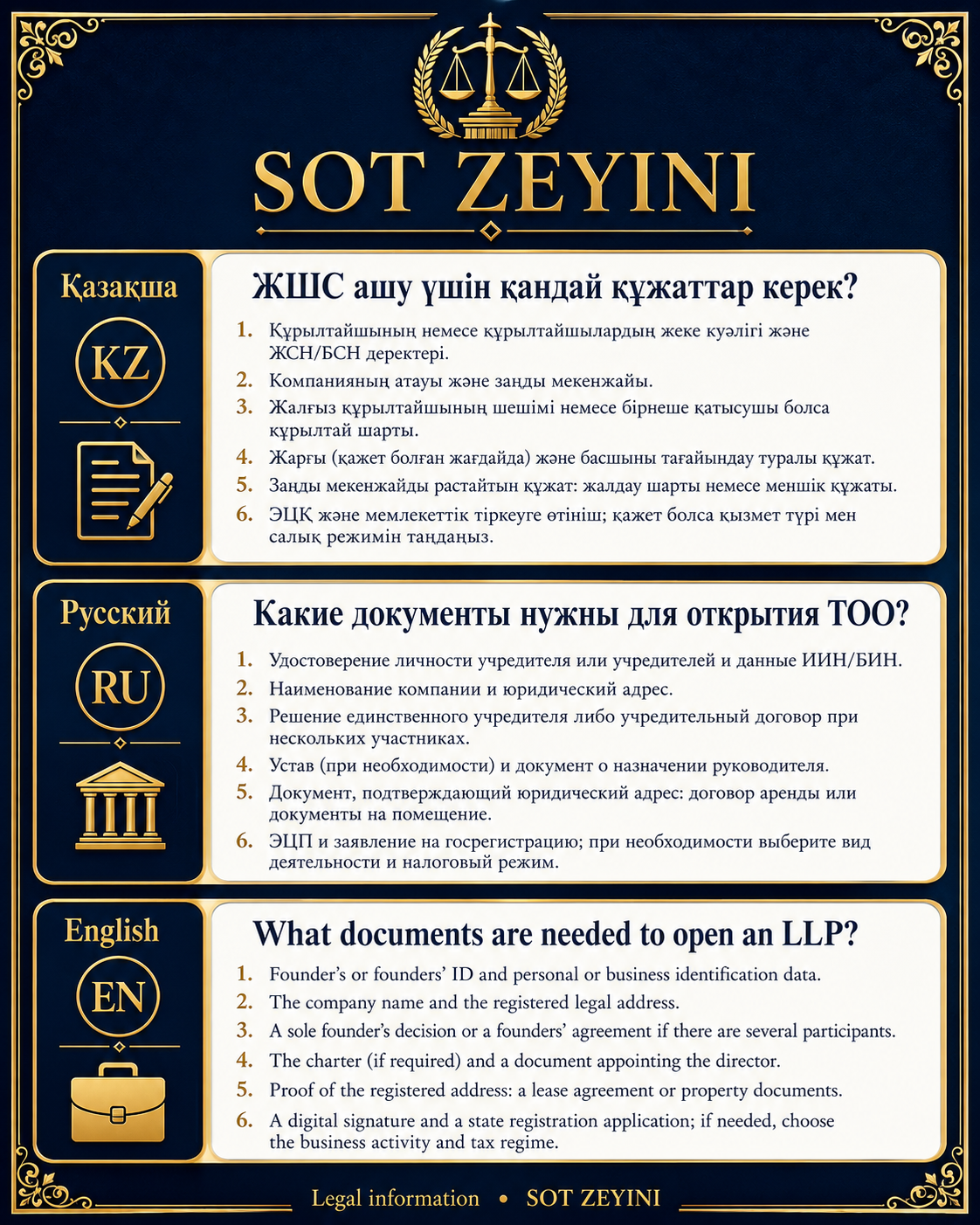
What Documents Are Needed to Open an LLP in Kazakhstan?
What is an LLP?
An LLP, or Limited Liability Partnership, is one of the most common legal forms for doing business in Kazakhstan. It may be established by one or several individuals or legal entities.
Opening an LLP allows a business to officially enter into contracts, open a bank account, hire employees, participate in tenders, pay taxes, and work with corporate clients.
In simple terms, an LLP gives a business a formal legal identity.
What documents are needed to open an LLP?
The list of documents depends on the number of founders, whether there is foreign participation, the registration method, and the type of business activity. In general, the following documents and information are needed:
- identity document of the founder;
- digital signature;
- LLP name;
- legal address;
- information about the director;
- decision of the sole founder or minutes of the founders’ meeting;
- charter of the LLP;
- foundation agreement, if there are several founders;
- information about participation shares;
- business activity code;
- chosen tax regime;
- license or permit, if the activity is licensed.
If the LLP has one founder, the process is simpler. If there are several founders, the shares and management rules should be prepared carefully.
Documents for an LLP with one founder
If an LLP is established by one participant, the following are usually needed:
- identity document of the founder;
- digital signature;
- decision of the sole participant to establish the LLP;
- charter or model charter;
- legal address;
- decision appointing the director;
- LLP name;
- business activity;
- tax regime.
If there is only one founder, a foundation agreement is not required because there are no relations between multiple founders to regulate.
Documents for an LLP with several founders
If two or more founders establish an LLP, the following may be needed:
- identity documents of all founders;
- digital signatures of the founders;
- minutes of the founders’ meeting;
- foundation agreement;
- charter of the LLP;
- information about participation shares;
- decision appointing the director;
- legal address;
- LLP name;
- business activity;
- tax regime.
It is very important to define the shares correctly. For example, the founders may hold 50/50, 70/30, or another distribution. These shares affect profit distribution, voting, exit from the LLP, and possible corporate disputes.
How to choose the LLP name
The LLP name should be distinguishable from the names of existing legal entities and should not mislead clients. It should not unlawfully copy a state body name, another brand, or restricted wording.
When choosing a name, it is useful to:
- keep it short and memorable;
- connect it with the business activity;
- check for similar company names;
- check domain and social media availability;
- consider future branding.
The name is the first impression of the business, so it should work not only legally but also commercially.
Is a legal address required?
Yes, a legal address is required for LLP registration. It may be:
- an office;
- leased premises;
- the founder’s address;
- a business center address;
- coworking address.
The address should be real and accessible. Official letters, tax notifications, and other documents may be sent there.
If the premises are leased, a lease agreement or the owner’s consent may be required.
Is a charter required?
Yes, an LLP must have a charter. The charter sets out the main legal rules of the company.
The charter usually includes:
- LLP name;
- location;
- purpose of activity;
- rights and obligations of participants;
- charter capital;
- participation shares;
- management bodies;
- powers of the director;
- profit distribution procedure;
- exit procedure;
- transfer of shares;
- reorganization and liquidation.
In some cases, a model charter may be used. However, if there are several founders or the business is complex, an individual charter is usually better.
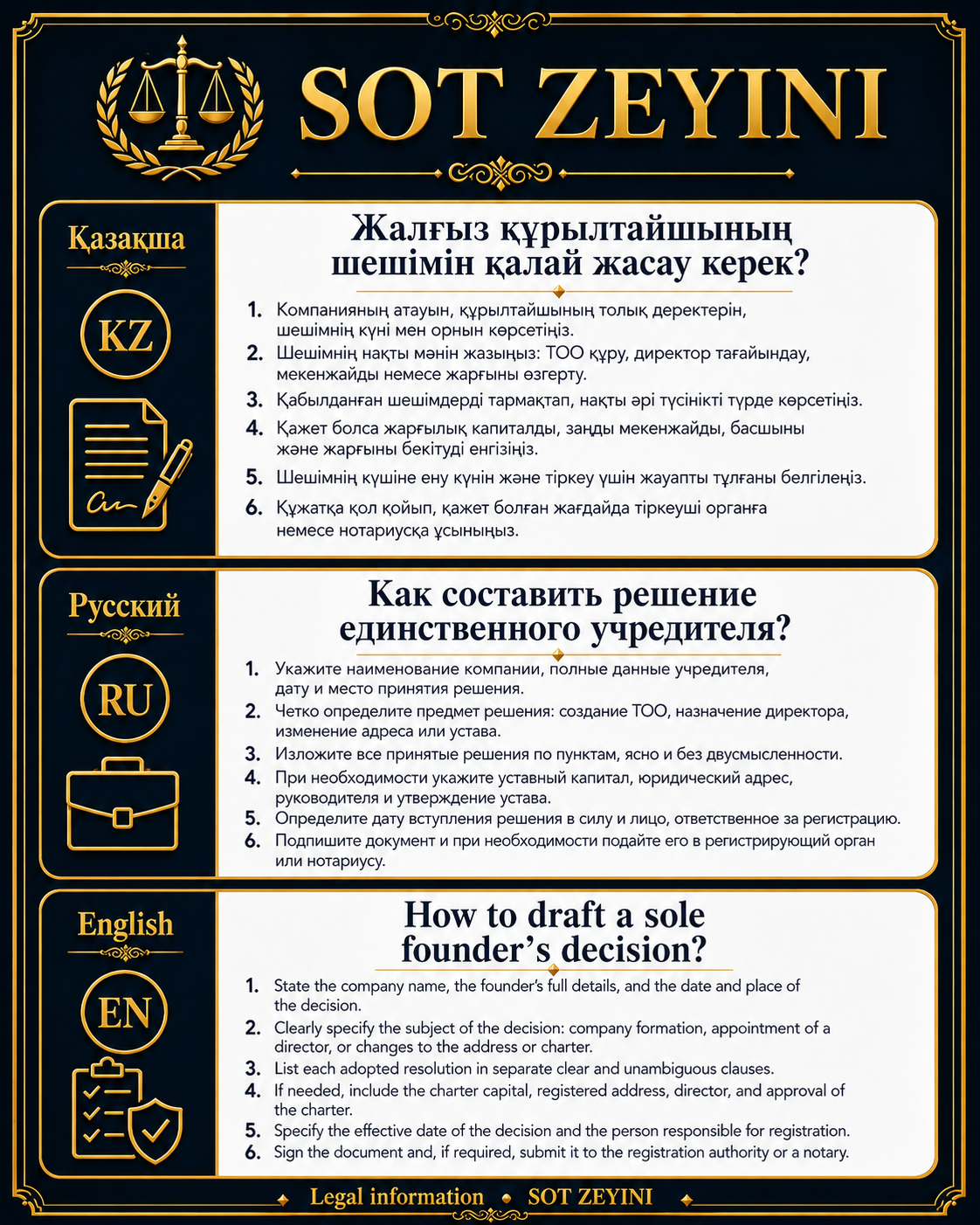
What is a founder decision?
If an LLP is established by one person, that person makes a decision to create the LLP. The decision usually states:
- establishment of the LLP;
- LLP name;
- legal address;
- charter capital;
- appointment of the director;
- approval of the charter;
- business activity.
This is the main document confirming the sole founder’s intention to create the company.
What are minutes of the founders’ meeting?
If there are several founders, minutes of the founders’ meeting are prepared. They usually state:
- decision to establish the LLP;
- name;
- legal address;
- participation shares;
- charter capital;
- director;
- approval of the charter;
- conclusion of the foundation agreement.
The minutes are important not only for registration but also for future relations between the participants.
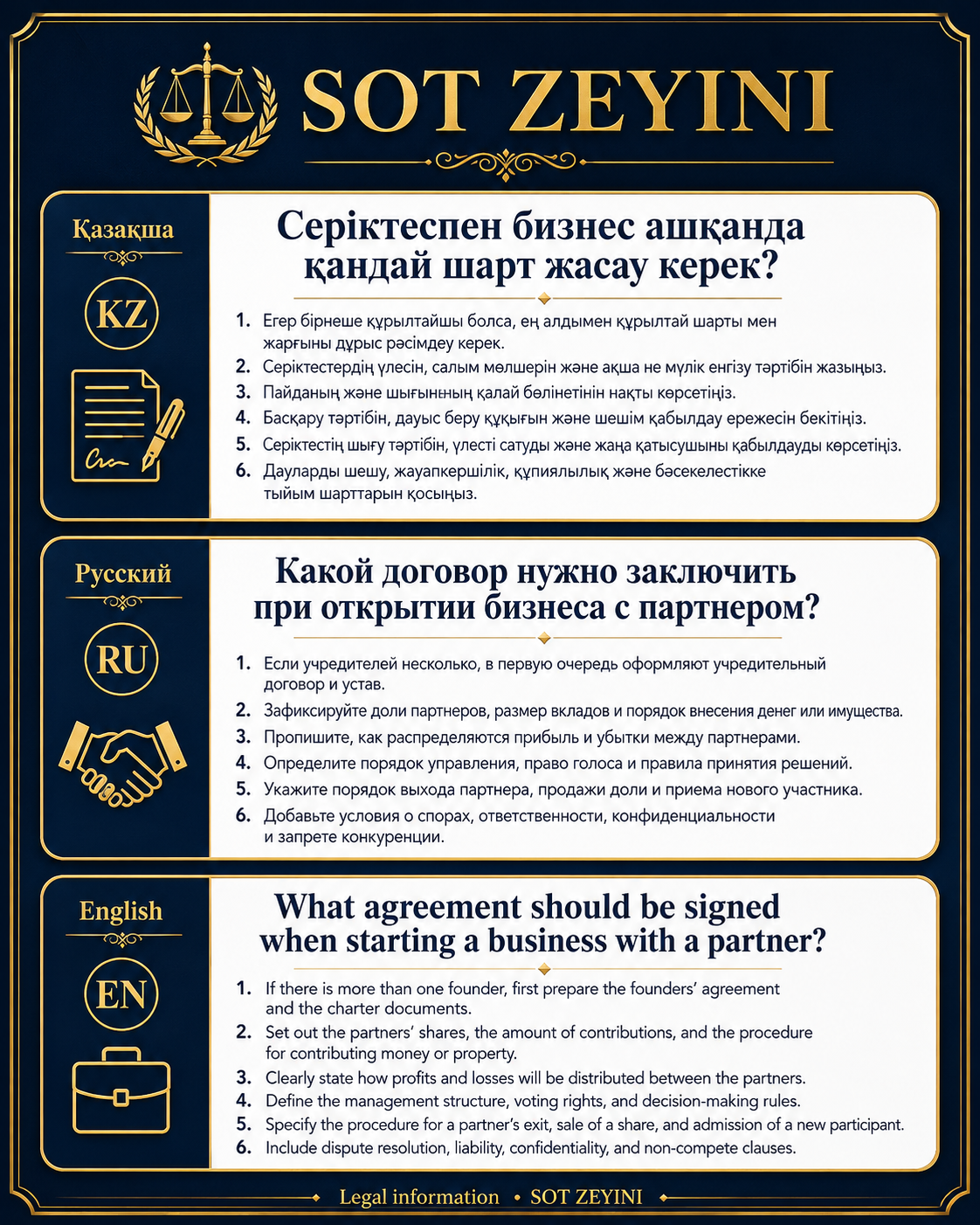
When is a foundation agreement needed?
A foundation agreement is needed when an LLP is established by several founders. It regulates their relations during the creation of the company.
The agreement may specify:
- who contributes what;
- size of shares;
- formation of charter capital;
- expenses related to registration;
- obligations of the founders;
- liability of the parties;
- joint actions for registration.
If there is only one founder, a foundation agreement is not needed.
Is charter capital required?
An LLP must indicate charter capital. Charter capital represents the founders’ contributions to the company.
For small business entities, the minimum charter capital requirements may be simplified. However, in practice, it is often better to state a reasonable amount that matches the business scale.
Charter capital may be contributed in the form of:
- money;
- property;
- equipment;
- property rights.
If there are several participants, each participant’s share should be clearly defined.
How is the director appointed?
During LLP registration, information about the director is provided. The director is appointed by:
- decision of the sole participant;
- minutes of the founders’ meeting.
The director acts on behalf of the LLP, signs contracts, opens bank accounts, hires employees, and represents the company before third parties.
The director may be the founder or another individual.
Is it necessary to choose a tax regime?
Yes, choosing the correct tax regime is important after registration. An LLP may operate under the general tax regime or under a special tax regime if it meets the relevant requirements.
When choosing a tax regime, consider:
- turnover;
- number of employees;
- type of activity;
- client structure;
- VAT needs;
- expenses;
- accounting system.
Choosing the wrong tax regime may lead to extra taxes, reporting difficulties, and penalties.
Can an LLP be opened through eGov?
Yes, an LLP can be registered online through eGov. A digital signature is required. The online application usually includes the LLP name, address, director, founders, and business activity.
Online registration is convenient. However, if there are several founders, foreign participation, a non-standard charter, or licensed activity, it is better to review the documents in advance.
What documents are needed if there is a foreign founder?
If the founder is a foreign citizen or a foreign legal entity, additional documents may be required.
For example:
- passport of the foreign citizen;
- notarized translation;
- business visa or temporary residence permit, if required;
- extract from the trade register for a foreign legal entity;
- legalized or apostilled documents;
- translation into Kazakh and Russian.
For foreign participation, legalization and translation should be checked carefully, because mistakes may delay or prevent registration.
What should be done after LLP registration?
After registration, the LLP should:
- open a bank account;
- decide whether a seal is needed;
- organize accounting;
- confirm the tax regime;
- check whether a cash register is needed;
- prepare employment contracts if there are employees;
- check licensing requirements;
- prepare contract templates;
- connect electronic services;
- organize internal documents.
Registration is only the start. Proper operation matters just as much.
Common mistakes when opening an LLP
Common mistakes include:
- poor choice of company name;
- formal or unreliable legal address;
- unclear distribution of shares;
- using a random charter template;
- unclear director powers;
- wrong tax regime;
- no foundation agreement with several founders;
- failure to check licensing requirements;
- delaying accounting setup;
- no written arrangements between partners.
These mistakes may later create tax, banking, and corporate problems.
Conclusion
To open an LLP, the main documents and information are: identity document, digital signature, LLP name, legal address, director details, founder decision or minutes, charter, and foundation agreement if there are several founders.
If one person opens the LLP, the process is simpler. If there are several founders, the shares, management, exit procedure, and profit distribution should be agreed in advance.
Technically, opening an LLP is not very difficult. But preparing the documents correctly creates a solid legal foundation for the business.
FAQ
What documents are needed to open an LLP?
Identity document, digital signature, LLP name, legal address, director details, founder decision or minutes, charter, and foundation agreement if there are several founders.
Can one person open an LLP?
Yes, an LLP may be established by one participant. In that case, a sole participant decision is prepared.
Is a foundation agreement required?
It is not required if there is one founder. If there are several founders, it is needed to regulate relations between them.
Can an LLP be opened online?
Yes, an LLP can be registered through eGov with a digital signature.
Is a legal address required?
Yes, a legal address is required for LLP registration.
Is a charter required?
Yes, an LLP should have a charter. A model charter or individual charter may be used.
What should be done after registration?
Open a bank account, choose a tax regime, organize accounting, check licenses, and prepare business contracts.