 +7 775 858 9294
 WhatsApp
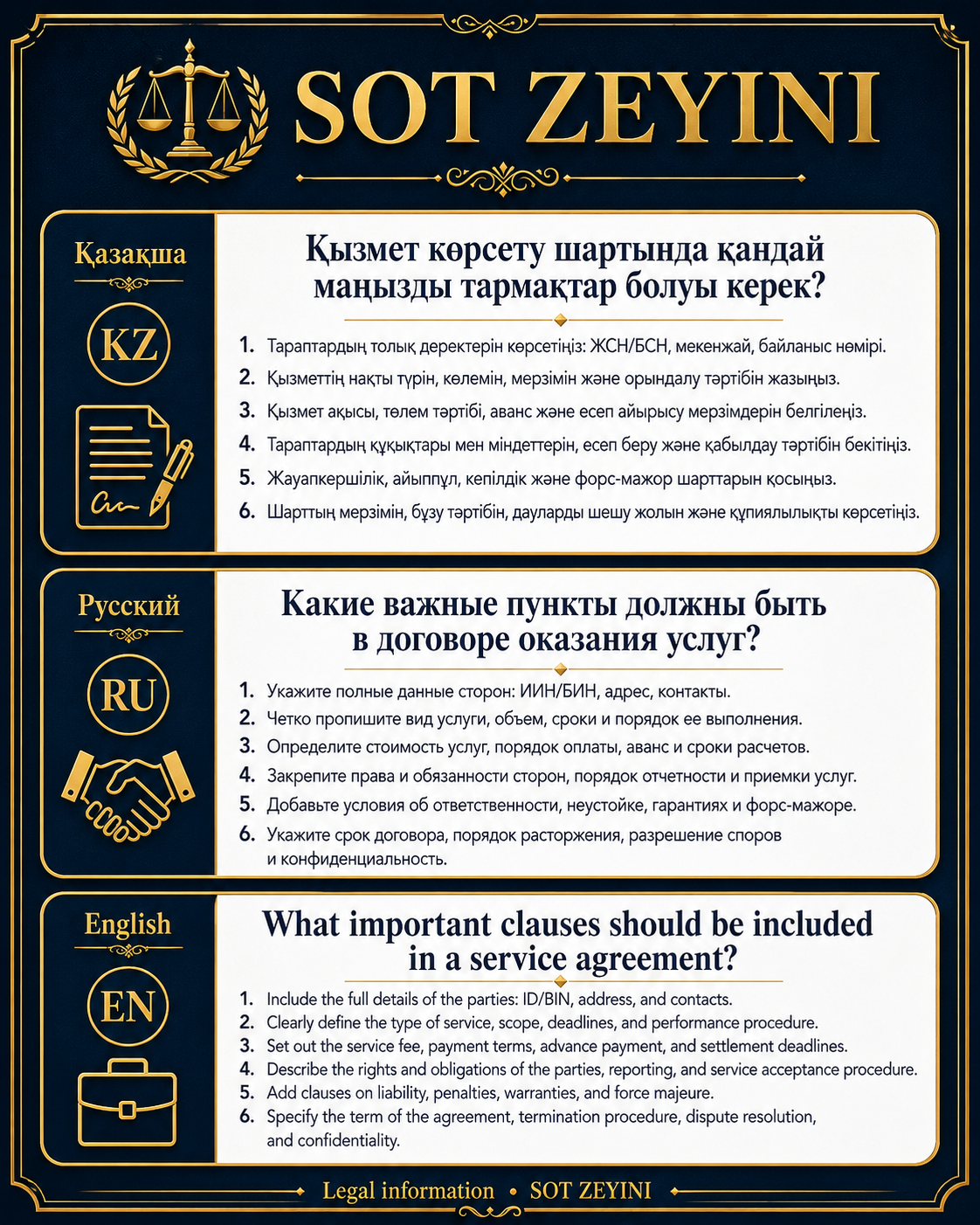
What Important Clauses Should Be Included in a Service Agreement?
What is a service agreement?
A service agreement is a contract under which one party, the service provider, agrees to provide certain services to the client, and the client agrees to accept and pay for those services.
Service agreements are used in many areas, including legal services, accounting, marketing, advertising, IT, design, consulting, education, repair, business support and other professional services.
The main purpose of a service agreement is to clearly answer several important questions: who provides the service, what exactly must be done, when it must be done, how much it costs and what happens if one party fails to perform. Without these answers, the agreement becomes legally weak.
1. Details of the parties
The agreement must clearly identify the client and the service provider.
For an individual, the agreement should include:
- full name;
- personal identification number;
- identity document details;
- address;
- phone number.
For an individual entrepreneur or legal entity, the agreement should include:
- full legal name;
- business identification number;
- legal address;
- bank details;
- director’s details;
- authority of the representative, if applicable.
Incorrect party details may cause problems with payment recovery, termination of the agreement or court proceedings.
2. Scope of services
The scope of services is one of the most important parts of the agreement.
It is not enough to write that “the provider shall provide services.” The agreement must clearly describe what services will be provided, in what volume and in what format.
For example, for legal services, the agreement may specify:
- consultation;
- preparation of legal documents;
- court representation;
- enforcement support;
- preparation of claims, complaints or applications.
For marketing services, the agreement may specify:
- advertising management;
- content creation;
- number of posts or videos;
- platforms;
- service period;
- reporting format.
The more specific the scope is, the lower the risk of disputes.
3. Deadlines and service period
A service agreement should clearly state when the services start and when they must be completed.
The term may be defined as:
- a specific start and end date;
- a period starting from receipt of prepayment;
- monthly service support;
- performance in stages;
- completion by a specific deadline.
If deadlines are unclear, the client and the provider may interpret the agreement differently. The client may expect immediate results, while the provider may believe there is still time to perform.
4. Service fee and payment procedure
The agreement must clearly state the price and payment procedure.
It should specify:
- total service fee;
- prepayment amount;
- final payment procedure;
- stage-by-stage payments;
- payment deadline;
- payment method;
- consequences of late payment.
Bank payments are preferable because they create clear evidence. If payment is made in cash, the parties should sign a receipt or another document confirming the transfer of money.
5. Result of the service and reporting
Some services produce a specific result, such as a document, website, design, report, project, video or advertising campaign. Other services are process-based, such as consultation, training, legal support or negotiations.
The agreement should clearly state:
- what result must be delivered;
- in what format;
- how the provider reports to the client;
- how the client accepts the services;
- within what period the client may raise objections.
This helps avoid disputes over whether the services were actually provided.
6. Acceptance act
An acceptance act confirms that the services were provided and accepted by the client.
It usually includes:
- list of services provided;
- service period;
- price;
- whether the client has any objections;
- signatures of the parties.
Without an acceptance act, it may be harder for the provider to prove that the services were completed. For this reason, it is better to sign an acceptance act after each stage or reporting period.
7. Rights and obligations of the parties
The agreement should clearly define the duties of both parties.
The service provider should:
- provide services properly;
- comply with deadlines;
- provide reports;
- maintain confidentiality;
- deliver the agreed result.
The client should:
- provide necessary documents and information;
- pay for the services on time;
- accept the services;
- provide feedback;
- avoid obstructing performance.
This section helps keep both parties accountable.
8. Liability of the parties
The agreement should include liability for breach of contract.
For example:
- penalty for late payment;
- penalty for missed deadlines;
- consequences of failure to provide documents;
- compensation for losses;
- liability for disclosure of confidential information;
- consequences of unilateral termination.
Without a liability clause, it may be more difficult to claim penalties or damages.
9. Confidentiality
If the service provider receives access to documents, client databases, commercial information, financial data or personal data, the agreement should include a confidentiality clause.
This clause should specify:
- what information is confidential;
- prohibition on disclosure to third parties;
- confidentiality period;
- liability for breach.
This is especially important for legal, accounting, IT, marketing and consulting services.
10. Termination procedure
The agreement should state how it may be terminated.
It should specify:
- grounds for termination;
- whether written notice is required;
- notice period;
- payment for services already provided;
- return of documents and materials.
If the termination procedure is not clearly written, the parties may later dispute payment, scope of work and obligations after termination.
11. Dispute resolution
The agreement should include a dispute resolution procedure.
It may provide for:
- written claim before court action;
- deadline for responding to the claim;
- negotiations;
- mediation;
- court jurisdiction.
This clause helps structure the dispute process and may be important if the matter later goes to court.
12. WhatsApp and email communication
In practice, many tasks, approvals and reports are exchanged through WhatsApp, Telegram or email. Therefore, the agreement may state that communication through agreed phone numbers and email addresses has legal effect.
This can help the parties use correspondence as evidence in case of a dispute.
Conclusion
A service agreement should not be treated as a simple formality. It is a legal tool that protects both the client and the service provider.
A proper service agreement should include the scope of services, deadlines, price, payment procedure, result of services, acceptance act, liability, confidentiality, termination and dispute resolution clauses.
If the agreement is poorly drafted, the provider may have difficulty receiving payment, while the client may receive poor-quality services. Therefore, it is always better to have the agreement reviewed by a lawyer before signing.
SOT ZEYINI lawyers can help draft or review a service agreement, identify legal risks and protect your interests.
FAQ
Should a service agreement be in writing?
Yes, it is safer to have a written agreement, especially if the service fee is significant or the services are provided over a long period.
What if the client does not pay?
The provider may send a written claim first. If payment is not made, the provider may file a lawsuit to recover the debt, penalties and damages.
Can services be proven without an acceptance act?
Yes, services may be proven by correspondence, reports, payment documents, files, photos, videos or other evidence. However, an acceptance act makes the provider’s position stronger.
What if the provider performs poorly?
The client may demand correction of defects, price reduction, termination of the agreement or compensation for losses.
Can a penalty be included in a service agreement?
Yes, the parties may agree on penalties, interest or other consequences for breach of contract.
Does WhatsApp correspondence have legal value?
Yes, if the correspondence clearly identifies the parties, the task, deadlines and approval of the work.
Can I use an online template?
You can use a template, but it must be adapted to the specific services. A generic template may not protect against real legal risks.