 +7 775 858 9294
 WhatsApp
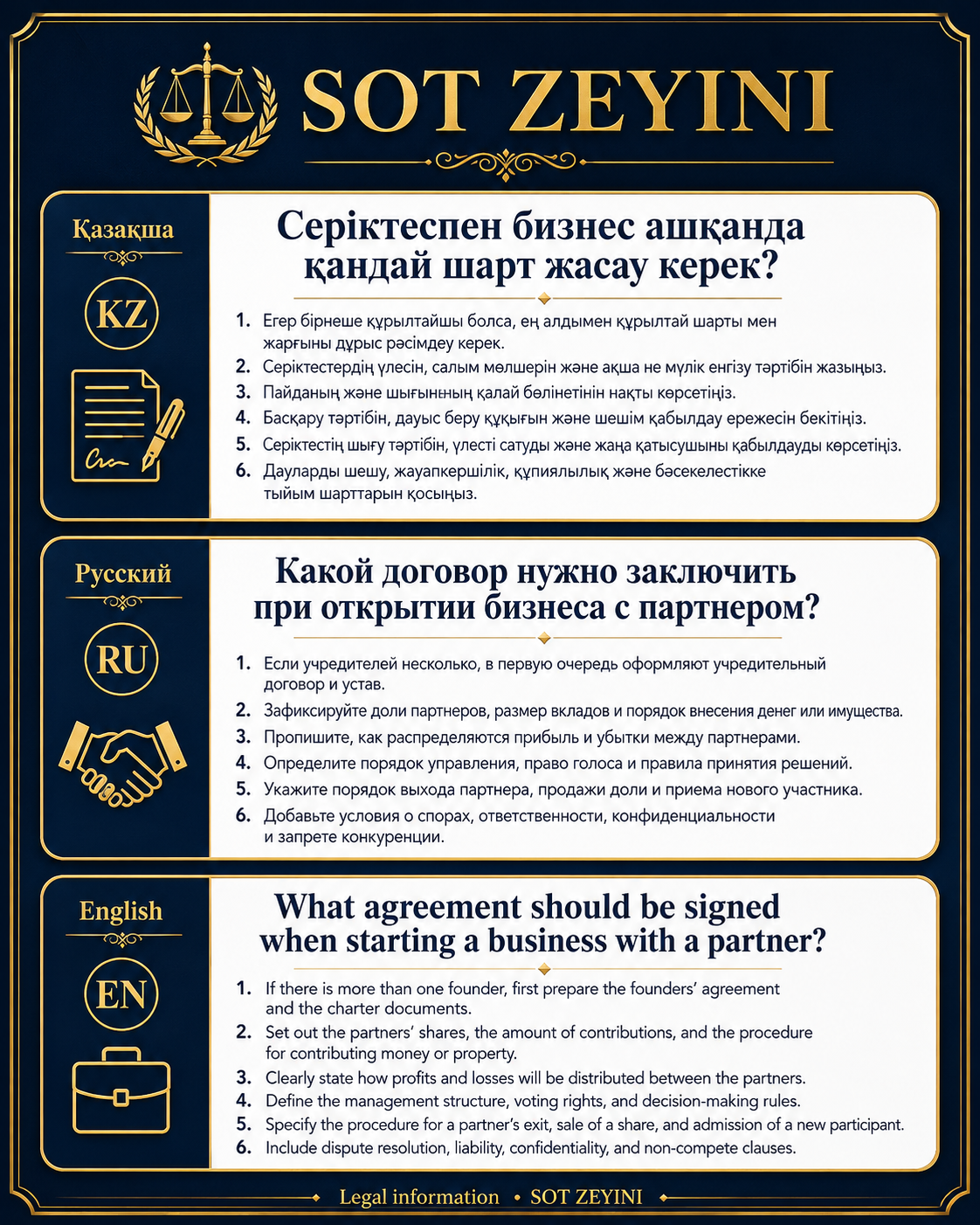
What Agreement Should You Sign When Starting a Business with a Partner?
Why You Should Not Start a Business With a Partner Based Only on Trust
Many people start a business with a friend, relative, or acquaintance without signing a written agreement. At the beginning, everything may seem clear: one person invests money, another manages the business, and someone else brings clients.
But when profit, expenses, debts, or disagreements appear, verbal promises are often not enough.
Without a written agreement, partners may argue about:
- who invested how much;
- who owns what share of the business;
- how profit should be distributed;
- who manages the company;
- who is responsible for debts;
- who owns the website, brand, Instagram, WhatsApp, CRM, and client database;
- what happens if one partner leaves the business.
A written agreement is not a sign of mistrust. It is a normal legal tool that protects both the business and the partners.
What Agreement Do You Need When Starting a Business With a Partner?
If the partners open a business through an LLP in Kazakhstan, the main documents usually include:
- Foundation agreement
- Charter of the LLP
- Shareholders’ or partners’ agreement
- Investment agreement, if one partner invests money
- Loan agreement, if money is provided as a loan
- NDA, if confidential information must be protected
- Non-solicitation and non-compete clauses, if the business depends on clients and sales channels
The exact set of documents depends on the business model. If an LLP is created, the foundation agreement and charter are essential. If the partners have not yet registered a legal entity, they can sign a separate partnership agreement.
What Should Be Included in a Business Partner Agreement?
A business partner agreement should clearly define each partner’s rights and obligations. The more detailed the agreement is, the lower the risk of future disputes.
1. Ownership Shares
The agreement should clearly state each partner’s share, for example:
- 50/50;
- 70/30;
- 60/40;
- or another agreed structure.
If ownership shares are not fixed in writing, disputes may arise regarding profit, control, assets, and exit from the business.
2. Contributions of Each Partner
The agreement should state what each partner contributes to the business:
- money;
- equipment;
- premises;
- vehicles;
- website;
- brand;
- client database;
- management experience;
- personal work;
- business contacts.
If one partner invests money and the other contributes work, this must be clearly written. Otherwise, one partner may later say, “I invested the money,” while the other says, “I built the whole business.”
3. Profit Distribution
The agreement should explain how profit will be distributed:
- according to ownership shares;
- under another agreed formula;
- monthly;
- quarterly;
- after covering all expenses;
- after creating a company reserve.
It is important to distinguish revenue from profit. Money received by the company is not automatically net profit. Taxes, rent, salaries, advertising, supplies, and other expenses must be deducted first.
4. Business Management
One of the most common conflicts between partners is who has the right to make decisions.
The agreement should define:
- who will be the director;
- what decisions the director can make alone;
- what decisions require approval of all partners;
- who has access to the bank account;
- who signs contracts;
- who approves large expenses;
- who hires employees;
- who controls marketing and sales.
If one partner becomes the director, it is advisable to limit the director’s powers so that they cannot freely dispose of company money and assets without the other partner’s approval.
Is a 50/50 Business Partnership Risky?
A 50/50 structure may look fair, but it has one major risk. If partners disagree, the business can become blocked.
For example, one partner wants to open a new branch, while the other disagrees. One wants to invest in advertising, while the other refuses.
That is why a 50/50 agreement should include a deadlock mechanism, such as:
- negotiations;
- mediation;
- buyout of one partner’s share;
- independent business valuation;
- sale of the business;
- liquidation;
- deciding vote on specific issues.
What Happens If a Partner Leaves the Business?
The agreement should clearly describe the exit procedure:
- how much notice must be given;
- how the partner’s share will be valued;
- who has the first right to buy the share;
- whether payment can be made in installments;
- whether the leaving partner may take clients;
- whether the leaving partner may open a competing business;
- what happens to access to CRM, WhatsApp, Instagram, and the website.
If the exit procedure is not defined, a partner may leave and try to take clients, employees, or digital assets.
How to Protect the Client Database, Brand, and Website
In modern business, the most valuable assets are often not office space or equipment. The key assets may be the client database, brand, website, social media accounts, WhatsApp Business, and CRM.
The agreement should state:
- who owns the domain;
- who owns the website;
- who owns the brand;
- who has access to Instagram, TikTok, WhatsApp, and CRM;
- whether the client database belongs to the company;
- whether a partner may use clients after leaving the business;
- what liability applies if the database is transferred to competitors.
Ideally, key digital assets should be registered in the name of the company, not in the name of one partner.
Do Business Partners Need an NDA?
Yes, if the business has confidential information. An NDA helps protect:
- client database;
- pricing;
- contracts;
- internal policies;
- advertising strategies;
- financial data;
- supplier lists;
- business model;
- CRM data.
If a partner transfers this information to competitors or uses it for personal benefit, the NDA can help claim liability and damages.
What If One Partner Invests Money and the Other Works?
This is a common structure: one partner provides capital, while the other manages the business. In this case, the agreement must clearly define the status of each party.
The agreement should state:
- whether the money is a contribution or a loan;
- whether the investor receives a share or only repayment;
- whether the working partner receives salary or ownership;
- who bears losses;
- who makes decisions;
- what happens if the business does not make profit;
- whether the investor can demand repayment of the investment.
In some cases, it is better to sign both foundation documents and a separate investment agreement.
Who Is Responsible for Business Debts?
If the business takes a loan, rents premises, buys goods on credit, or signs long-term contracts, responsibility must be defined in advance.
The agreement should specify:
- who may incur debts on behalf of the business;
- whether all partners must approve obligations;
- who is responsible for personal guarantees;
- what happens in case of late payment;
- who pays debts if the business closes;
- whether one partner is prohibited from taking obligations without approval.
This is especially important if one partner has authority to sign contracts on behalf of the company.
What If a Partner Violates the Agreement?
The agreement should include liability for violations, such as:
- failure to contribute money;
- failure to participate in the business;
- taking clients away;
- transferring the client database to competitors;
- using company money for personal needs;
- opening a competing business;
- hiding income;
- signing contracts without approval.
The agreement may include penalties, damages, buyout rights, removal from the project, or court protection.
Can Partners Work Without a Written Agreement?
Technically, partners can start without a written agreement, but it is risky. Verbal agreements are difficult to prove. Once money, clients, and assets appear, each partner may interpret the terms differently.
A written agreement creates clear rules and helps prevent conflicts.
What Documents Should Be Prepared Before Starting a Business?
Before starting a business with a partner, it is advisable to prepare:
- Foundation agreement
- LLP charter
- Partners’ agreement
- Investment agreement
- Loan agreement
- NDA
- Commercial secrecy policy
- Client database protection agreement
- Decision limiting the director’s authority
- Exit procedure for a partner
Why Should You Consult a Lawyer?
A template agreement from the internet rarely reflects the real business model. Every project has its own structure: money, shares, management, clients, brand, expenses, debts, and risks.
A lawyer can help prepare documents that protect ownership, client base, brand, investments, and decision-making rights.
Conclusion
Before starting a business with a partner, it is not enough to discuss the idea. All key terms should be fixed in writing.
The most important issues are ownership shares, contributions, profit distribution, management, liability, exit rules, protection of clients, and brand ownership.
A well-drafted agreement helps protect the business, money, and relationship between partners. Most importantly, it reduces the risk of future disputes.
FAQ
What agreement should I sign with a business partner?
If an LLP is created, you usually need a foundation agreement, charter, and partners’ agreement. If no legal entity is created yet, a separate partnership agreement may be used.
Can I start a business with a friend without a contract?
You can, but it is risky. Even with a friend, it is better to have a written agreement to avoid disputes over money, shares, and clients.
What is more important: the charter or the partners’ agreement?
Both are important. The charter regulates the LLP, while the partners’ agreement can define internal rules between the partners in more detail.
How should partners share profits?
Profit can be shared according to ownership shares or another formula agreed in writing. The key point is to define the method in advance.
What happens if a partner wants to leave the business?
The exit procedure should be regulated by the agreement. It should include valuation of the share, buyout rights, and payment terms.
Can a partner be prohibited from taking clients?
Yes. The agreement may include protection of the client database, NDA, non-solicitation clauses, and liability for misuse of client data.
What should I do if a partner violates the agreement?
You may send a legal notice, claim damages, apply penalties, or file a lawsuit depending on the terms of the agreement.
Do I need a lawyer for a business partner agreement?
Yes, especially if money, ownership shares, clients, a website, a brand, loans, or investments are involved. A poorly drafted agreement can cost much more than proper legal preparation.